Basalt-Based Enhanced Rock Weathering for Long-Term CO2 Storage: Insights from Mineral Carbonation Experiments
This week, we take a deep dive into a paper recently published in Industrial & Engineering Chemistry Research. The study was developed by Pragalathan Rasaiah, Prerna Yogeshwar, Suraj Kumar, and Jitendra S. Sangwai, affiliated with the Department of Chemical Engineering of the Indian Institute of Technology Madras (India).
Basalt from India’s Rajmahal traps shows potential for CO₂ mineralization in controlled laboratory experiments. Using finely ground rock in a stirred aqueous reactor, the researchers examined how basalt loading and CO₂ pressure influence uptake. The highest reported uptake was 9.72 g CO₂/kg basalt after 24 hours at 10 bar and approximately 30 °C. This represented 6.27% of the estimated theoretical capacity, while complementary analyses supported carbonate formation. A substantial reduction in accessible surface area also suggested pore filling that could constrain further reaction. The study provides a regional feedstock assessment, with atmospheric removal rates and net climate benefits still requiring field validation.
The study provides a detailed assessment of basalt from the Rajmahal traps, an understudied geological formation in eastern India. Because basalt composition varies between regions, its suitability for carbon mineralization requires evaluation of the specific feedstock. The authors combine controlled carbonation experiments with mineralogical, chemical, thermal, and surface characterization to connect CO₂ uptake with changes in the rock. Their experiments use finely ground basalt, with a median particle size of approximately 14 μm, in a stirred reactor operated for 24 hours at approximately 30 °C. By varying basalt loading and initial CO₂ pressure, and subtracting uptake measured in corresponding water-only controls, they assess the additional uptake associated with the basalt. This provides a useful experimental basis for understanding the material’s reactivity, although the pressurized system does not reproduce terrestrial ERW conditions.
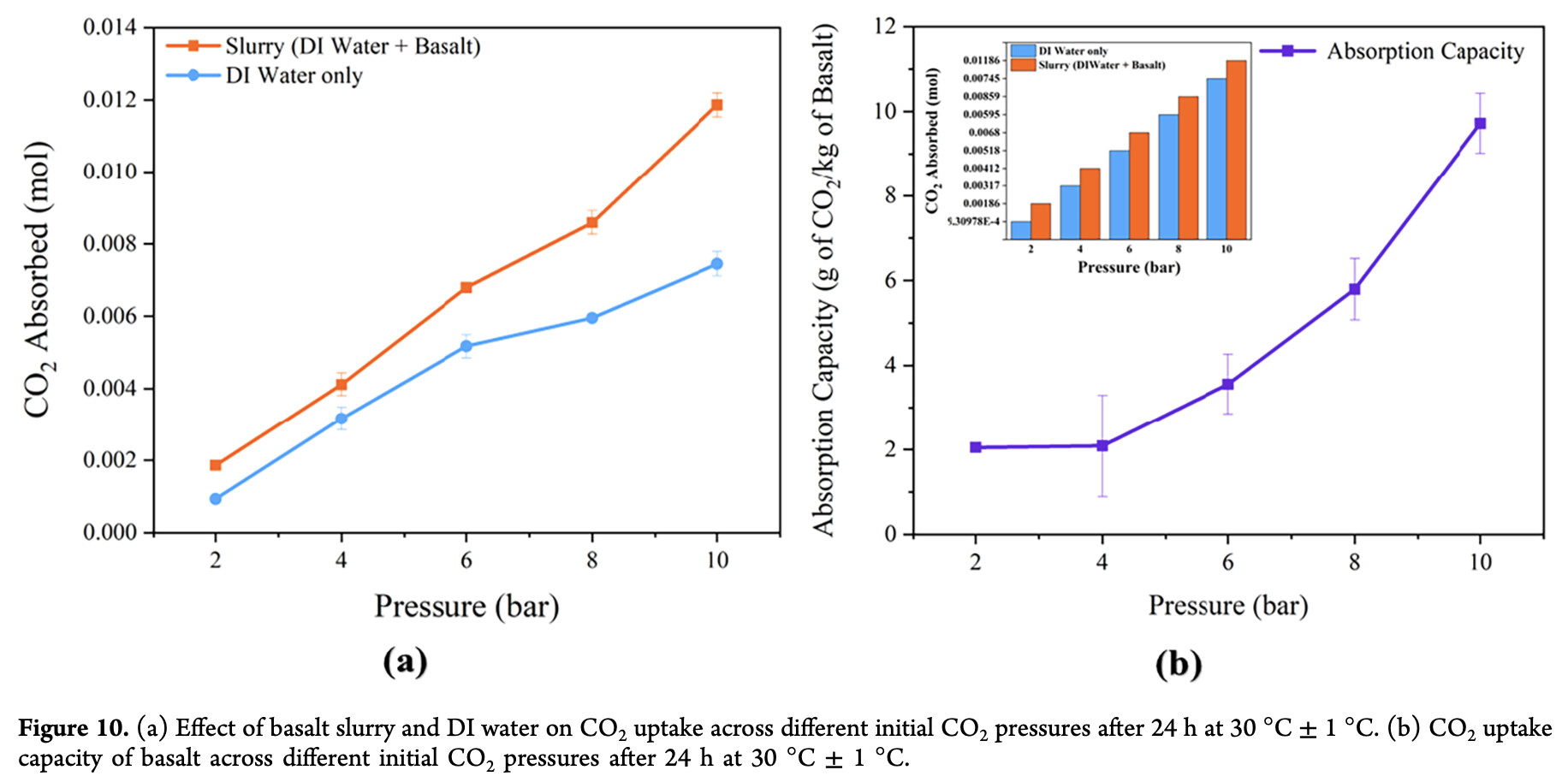
The highest uptake within the tested conditions occurred with 20 g basalt mixed with 20 mL water at 10 bar: 9.72 g CO₂/kg basalt, equivalent to 6.27% of the estimated theoretical capacity of 155 g/kg. Uptake increased from 2.05 g/kg at 2 bar to 9.72 g/kg at 10 bar, while increasing basalt loading beyond 20 g reduced uptake per unit rock mass, which the authors attribute to mixing and mass-transfer limitations. XRD identified phases assigned to calcite, magnesite, and siderite after reaction, with FTIR, thermogravimetry, and microscopy providing complementary evidence of carbonation. Meanwhile, specific surface area decreased by approximately 72% and pore volume by 45%, consistent with secondary precipitation reducing accessible pore space. These results support further investigation of Rajmahal basalt for mineral carbon storage, but they do not establish field removal rates or net atmospheric CDR; those require realistic exposure conditions, carbon accounting, and life-cycle assessment.
Here is a list of the main takeaways of this paper:
- Rajmahal basalt showed measurable CO₂ uptake and evidence of carbonate formation.
- The highest reported uptake was 9.72 g CO₂/kg basalt: this occurred after 24 hours at 10 bar and approximately 30 °C and corresponds to 6.27% of the estimated theoretical capacity, indicating limited conversion under the tested conditions.
- Pressure and reactor loading influenced performance: higher pressure increased uptake, while 20 g provided the highest uptake per unit basalt mass; adding more rock reduced mass-normalized performance, highlighting the importance of mixing and reactive-surface accessibility.
- Carbonation altered both mineralogy and pore structure: complementary analyses supported carbonate precipitation after reaction, and surface area fell by approximately 72%, suggesting that precipitation could also restrict continued access to reactive minerals.
- Field-scale CDR remains an open question: the experiments demonstrate accelerated carbonation under elevated CO₂ pressure, yet atmospheric removal rates, long-term behavior, and net benefits after processing emissions still need assessment.
Read the full paper here: Basalt-Based Enhanced Rock Weathering for Long-Term CO2 Storage: Insights from Mineral Carbonation Experiments