Microbiome manipulation and enhanced weathering influence tree growth in reforestation
This week, we deep dive into a paper recently published in Nature Communications Sustainability. The study was led by Bonnie G. Waring, affiliated with the Department of Life Sciences and the Georgina Mace Centre for the Living Planet at Imperial College London in London (UK).
This study tests whether reforestation can be strengthened by combining enhanced rock weathering with soil microbiome restoration. In an 11.5-hectare field experiment in Wales, the authors monitored 6,400 trees over four years. Adding crushed basaltic andesite increased aboveground carbon stocks in broadleaf stands by 27%, equivalent to an additional 787 kg C ha⁻¹. Forest-soil inoculation produced a strong initial growth benefit, but this effect varied among tree species and largely disappeared over time. Unexpectedly, applying the two interventions together reduced, rather than amplified, their individual benefits. The findings show that enhanced weathering can support both inorganic and biological carbon removal, but also demonstrate that interactions between minerals, microbes and tree species must be considered when designing integrated CDR projects.
The study moves beyond small-scale greenhouse or pot experiments and evaluates two emerging restoration interventions under realistic field conditions. More than 25,000 trees were planted across 72 experimental plots, with forest type, crushed-rock application and microbiome inoculation arranged in a replicated factorial design. According to the authors, it is the largest and most highly replicated field experiment to examine enhanced rock weathering and whole-soil inoculation in a newly planted forest. It is also among the first studies to investigate enhanced weathering not simply as a source of inorganic carbon removal, but as an intervention that may increase organic carbon storage by improving tree nutrition and growth. The experiment therefore connects two CDR pathways—mineral weathering and reforestation—within the same land footprint.
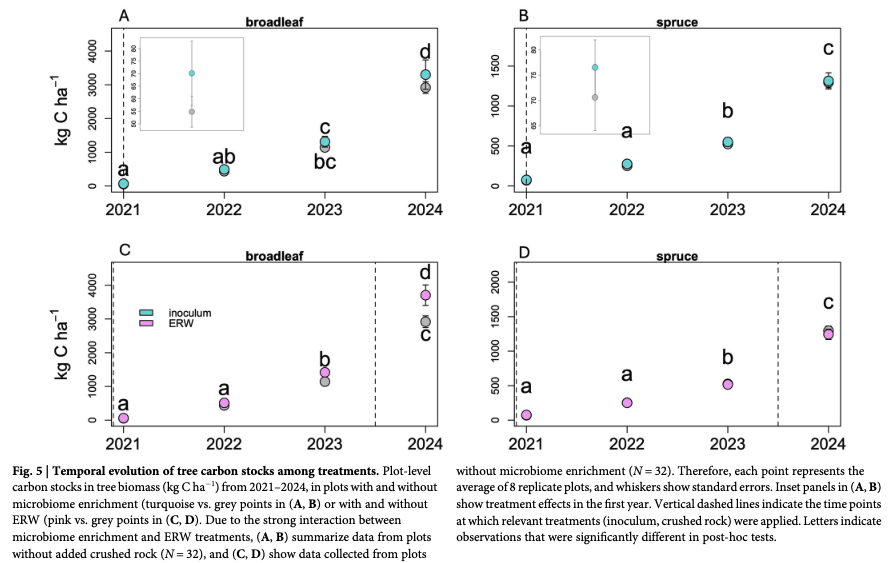
The clearest result was that crushed basaltic andesite stimulated forest carbon accumulation, particularly in native broadleaf stands. By 2024, broadleaf plots receiving the rock amendment stored approximately 3,705 kg C ha⁻¹ in aboveground tree biomass, compared with 2,917 kg C ha⁻¹ in untreated plots—a 27% increase, or 787 kg C ha⁻¹ of additional carbon. The treatment raised soil pH and increased plant calcium and copper stocks, suggesting that improved nutrient availability contributed to tree growth. Microbiome inoculation increased sapling growth by an average of about 5% across the experiment and by 45.7% during the first year, but its average effect fell to only 0.6% by 2024 and differed substantially among species. Most importantly, the two treatments were antagonistic: soil inoculation suppressed the growth and carbon benefits associated with the rock amendment. The combined treatment created a distinct fungal community and was associated with slower calcium loss from buried rock, indicating that microbiome modification may have altered mineral-weathering processes.
Here is a list of the main takeaways of this paper:
- Crushed silicate rock raised aboveground carbon stocks in broadleaf stands by 27% within four years.
- The intervention produced more than one potential CDR pathway: rock weathering may remove CO₂ as bicarbonate while also promoting additional carbon storage in tree biomass.
- Soil inoculation strongly stimulated growth in the first year, but the average effect declined substantially over time.
- Tree species and forest type strongly influenced treatment outcomes: broadleaf stands benefited more from enhanced weathering, while microbiome responses differed considerably among species.
- Combining CDR interventions does not automatically create synergies: applying rock and forest-soil inoculum together cancelled much of the rock treatment’s carbon benefit, probably through ecological and biogeochemical interactions.
Read the full paper here: Microbiome manipulation and enhanced weathering influence tree growth in reforestation