Impact on oysters in first-of-its-kind field trial of marine Enhanced Rock Weathering (mERW) with olivine as carbon dioxide removal (CDR) strategy
This week, we deep dive into a paper recently published in Frontiers in Climate. The study was led by Emilia Jankowska, affiliated with Hourglass Climate NPO in Montclair, NJ (United States).
This article presents the first field trial testing how marine Enhanced Rock Weathering (mERW) with olivine affects oysters under real coastal conditions. The study placed about 650 tonnes of olivine sand on an intertidal beach in Peconic Bay, New York, and followed juvenile Eastern oysters for one year across olivine-treated and control sites. The central question is both ecological and practical: can olivine-based carbon dioxide removal support shellfish by raising alkalinity, while avoiding harmful trace-metal accumulation? The results suggest a limited biological impact: oysters exposed to olivine showed a small, non-significant biomass increase after two months, but no long-term difference in growth after one year. Although olivine initially elevated nickel in porewaters, oyster tissue metal concentrations did not become significantly higher at the olivine site and remained below food-safety concern thresholds. Overall, the paper provides cautious early evidence that olivine-based mERW may be compatible with oyster aquaculture, while emphasizing the need for broader field testing.
This study moves the assessment of olivine-based mERW from laboratory or highly controlled exposure settings into a real coastal field trial. The authors describe this as the world’s first field trial of marine enhanced rock weathering, carried out by applying olivine sand to an intertidal beach and then monitoring oyster growth, oyster tissue metal accumulation, sediment olivine redistribution, porewater chemistry, and water-column conditions over time. This is important because many concerns around mERW depend on real-world hydrodynamics: olivine does not remain fixed in place, dissolution products are diluted or redistributed, and organisms may experience only intermittent exposure. In this study, olivine was initially concentrated at the treated site but was rapidly transported along the coastline, with the original olivine site dropping from high olivine content shortly after placement to nearly zero in the sampled 1–3 cm sediment layer after about one year. This makes the field setting especially valuable, because it captures the complexity that laboratory tanks cannot reproduce.
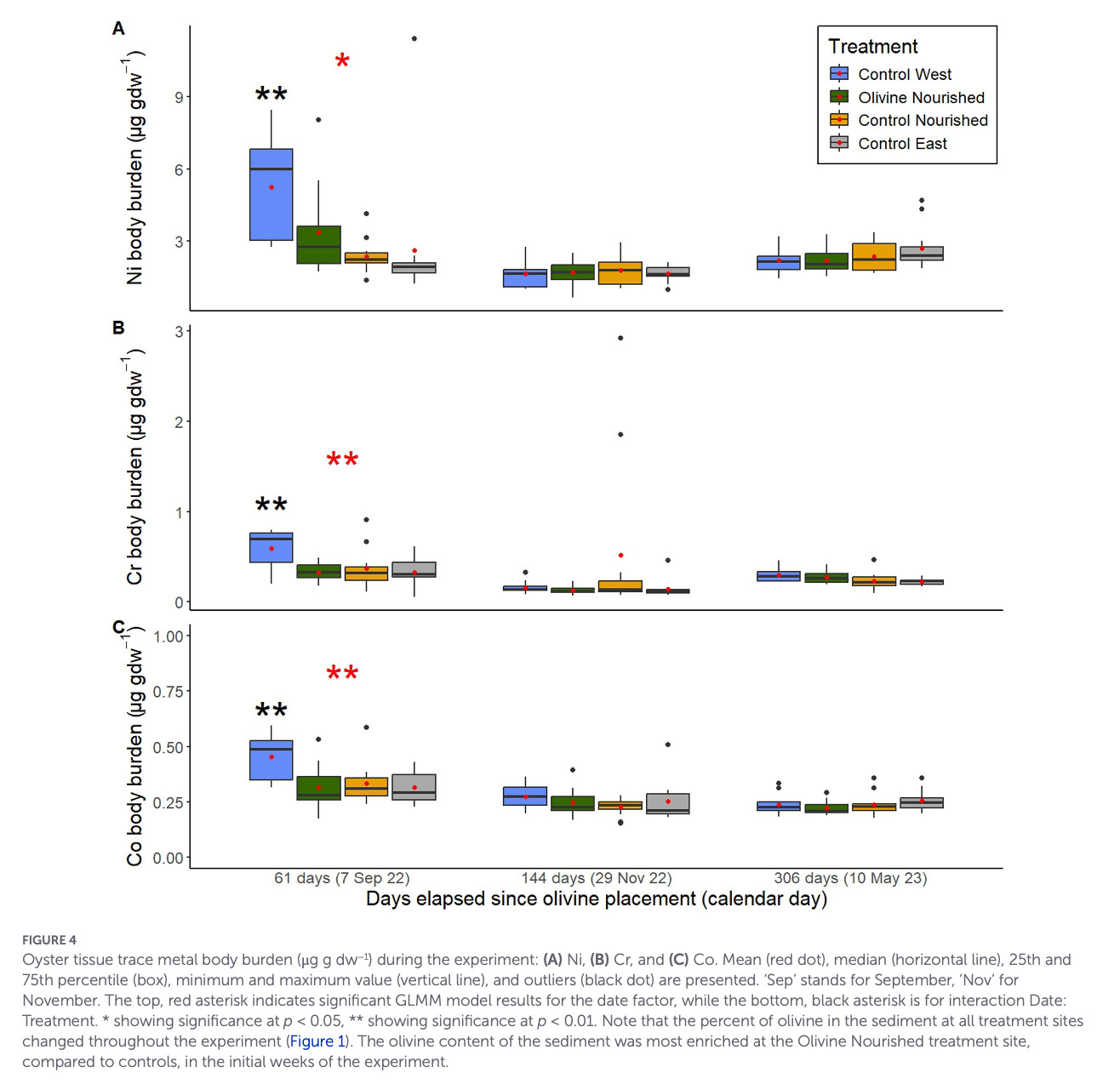
The main result is that olivine exposure did not produce clear negative effects on oysters. In the first 61 days, oysters in the Olivine Nourished treatment had higher average dry biomass than controls, but this difference was only marginally non-significant, so it should be interpreted as suggestive rather than conclusive. Porewater at the olivine site showed elevated total alkalinity and nickel early in the trial, consistent with olivine dissolution, but these signals weakened over time and were not mirrored by significant increases in bottom-water metal concentrations. Oyster tissue concentrations of nickel, chromium, and cobalt remained low, with no evidence of a long-term olivine-driven bioaccumulation problem. Interestingly, the highest early nickel, chromium, and cobalt burdens were found in oysters from Control West rather than the olivine treatment, which the authors link to local environmental stressors and possible transport of fine olivine particles. By the end of the experiment, oyster biomass and metal concentrations were broadly similar across treatments, supporting the conclusion that olivine-derived metals did not create oyster safety concerns in this trial.
Here is a list of the main takeaways of this paper:
- By testing olivine sand in an open coastal environment with natural tides, sediment transport, and dilution, this study moves beyond lab-based exposure experiments towards real-world mERW field tests.
- The olivine site initially showed higher total alkalinity and significantly elevated nickel in porewater, but these effects declined as olivine redistributed through the system.
- Oysters grew over time at all sites, and the olivine treatment showed a small early biomass increase, though this was not statistically significant.
- Nickel, chromium, and cobalt in oyster tissues did not become significantly elevated at the olivine site after one year and remained within natural global ranges.
- Oyster metal concentrations stayed below US Food and Drug Administration warning thresholds, suggesting no food-safety concern under the tested conditions.
Read the full paper here: Impact on oysters in first-of-its-kind field trial of marine Enhanced Rock Weathering (mERW) with olivine as carbon dioxide removal (CDR) strategy