Beyond one-size-fits-all: tailoring engineered biochar for purpose-specific rhizosphere engineering in crop production, protection, and soil remediation
This week, we deep dive into a paper recently published in Biochar. The study was led by Adnan Mustafa and Qudsia Saee, affiliated with the Guangdong Provincial Key Laboratory of Applied Botany of the South China Botanical Garden - Chinese Academy of Sciences, and the Laboratory of National Forestry and Grassland Administration on Plant Conservation and Utilization in Southern China, both based in Guangzhou (China).
This review argues that engineered biochar should not be applied as a generic soil amendment, but instead tailored to specific functions within the rhizosphere. By modifying its physicochemical properties, biochar can simultaneously enhance crop productivity, protect plants from pathogens, and remediate contaminated soils. The paper highlights key mechanisms—nutrient cycling, microbial stimulation, and contaminant immobilization—while emphasizing trade-offs across these objectives. It shows that biochar acts as an “active rhizosphere architect,” reshaping root–soil–microbe interactions. However, practical deployment remains constrained by complexity, variability, and cost. Overall, the study provides a framework for precision biochar design in sustainable agriculture and environmental management.
This paper proposes a unified “rhizosphere engineering” framework, moving beyond fragmented perspectives on biochar. Rather than treating biochar as a passive amendment, the authors conceptualize it as a tool that actively modifies root–soil–microbe interactions through targeted engineering. A key innovation is the systematic classification of engineered biochars (e.g., nutrient-enriched, bioprimed, antimicrobial, adsorptive, nanocomposite), each linked to specific rhizosphere functions and applications. This integrated perspective bridges previously siloed literatures on crop production, plant protection, and soil remediation, showing how these domains are interconnected but also subject to important trade-offs. The paper also contributes by emphasizing spatial and temporal variability in biochar effects and by explicitly addressing the challenge of optimizing biochar design for competing objectives.
In terms of results and insights, the review synthesizes extensive empirical evidence to show that engineered biochar can enhance nutrient availability, stimulate beneficial microbial communities, suppress pathogens, and immobilize contaminants. These mechanisms translate into improved crop yields, increased resilience to abiotic stress (e.g., drought, salinity), and reduced pollutant uptake by plants. However, the paper also highlights that these benefits are context-dependent: soil type, crop system, and biochar properties critically shape outcomes. Importantly, it documents key trade-offs—for example, biochars optimized for contaminant immobilization may reduce nutrient availability, while those enhancing fertility may be less effective for remediation. The overall conclusion is that purpose-specific design and precise application strategies are essential, supported by long-term field validation and integration with precision agriculture approaches.
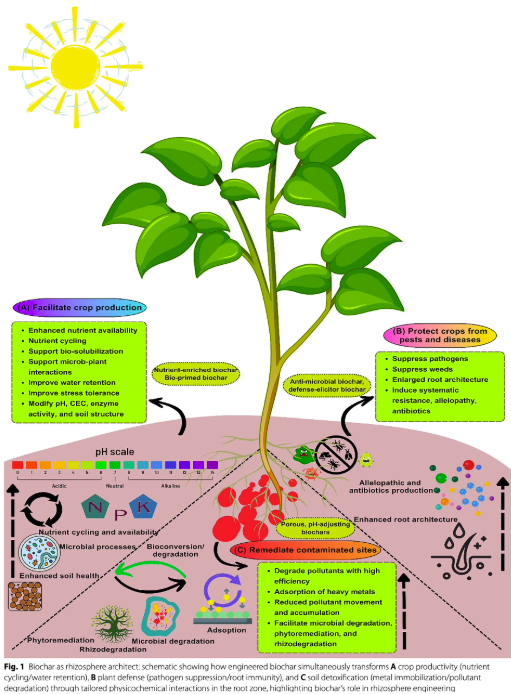
Here is a list of the main takeaways of this paper:
- No one-size-fits-all: Biochar must be engineered for specific goals (production, protection, remediation), not applied generically.
- Rhizosphere engineering: Biochar reshapes root–soil–microbe interactions, acting as an active “architect” of soil processes.
- Multiple mechanisms: Benefits arise via nutrient cycling, microbial stimulation, pathogen suppression, and contaminant immobilization.
- Trade-offs matter: Optimizing one function (e.g., remediation) can undermine another (e.g., crop growth).
- Future direction: Precision design, long-term field studies, and integration with climate-smart agriculture are critical for scaling.
Read the full paper here: Beyond one-size-fits-all: tailoring engineered biochar for purpose-specific rhizosphere engineering in crop production, protection, and soil remediation