Air‐Sea Gas Exchange in the Coastal Baltic Sea: Implications for Marine Carbon Dioxide Removal
This week, we deep dive into a paper recently published in JGR Oceans. The study was led by Ryo Dobashi, affiliated with the Department of Oceanography of the University of Hawai’i at Mānoa in Honolulu (USA).
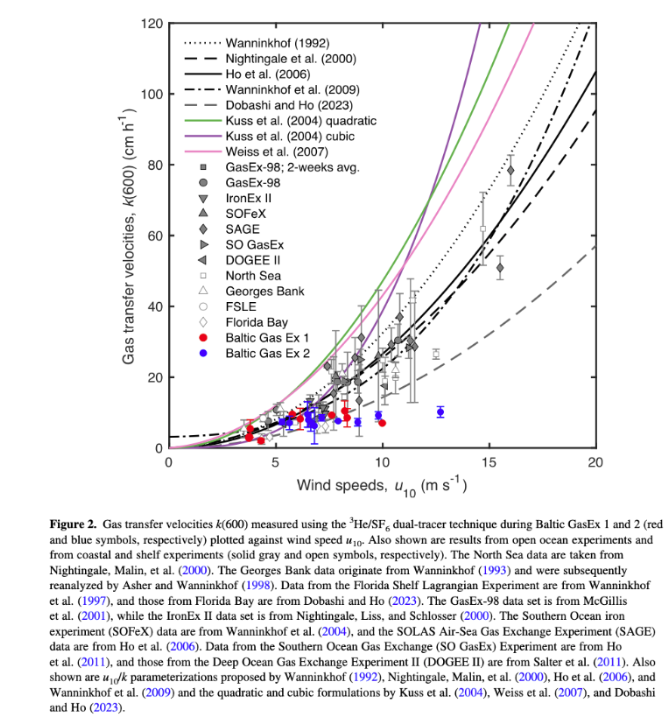
This paper investigates air–sea gas exchange in the coastal Baltic Sea, a key process governing oceanic CO₂ uptake, hence the effectiveness of marine carbon dioxide removal (mCDR). Using a dual-tracer (³He/SF₆) experiment, the authors directly measure gas transfer velocities (k) in a nearshore environment. They find that k is about 39–40% lower than in open ocean or other coastal regions at comparable wind speeds. This discrepancy is especially pronounced at high wind speeds and during developing wave conditions. The results show that standard wind-based parameterizations systematically overestimate gas exchange in such environments. The study highlights the importance of local physical and biogeochemical factors—particularly wind fetch limitation, wave dynamics, and surfactants—for accurately quantifying CO₂ uptake in nearshore systems.
This paper relies on the direct measurement of air–sea gas exchange in a nearshore, fetch-limited coastal system using the ³He/SF₆ tracer technique—an approach rarely applied in such environments. While most existing parameterizations of gas transfer velocity rely heavily on wind speed and are calibrated in open ocean conditions, this study explicitly tests their validity in a coastal inland sea where additional processes are at play. By combining tracer measurements with detailed environmental data (wind, waves, surfactants), the authors provide a more mechanistic understanding of gas exchange in nearshore regions. This is particularly relevant for mCDR, since many proposed interventions will occur in coastal zones where monitoring, reporting, and verification (MRV) critically depend on accurate flux estimates.
The main result is that gas transfer velocities in the coastal Baltic Sea are systematically lower—by roughly 39–40%—than predicted by widely used parameterizations, even those specifically developed for the Baltic Sea. The study attributes this reduction to three interacting mechanisms: (i) wind fetch limitation, which prevents full wave development and reduces turbulence; (ii) wind–wave interactions, especially under young wave conditions that dampen effective momentum transfer; and (iii) elevated surfactant concentrations, which suppress small-scale turbulence at the air–sea interface. Together, these factors weaken the link between wind speed and gas exchange. Importantly, the findings imply that relying on standard parameterizations leads to systematic overestimation of CO₂ uptake, which could bias MRV assessments of mCDR projects in coastal regions.
Here is a list of the main takeaways of this paper:
- Gas transfer velocity (k) in the coastal Baltic Sea is ~40% lower than in open ocean settings at the same wind speed, challenging the widespread use of standard wind-based parameterizations.
- Existing parameterizations (both open ocean and Baltic-specific) systematically overestimate air–sea gas exchange, and errors are largest at higher wind speeds and under developing wave conditions.
- Wind fetch limitation plays a key role by preventing full wave development and reducing turbulence: this weakens the expected relationship between wind speed and gas exchange.
- Surfactants in the sea surface microlayer further suppress gas exchange by damping small-scale turbulence, which may explain around 13–14% of observed reductions in k.
- Implications for mCDR are substantial: slower gas exchange implies longer CO₂ equilibration times; accurate, site-specific measurements of k are essential for credible MRV frameworks.
Read the full paper here: Air‐Sea Gas Exchange in the Coastal Baltic Sea: Implications for Marine Carbon Dioxide Removal