Decoupled timescales of organic carbon and phosphorus recycling in the global ocean
This week, we deep dive into a paper recently published in PNAS. The study was led by Megan R. Sullivan, affiliated with the Department of Earth System Science of the University of California in Irvine, and the Graduate School of Oceanography of the University of Rhode Island in Narragansett (USA).
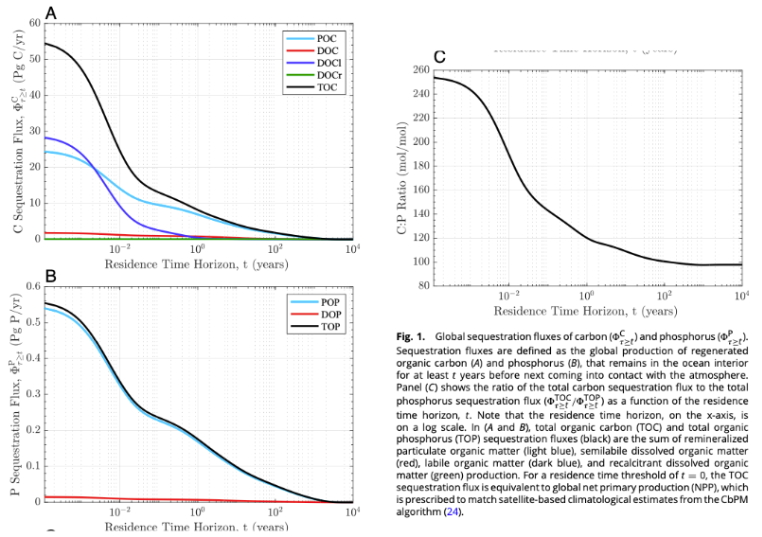
This paper examines how organic carbon and phosphorus cycle through the ocean on different timescales and what this implies for long-term carbon sequestration. Using a global inverse biogeochemical model, the authors show that most organic carbon is rapidly recycled, with only a very small fraction remaining sequestered for climate-relevant timescales. In contrast, phosphorus tends to remain in the ocean interior longer. This decoupling leads to a decline in the carbon-to-phosphorus (C:P) ratio with increasing storage time. These findings challenge common assumptions about the efficiency of the biological carbon pump and suggest that marine carbon dioxide removal strategies may overestimate long-term carbon storage if nutrient cycling is ignored.
This paper shifts from depth-based metrics of carbon export (e.g., flux below 1,000 m) to a residence-time framework that directly tracks how long regenerated carbon and nutrients remain isolated from the atmosphere. By combining a steady-state global inverse model with observational constraints, the authors partition organic matter production according to the time it takes for remineralized carbon and phosphorus to return to the surface. This allows them to quantify sequestration durability more directly than previous approaches. Crucially, the model incorporates distinct pathways for particulate and dissolved organic matter, including fast-cycling labile pools, enabling a more realistic representation of ocean biogeochemistry.
The key result is that carbon and phosphorus are decoupled in their recycling timescales, with carbon cycling significantly faster. Less than 15% of organic carbon remains sequestered for at least one year, and only about 3.3% persists for a century, compared to 31% and 8.3% for phosphorus, respectively. This leads to a systematic decline in the C:P ratio of sequestered material—from over 250:1 at production to ~98:1 at century timescales. Mechanistically, this arises because carbon is preferentially remineralized at shallower depths and on faster timescales than phosphorus. The implication is profound: nutrient recycling—especially the slow return of phosphorus—can suppress future productivity after initial carbon export (“productivity hangover”), reducing the long-term effectiveness of ocean-based carbon removal strategies.
Here is a list of the main takeaways of this paper:
- Most carbon export is short-lived: the majority of organic carbon is rapidly remineralized and returned to the surface, with only ~3% stored for ≥100 years.
- Phosphorus persists longer than carbon: a larger fraction of phosphorus remains sequestered over long timescales, creating a mismatch in nutrient vs. carbon cycling.
- C:P ratios decline with time: sequestered material becomes progressively less carbon-rich, reflecting faster recycling of carbon relative to phosphorus.
- Standard metrics ignoring nutrient cycling likely overstate long-term carbon sequestration potential.
- Nutrient fertilization could trigger a “productivity hangover,” reducing future CO₂ uptake due to delayed nutrient return, with implications for marine CDR.
Read the full paper here: Decoupled timescales of organic carbon and phosphorus recycling in the global ocean