Blue Carbon in the Persian Gulf: Evidence of Phytoplankton Contribution to Carbon in Sediments
This week, we deep dive into a paper recently published in Sustainability. The study was led by Saif Uddin, affiliated with the Environment and Life Sciences Research Centre of the Kuwait Institute for Scientific Research in Safat (Kuwait).
This paper revisits blue carbon dynamics in the Persian Gulf, highlighting major data gaps and methodological inconsistencies in current assessments. It argues that traditional blue carbon frameworks—focused on mangroves, seagrasses, and salt marshes—overlook potentially significant contributors such as phytoplankton. Using metagenomic analysis of marine sediments, the authors provide direct evidence of phytoplankton DNA, suggesting their role in long-term carbon burial. The authors also express concerns about heavy reliance on low-resolution remote sensing for habitat mapping, which introduces uncertainty. Overall, this paper’s results point to more inclusive and standardised carbon accounting frameworks that incorporate microalgae to improve the accuracy of regional and global climate mitigation strategies.
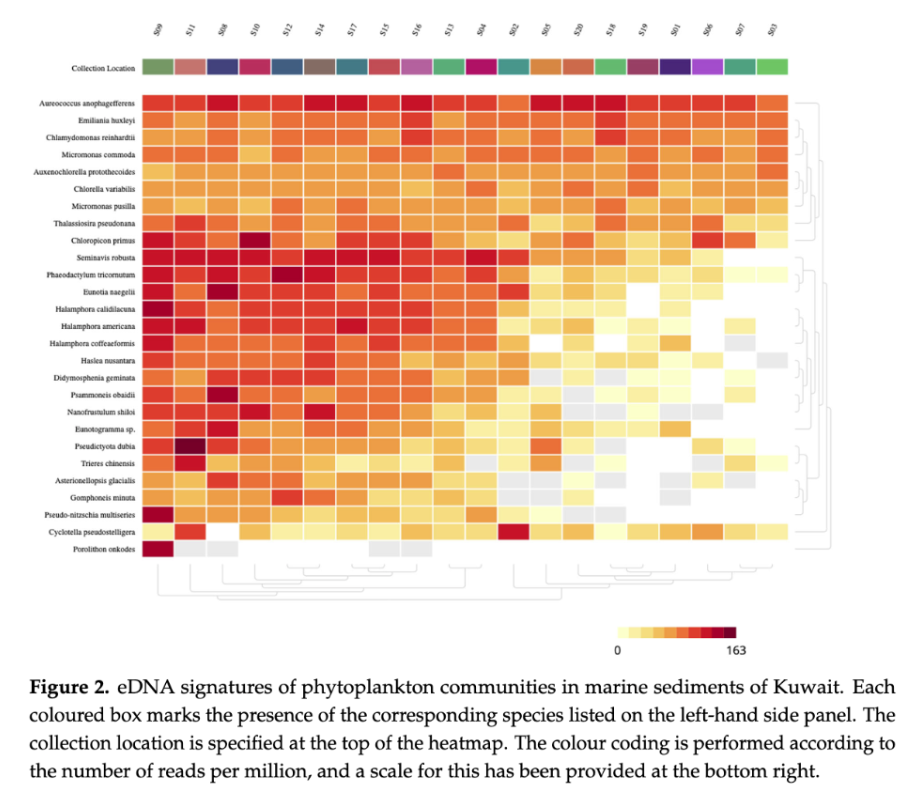
Focusing on the exclusion of phytoplankton from carbon accounting frameworks, this paper bridges a conceptual and empirical gap in blue carbon science. While prior research has focused on vegetated coastal ecosystems, this study introduces direct genomic evidence of phytoplankton presence in marine sediments in the Persian Gulf. By applying shotgun metagenomic sequencing to sediment cores across 20 sites, the authors identify 26 phytoplankton species, with several consistently present across all locations. This provides strong support for the hypothesis that phytoplankton-derived carbon can be transported and permanently buried in sediments—challenging the prevailing assumption that their contribution is too diffuse or transient to quantify.
The study provides both ecological and methodological insights. Ecologically, it shows that phytoplankton—especially dominant species such as Aureococcus anophagefferens and Thalassiosira pseudonana—are not only present but potentially significant contributors to sediment carbon stocks. Methodologically, it highlights the limitations of existing blue carbon assessments in the Gulf, which rely heavily on coarse satellite data (e.g., Landsat) and inconsistent mapping techniques. The combination of eDNA and metagenomics is presented as a more precise alternative for detecting carbon-contributing organisms, particularly those that are difficult to observe directly. Together, these findings imply that current blue carbon estimates may be systematically underestimated if microalgae are excluded.
Here is a list of the main takeaways of this paper:
- Phytoplankton matter for blue carbon: the study provides direct evidence that they contribute to carbon burial in marine sediments, challenging their exclusion from blue carbon frameworks.
- Metagenomics as a breakthrough tool: eDNA sequencing enables the detection of diverse and low-abundance species, offering a more accurate assessment of carbon contributors.
- Significant data gaps in the Gulf: blue carbon inventories in the Persian Gulf are sparse, temporally inconsistent, and often based on low-resolution satellite data.
- Methodological inconsistencies create uncertainty: differences in remote sensing approaches and spatial resolution lead to unreliable estimates of blue carbon stocks.
- Including microalgae and macroalgae could substantially increase estimated carbon sequestration and improve climate policy relevance.
Read the full paper here: Blue Carbon in the Persian Gulf: Evidence of Phytoplankton Contribution to Carbon in Sediments