Zero Deforestation Commitments and Industry 4.0 Enabling Technologies: An Analysis of Their Role in Mitigating Deforestation
This week, we deep dive into a paper recently published in Business Strategy and the Environment. The study was led by Valentina Beretta, affiliated with the University of Pavia, in Pavia (Italy).
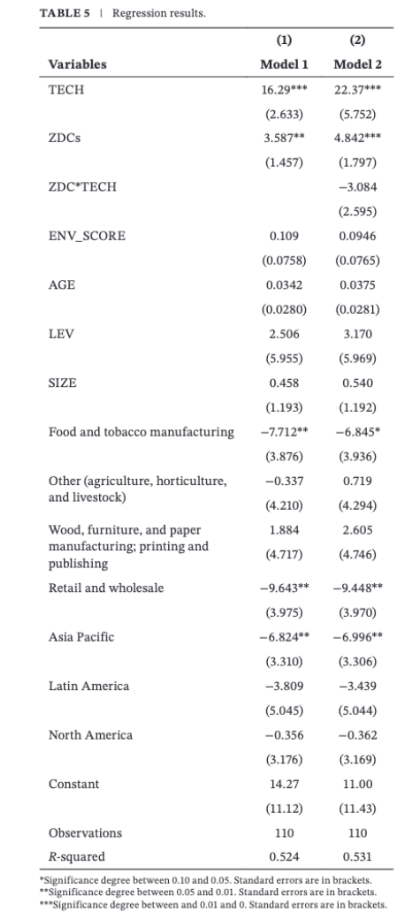
This paper investigates whether corporate Zero-Deforestation Commitments (ZDCs) and Industry 4.0 (I4.0) technologies actually improve firms’ deforestation performance. Using data on 110 companies from the Forest 500 dataset, the authors test whether sustainability “talk” translates into measurable outcomes. They find that both ZDCs and digital technologies are individually associated with better deforestation scores, suggesting real impact rather than mere symbolic signaling. However, the interaction between the two is not significant, suggesting that combining commitments with digital tools does not automatically amplify results. Overall, the study highlights both the promise and limits of corporate sustainability strategies.
This paper bridges two strands of literature that are usually studied separately: corporate sustainability commitments (such as ZDCs) and digital transformation (I4.0 technologies). The authors combine the performative view of sustainability communication—which examines whether corporate “talk” leads to actual behavioral change—with the Technology–Organization–Environment (TOE) framework, which explains how firms adopt and benefit from new technologies. This dual-theory approach allows them to address a central but underexplored question: whether firms’ public commitments and their technological capabilities jointly shape environmental outcomes, specifically deforestation mitigation.
Empirically, the study provides evidence that both ZDCs and I4.0 technologies are positively associated with higher deforestation scores, meaning better performance in managing deforestation risks. This supports the idea that corporate commitments are not purely symbolic but can translate into substantive action, and that digital tools (e.g., blockchain, IoT, big data) enhance monitoring, traceability, and supply-chain transparency. However, the absence of a significant interaction effect is particularly insightful: it suggests that adopting both strategies does not create automatic synergies. In other words, firms cannot rely on technology alone to “activate” their commitments—organizational and implementation factors remain critical.
Here is a list of the main takeaways of this paper:
- Commitments matter: zero-deforestation pledges are positively linked to improved environmental performance, indicating that “talk” can translate into action.
- Technology enables monitoring: Industry 4.0 tools improve traceability and data management, helping firms better control deforestation risks in supply chains.
- No automatic synergy: combining commitments with digital technologies does not significantly enhance outcomes beyond their individual effects.
- Implementation gap remains: findings highlight that organizational processes—not just tools or pledges—are crucial for effective sustainability outcomes.
- Policy and managerial relevance: regulators and firms should focus not only on commitments and tech adoption but also on governance and execution quality.
Read the full paper here: Zero Deforestation Commitments and Industry 4.0 Enabling Technologies: An Analysis of Their Role in Mitigating Deforestation