Enhancing carbon sinks in China using a spatially-optimized forestation strategy
This week, we deep dive into a paper recently published in Nature Communications. The study was led by Yanli Dong, affiliated with the State Key Laboratory of Climate System Prediction and Risk Management of the Nanjing University of Information Science and Technology in Nanjing (China).
China’s planned expansion of nearly 50 Mha of new forests by 2050 could drastically increase carbon sequestration, but traditional estimates tend to overlook how forest edge effects — where stressors like wind, drought, pests, and fire elevate tree mortality — reduce biomass carbon storage. The authors quantify this edge influence and develop a spatial optimization strategy that prioritizes afforestation in locations that minimize these degrading edge effects. Their model suggests that an edge-aware strategy could boost China’s forest carbon gains by ~51 % by 2060 compared with non-optimized planting. Notably, about half of that benefit arises purely from reducing edge effects, rather than from simply adding more forest area. The study highlights that ignoring forest fragmentation and edge degradation can overestimate carbon sink potential, and that optimized spatial planning offers a more effective pathway for maximizing climate mitigation and ecological co-benefits.
China’s ambitious forest expansion goals, aiming for ~49.5 million hectares of additional forest by 2050,reflect both national ecological priorities and contributions to global carbon neutrality targets. Yet most carbon sink projections tied to this expansion assume that all planted forests will sequester carbon uniformly and do not account for forest edge effects, where heightened environmental stress and disturbance markedly reduce tree survival and biomass accumulation. This study’s originality lies in explicitly quantifying how proximity to edges, created by fragmentation from past land use and development,diminishes carbon storage potential across China’s newly-afforested landscapes. By integrating edge effect functions into a spatially explicit model, the authors not only assess how much carbon is lost due to these effects, but also identify where new forests should be planted to minimize edge disturbance and maximize biomass growth.
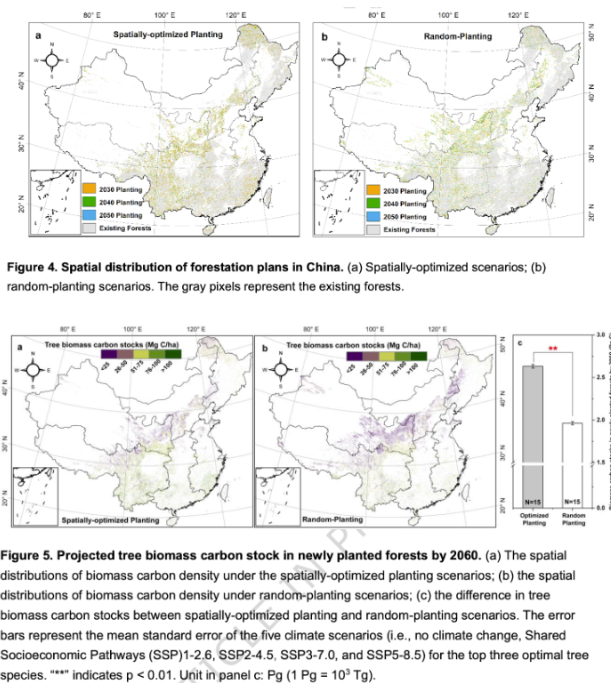
The main findings demonstrate that spatially optimized forestation (strategic site selection that avoids high-impact edge environments) can substantially increase the effectiveness of China’s afforestation program. Under their projections, such optimization could raise total carbon gains by roughly 51 % by 2060 compared to scenarios that ignore edge effects, equivalent to nearly 986 ± 22 Tg of carbon. Importantly, approximately half of this advantage stems from simply reducing losses from edge-related stress rather than expanding overall forest area. This highlights a frequent pitfall in large-scale carbon sink assessments — overlooking spatial context and fragmentation dynamics can lead to overestimates of sequestration potential. The authors thus propose that incorporating edge-aware planning into national afforestation policies could yield greater climate and ecological benefits without additional land use demands.
Here is a list of the main takeaways of this paper:
- Edge effects significantly reduce biomass carbon storage in planted forests, especially where forests are fragmented and border disturbed lands.
- Spatial optimization of afforestation can prioritize areas with lower edge stress, improving forest carbon sequestration efficiency.
- Optimized planting increases China’s projected carbon gains by ~51 % by 2060 compared with non-optimized scenarios.
- About half of the additional sequestration comes from reduced edge impacts, not just added forest area.
- Ignoring edge effects can overestimate carbon sink potential; spatially aware strategies support more effective climate mitigation and ecological outcomes.
Read the full paper here: Enhancing carbon sinks in China using a spatially-optimized forestation strategy