Carbon fixation of a temperate plankton community in response to calcium- and silicate-based Ocean Alkalinity Enhancement using air-sea gas exchange measurements
This week, we deep dive into a paper recently published in Biogeosciences. The study was led by Julieta Schneider and Kai Georg Schulz, affiliated with —respectively— the GEOMAR Helmholtz Centre for Ocean Research Kiel in Kiel (Germany), and the Faculty of Science and Engineering of Southern Cross University in Lismore (Australia).
This study investigates how a temperate plankton community responds to Ocean Alkalinity Enhancement (OAE), a carbon dioxide removal strategy, under conditions that mimic real-world deployment. Researchers used large-scale mesocosms in a Norwegian fjord to apply a gradient of alkalinity increases (0–600 µmol kg⁻¹) with two mineral types (calcium- and silicate-based) without pre-equilibrating with atmospheric CO₂. Over a 47-day experiment, added alkalinity remained relatively stable, and gas exchange measurements revealed slow CO₂ re-equilibration, which in high-alkalinity treatments could take on the order of years. Biological responses varied with mineral type: coccolithophore calcification peaked at intermediate CO₂ conditions, while net community production was higher in silicate treatments and unaffected by pCO₂ changes. Zooplankton respiration decreased with silicate treatments and was negatively correlated with pCO₂ levels. These findings highlight that both alkalinity level and mineral composition influence biological processes, providing important considerations for designing safe and effective OAE deployments at scale.
Ocean Alkalinity Enhancement is a promising carbon dioxide removal strategy that accelerates the ocean’s natural ability to absorb and store CO₂ by adding alkaline minerals to seawater, thereby increasing total alkalinity and pH. Most prior research has focused on models or laboratory cultures, with limited data on whole community responses in situ. This study represents one of the first comprehensive experimental evaluations of non-CO₂-equilibrated Ocean Alkalinity Enhancement under near-natural conditions using large mesocosms. The authors deployed 10 enclosed water columns in a temperate fjord and applied a controlled gradient of alkalinity increases using simulated calcium- and silicate-based minerals — a design that allowed simultaneous assessment of chemical dynamics (carbonate system changes and CO₂ gas exchange) and biological processes (plankton carbon fixation, calcification, and zooplankton respiration). By not pre-equilibrating added alkalinity with atmospheric CO₂, the experiment intentionally mirrored feasible future field applications but also exposed communities to prolonged low pCO₂ and high pH conditions, which could produce unexpected ecological effects.
The main findings reveal complex interactions between OAE treatment, alkalinity levels, and biological responses. Across the alkalinity gradient, added alkalinity persisted for the 47-day experiment, and air-sea CO₂ exchange rates suggested that full equilibration with the atmosphere for the highest alkalinity increase could take roughly 1,050 days — highlighting that OAE effects could persist long after deployment. Coccolithophore calcification exhibited a peak response at intermediate CO₂ levels similar to laboratory culture results, supporting the “white vs. green ocean” hypothesis that different materials might favor different primary producers. In contrast, net community production was consistently higher in silicate-based treatments regardless of CO₂ variation, suggesting that silicate additions may stimulate overall productivity independently of carbonate chemistry. Zooplankton respiration was lower in silicate treatments and showed a negative correlation with pCO₂, implying potential shifts in trophic energy transfer. Overall, these results underscore that both chemical changes from OAE and the type of alkaline feedstock influence marine ecosystem function, with important implications for carbon removal efficacy and ecological risk assessment in larger-scale deployments.
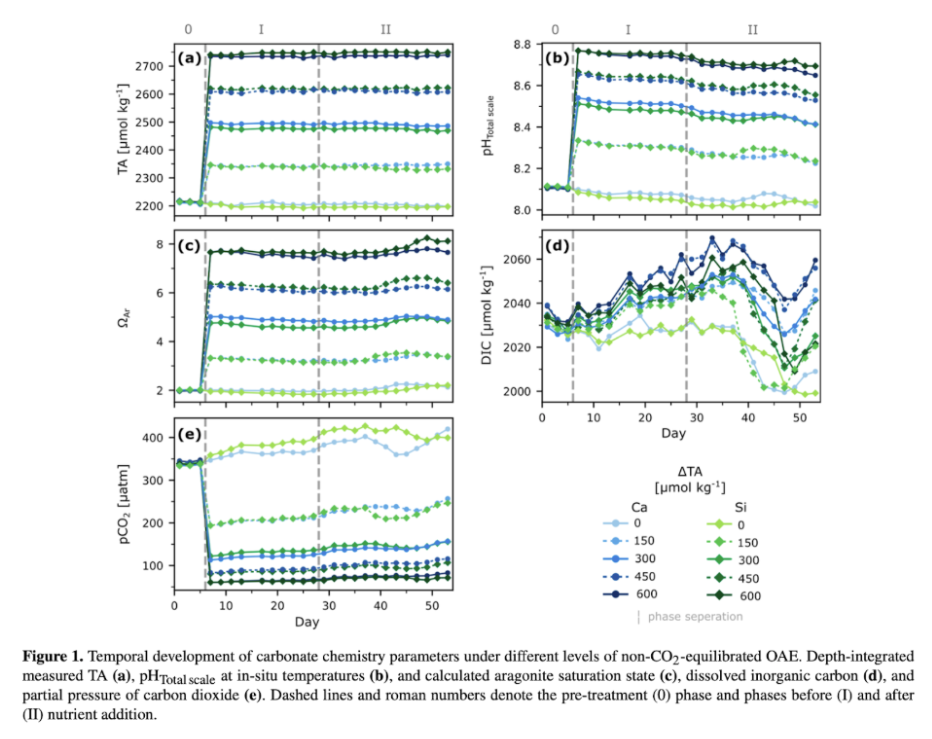
Here is a list of the main takeaways of this paper:
- OAE can create long-lasting changes in surface carbon chemistry: added alkalinity remained stable, and CO₂ re-equilibration with the atmosphere was slow, with ~95 % equilibration estimated to take ~1,050 days at the highest TA level.
- Mineral type matters for biological responses: while coccolithophore calcification showed optimal responses along the CO₂ gradient, silicate treatments boosted net community production independent of pCO₂ shifts.
- Zooplankton metabolism is affected by treatments: silicate-based treatments lowered zooplankton respiration, which correlated negatively with pCO₂ levels.
- Non-equilibrated OAE reflects realistic deployment scenarios, by also highlighting potential biological risks from prolonged low pCO₂ and high pH exposure.
- Findings support tailored OAE approaches that balance carbon removal goals with ecological impacts, emphasizing monitoring and verification in future trials.
Read the full paper here: Carbon fixation of a temperate plankton community in response to calcium- and silicate-based Ocean Alkalinity Enhancement using air-sea gas exchange measurements