Maximizing the Detectability of Ocean Alkalinity Enhancement (OAE) While Minimizing Its Exposure Risks: Insights From a Numerical Study
This week, we deep dive into a paper recently published in Earth’s Future. The study was led by Bin Wang, affiliated with the Department of Oceanography of Dalhousie University in Halifax (Canada), and the State Key Laboratory of Satellite Ocean Environment Dynamics, within the Ministry of Natural Resources in Zhejiang (China).
Ocean alkalinity enhancement (OAE) is a marine carbon dioxide removal (CDR) approach with the potential to remove gigatons of CO2 from the atmosphere. This study tackles a key challenge for OAE, namely how to make added alkalinity detectable for monitoring, reporting, and verification (MRV) while minimizing environmental exposure risks. Using a high-resolution circulation-dissolution model tailored to Halifax Harbour, Canada, the authors simulate how different alkaline feedstocks behave under varied dosages, seasons, and addition sites. They quantify both detectability and exposure risk and show that seasonal conditions and feedstock properties significantly influence outcomes. Detection of dissolved alkalinity is easier in summer, but with higher exposure risks due to longer residence times. Their results highlight pathways to optimize OAE deployment with tailored strategies to balance MRV needs and safety.
This paper advances OAE research by explicitly confronting the operational trade-offs between making alkalinity additions measurable and ensuring that the process doesn’t create harmful spikes in chemistry or prolonged exposure for marine ecosystems. While past work on OAE has largely focused on theoretical carbon uptake or global-scale impacts, this study is novel in integrating a high-resolution regional ocean model with dissolution and transport processes, enabling realistic simulations of how different alkaline materials disperse, dissolve, and persist in a real coastal setting. The research pivots away from idealized, large-scale projections and moves toward practical MRV considerations, which are critical prerequisites before any large-scale or regulatory-approved OAE activities can occur. By explicitly quantifying detectability and exposure, the authors contribute a much-needed framework for comparing deployment scenarios informed by both physical oceanography and measurement science.
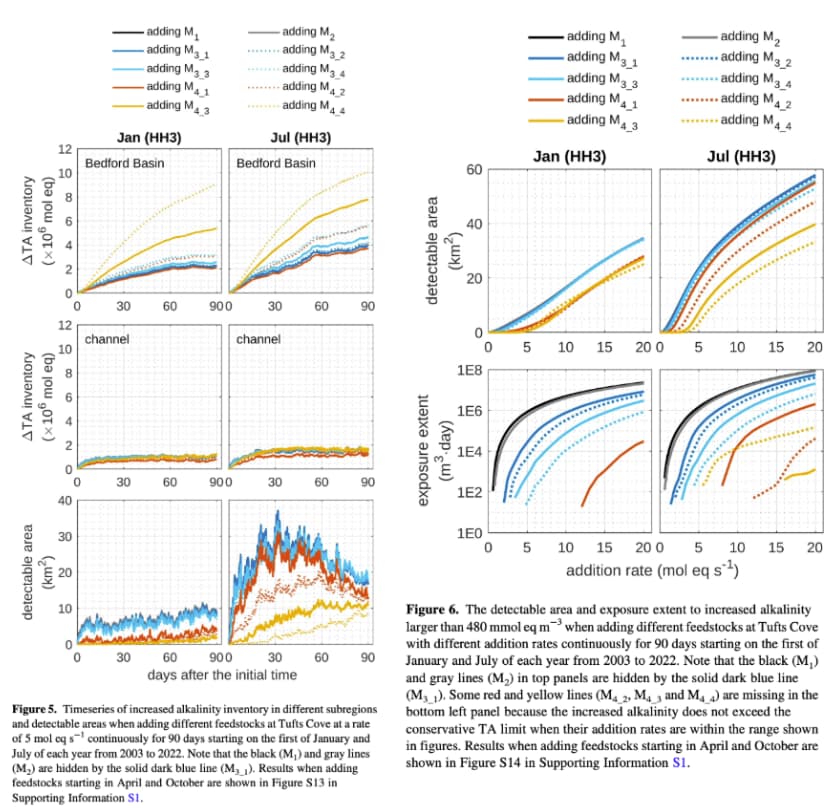
The modeling results reveal several key patterns. Detectability of added alkalinity — crucial for MRV — increases the longer the residence time of water in the target area. In practical terms, this means that additions made in summer, when waters remain in the region longer, are easier to measure than those in seasons with stronger flushing. However, this same condition also raises exposure risk, as elevated alkalinity lingers and potentially impacts local chemistry or organisms. The study finds that one can mitigate exposure without sacrificing detectability by selecting feedstocks with solubilities tuned to the seasonal circulation regime and by distributing additions across multiple sites to prevent localized accumulations. The authors thus provide computed optimal allocations of dosage, season, and feedstock that meet detectability objectives while staying within regulatory and safety constraints, underscoring the need for location-specific, context-aware planning in OAE deployment.
Here is a list of the main takeaways of this paper:
- OAE detectability improves with longer water residence times but concurrently increases exposure risk, posing a trade-off for monitoring and safety.
- Influence varies across seasons: summer conditions yield the highest detectability of alkalinity additions but also the greatest risk, due to slower water exchange.
- Optimal feedstock solubility varies by season, enabling reduced risk while keeping detectability high.
- Spreading alkalinity over several additional points helps lower exposure without significantly compromising detection.
- Effective OAE requires tailored planning, based on local hydrography, seasons, dosage, and feedstock to satisfy both MRV and regulatory safety standards.
Read the full paper here: Maximizing the Detectability of Ocean Alkalinity Enhancement (OAE) While Minimizing Its Exposure Risks: Insights From a Numerical Study