This week, we deep dive into a paper recently published in Earth’s Future. The study was led by Hans Sloterdijk, affiliated with the Center for Ocean and Society at the Institute for Agricultural Economics of Kiel University in Kiel (Germany), and with the German Centre for Integrative Biodiversity Research (iDiv) in Leipzig (Germany).
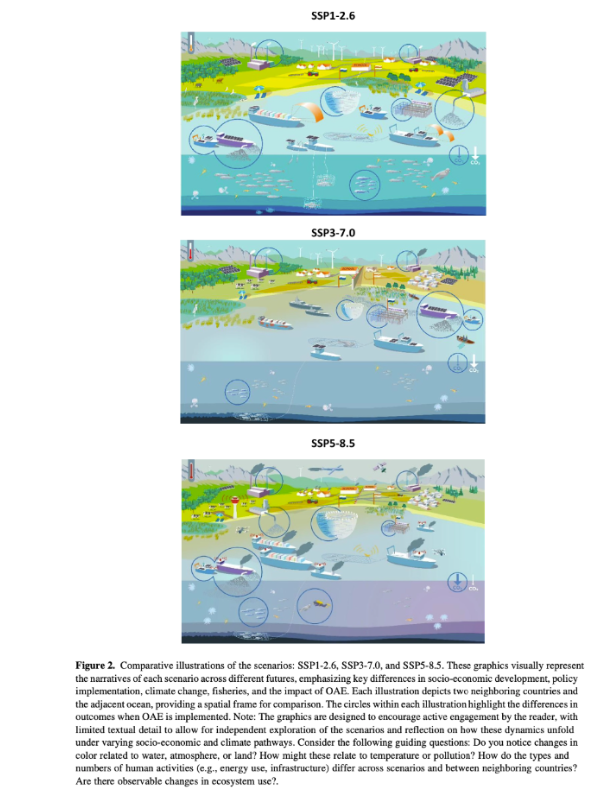
This study examines the potential interaction between ocean alkalinity enhancement (OAE) — a climate mitigation strategy designed to enhance the ocean’s carbon sequestration and mitigate acidification — and global fisheries under various future socioeconomic and climate scenarios. Using scenario frameworks such as Shared Socioeconomic Pathways (SSPs) tied to Representative Concentration Pathways (RCPs), the authors build integrated narratives that combine ecological, economic, technological, and policy dimensions. They compare a sustainability-focused world (SSP1-2.6) with others characterized by regional rivalry (SSP3-7.0) or high fossil dependency (SSP5-8.5). Results show that high emissions and fragmented development make it difficult to reconcile OAE deployment with sustainable fisheries. In contrast, a sustainability-oriented future offers the best prospects for aligning climate action with healthy fish stocks and food security.
At its core, this paper provides an original scenario analysis that goes beyond climate modeling alone by integrating biophysical and bio-economic factors, which are relevant to both climate mitigation and marine food systems. Unlike many studies that isolate physical climate interventions, the authors situate OAE within socio-economic pathways (SSPs) that also determine fishing costs, management effectiveness, technological progress, aquaculture development, and broader economic trends. By doing so, the authors offer a multi-dimensional perspective on how interventions aimed at enhancing ocean carbon uptake could ripple through marine ecosystems and human communities reliant on fisheries. This is particularly novel in the context of OAE, where potential feedbacks on pH, nutrient cycles, and ecological productivity are poorly understood and rarely linked quantitatively to future socioeconomic conditions.
The main results highlight stark contrasts across scenarios. Under a sustainability-oriented SSP1-2.6, where global cooperation, strong environmental policy, and technological innovation are prioritized, there is a plausible path for OAE to contribute to climate goals without undermining — and potentially even supporting — sustainable fisheries and aquaculture expansion. In contrast, under SSP3-7.0 (fragmented regional development) or SSP5-8.5 (continued high fossil use), socioeconomic barriers like weak management, high fishing pressure, and limited coordination obscure any potential synergy between OAE and fishery health. These findings underscore that climate interventions in the ocean cannot be evaluated in isolation; their outcomes depend critically on the broader societal context in which they are embedded.
Here is a list of the main takeaways of this paper:
- The study extends climate mitigation research by linking ocean alkalinity enhancement to global fisheries, considering socio-economic and climate pathway interactions.
- Three contrasting futures (sustainability, regional rivalry, and high emissions) reveal how governance, tech progress, and economic trends shape outcomes for both OAE viability and fishery sustainability.
- Under SSP1-2.6, strong cooperation and innovation make it more feasible to align OAE deployment with sustainable fisheries and food security goals.
- SSP3-7.0 and SSP5-8.5 scenarios show significant barriers to harmonizing climate mitigation with fisheries, due to weak management and socio-economic fragmentation.
- Effective integration of climate interventions with fisheries policy requires technological advances, governance coordination, and socio-economic development aligned with sustainability objectives.
Read the full paper here: Future Scenarios of Global Fisheries and Ocean Alkalinity Enhancement Under Socio-Economic and Climate Pathways