Observation of Decadal Natural Ocean Alkalinity Enhancement in the South China Sea
This week, we deep dive into a paper recently published in Geophysical Research Letters. The study was conducted by Hon‐Kit Lui, affiliated with the Department of Oceanography of the National Sun Yat‐sen University in Kaohsiung (Taiwan).
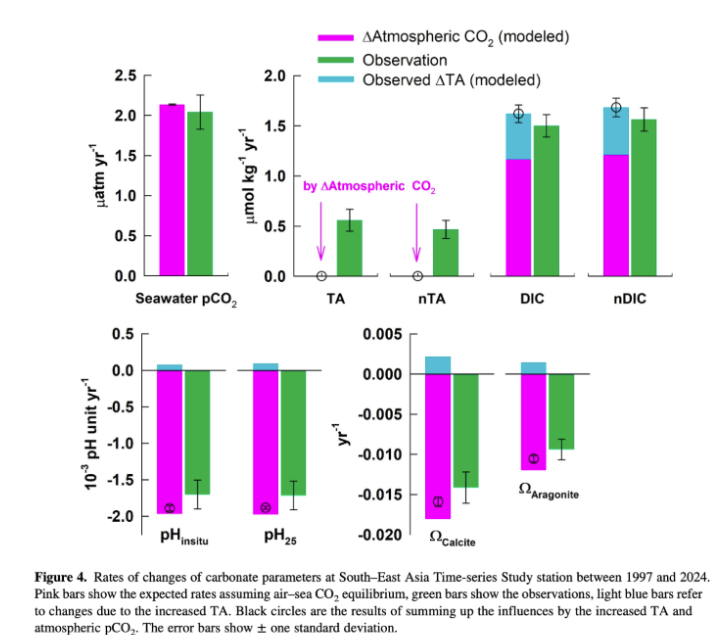
This study presents the first long-term observational evidence of a natural increase in ocean alkalinity in the northern South China Sea over a 26-year period. By analyzing continuous carbonate chemistry data, the author finds that total alkalinity has been rising steadily in surface waters, enhancing the ocean’s capacity to take up atmospheric CO₂. Over the study period, this natural alkalinization increased CO₂ absorption by ~28%, mitigated declines in pH by ~14%, and improved calcium carbonate saturation states by ~22%. These results bridge theoretical expectations about ocean alkalinity enhancement (OAE) with real field observations. The findings imply that increasing seawater alkalinity could be a viable long-term approach to support carbon removal and alleviate ocean acidification. Overall, the South China Sea serves as a valuable natural testbed illustrating how alkalinity shifts influence carbon cycling on decadal timescales.
Ocean alkalinity enhancement (OAE) has been proposed as a climate mitigation strategy where seawater’s buffering capacity is increased to boost its uptake of CO₂ from the atmosphere. However, most discussions of OAE are based on theoretical models or short-term experiments, and there is limited real-world evidence documenting how alkalinity changes unfold over decades in nature. This study fills this key gap by using a 26-year time series from the South China Sea—a region monitored as part of the Joint Global Ocean Flux Study—to show that seawater total alkalinity has been rising consistently over multiple decades. This long-term observational perspective is unprecedented, making it not just a test of OAE theory but also a novel empirical insight into how carbonate chemistry in a major marginal sea evolves over time.
Study findings reveal that the total alkalinity of surface waters increased at an average rate of about 0.56 μmol kg⁻¹ per year, which in turn enhanced the ocean’s natural CO₂ uptake by roughly 28% compared to earlier conditions. The rising alkalinity also helped offset declines in seawater pH associated with anthropogenic CO₂ absorption, reversing about 14% of the acidification trend, and improved the saturation state of calcium carbonate minerals by ~22%, which is beneficial for calcifying organisms. By linking the observed chemical changes to potential mechanisms of carbon uptake and ocean acidification moderation, the study provides strong field evidence supporting OAE as a feasible carbon removal pathway. While the South China Sea may have unique regional dynamics, the consistency between theory and observed trends suggests that similar processes might be harnessed or enhanced in other marine environments for climate mitigation.
Here is a list of the main takeaways of this paper:
- A 26-year dataset from the South China Sea provides the first long-term natural evidence of alkalinity increase, providing a key piece of field evidence for OAE.
- Natural alkalinity enhancement increased the seawater’s capacity to take up atmospheric CO₂ by about 28% over the study period.
- The observed alkalinity trend helped reverse roughly 14% of the ocean acidification decline in pH.
- Calcium carbonate saturation states increased by ~22%, providing better conditions for marine calcifiers.
- These real-world observations align with theoretical expectations and suggest that enhancing ocean alkalinity could be a promising long-term strategy for carbon removal.
Read the full paper here: Observation of Decadal Natural Ocean Alkalinity Enhancement in the South China Sea