This week, we deep dive into a paper recently published in Communications Earth & Environment. The study was conducted by Sophie Chlela and Sandrine Selosse, both affiliated with the Centre for Applied Mathematics of Mines Paris-PSL in Sophia Antipolis (France)
This study argues that while CDR is increasingly seen as vital for reaching net-zero emissions, current evaluations often fail to capture its full environmental and systemic implications. The authors review how Life Cycle Assessment (LCA), a standard tool for environmental impact assessment, is being applied to CDR techniques — such as afforestation, biochar, BECCS, and Direct Air Capture with Storage (DACS) — and highlight major methodological inconsistencies. They show that varied system boundaries, inconsistent functional units, and poor consideration of permanence and co-benefits severely limit the comparability and credibility of CDR claims. The authors call for stronger integration between LCA and system-level models (e.g., energy, land-use, and water systems) to better assess real-world feasibility, environmental trade-offs, and scalability.
Rather than simply comparing the climate-impact potentials of different CDR options, the authors investigate the foundations of those comparisons, critically focusing on the methodological weaknesses and inconsistencies in how LCA is used for CDR technologies. They analyze how divergent choices in system boundaries (e.g., cradle-to-gate vs. cradle-to-grave), functional units (per tonne CO₂ captured, sequestered, or avoided), and treatment of permanence (short- vs long-term storage) make cross-study results often incomparable or even misleading. By drawing attention to the often-ignored trade-offs — e.g,. land-use changes, water demand, resource competition, and indirect effects on food, ecosystems, energy infrastructure — this review emphasizes that “net-negative CO₂ removal” should not be assumed purely on gross CO₂ capture without fully accounting for life-cycle emissions and system-wide consequences.
The results point out that integrating LCA with broader system-level models (energy system models, land-use models, integrated assessment models) is crucial to realistically evaluate environmental performance and scalability of CDR. Such integration does allow for capturing temporal dynamics (e.g., regrowth of biomass, decay/leakage of storage), competition for land and water, dependencies on low-carbon energy supply, and systemic interactions: all features that isolated LCA or short-term assessments would miss. The authors also provide a comparative analysis of existing models that incorporate CDR, showing that many frameworks still lack comprehensive coverage of diverse CDR options or represent them with oversimplified assumptions. Finally, they suggest methodological recommendations — e.g., adopting consequential LCA rather than purely attributional LCA, defining a consistent functional unit (e.g., “one tonne of permanently removed CO₂”), and transparently disclosing assumptions about permanence, storage leakage, co-benefits, and resource competition.
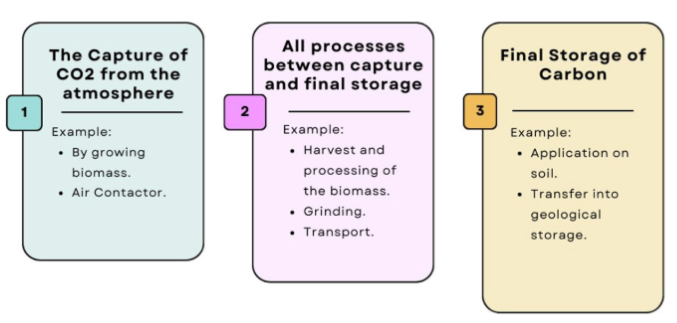
Here is a list of the main takeaways of this paper:
- CDR’s environmental impact is often underestimated because many LCA studies omit full life-cycle emissions, land-use and water impacts, and permanence of storage.
- Different LCA studies use inconsistent system boundaries and functional units, making comparisons across CDR methods largely unreliable.
- A shift from standard attributional LCA to consequential LCA is recommended to properly account for large-scale deployment effects and indirect system changes.
- Coupling LCA with system-level models improves realism by capturing resource competition, energy and infrastructure dependencies, and long-term trade-offs.
- For CDR to inform sound policy and governance, standardized, transparent, and comparable LCA protocols — including clear metrics like “tonnes CO₂ permanently removed” — are essential.
Read the full paper here: Life Cycle Assessment and System Integration of Carbon Dioxide Removal: Addressing Challenges in Environmental Evaluation and Model Representation