Biochar from Pellets: Influence of Binders and Pyrolysis Temperature on Physical Properties of Pyrolyzed Pellets
This week, we deep dive into a paper recently published in Communications Earth & Environment. The study was led by Magdalena Joka Yildiz, affiliated with the Faculty of Civil Engineering and Environmental Sciences of Bialystok University of Technology in Bialystok (Poland).
This study examines how different biomass feedstocks and two common binders—potato pulp and spent coffee grounds—shape the physical properties of pelletized biochar produced via continuous slow pyrolysis at 550°C and 700°C. The authors analyze ten pellet types derived from agricultural and food-processing residues, quantifying changes in particle and bulk density before and after pyrolysis. Results show strong correlations between the physical properties of biomass pellets and their resulting biochar, enabling predictive estimation of biochar density from precursor characteristics. Feedstock lignin/starch content and ash levels prove crucial for compaction, pellet durability, and final biochar density. High-temperature processing increases porosity and structural heterogeneity but maintains overall linear density trends.
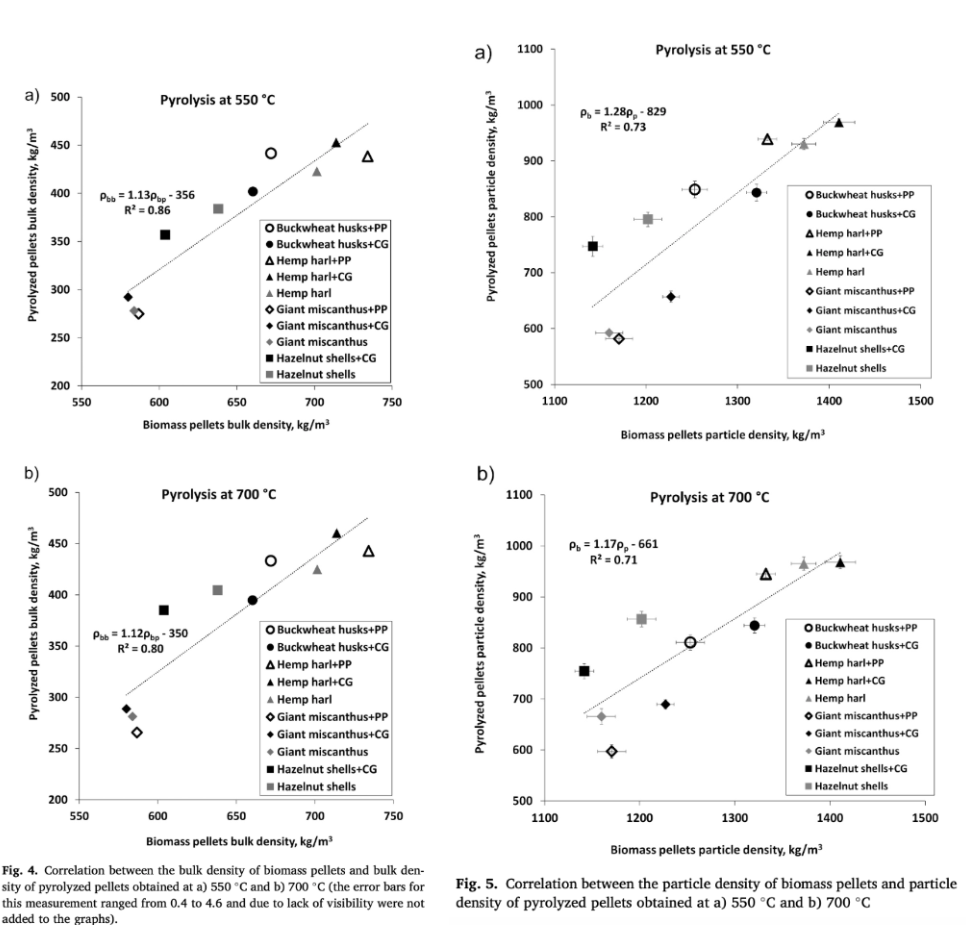
The authors propose a systematic, multi-feedstock evaluation of pelletized waste biomass processed in a continuous screw pyrolysis reactor—a scale and reactor type rarely studied in existing literature, which typically focuses on lab-scale batch systems. Ten biomass/binder configurations are integrated, combining compositional (lignocellulosic), mechanical, and thermal analyses with detailed measurements of bulk and particle density. By directly comparing pellets before and after pyrolysis, the study reveals robust linear relationships between precursor pellet density and final biochar density for both process temperatures (R² = 0.86 at 550 °C; R² = 0.80 at 700 °C). The work also uniquely quantifies pellet shrinkage, relaxation behavior, and binder-dependent effects on compaction and structural transformation during pyrolysis—insights critical for realistic techno-economic assessments of industrial biochar production.
The results highlight how feedstock properties—particularly lignin, starch, and ash content—govern densification behavior and post-pyrolysis structural integrity. Lignin-rich or starch-rich materials (e.g., buckwheat husks with binders, hemp harl) produced denser pellets and correspondingly denser biochars. Conversely, miscanthus stalks—despite moderate lignin—underwent significant relaxation and expansion during pelletization (Fig. 6), creating internal voids that later translated into lower-density biochars. Ash-rich biomass such as hemp harl yielded the highest biochar particle densities regardless of temperature, confirming the dominant influence of inorganic content. The authors further propose a practical linear regression model linking change in particle density during pyrolysis to biochar bulk density (R² = 0.91 at 550 °C; Fig. 8), offering a novel, scalable method for estimating bulk density when only small quantities of material are available. Together, these findings expand the methodological and predictive foundation needed to optimize pelletized biochar production in circular-economy systems.
Here is a list of the main takeaways of this paper:
- Pellet properties strongly predict biochar properties: Bulk and particle densities of pyrolyzed pellets correlate linearly with their biomass-pellet precursors.
- Feedstock composition matters: Lignin/starch content enhances compaction and results in denser biochar, while high ash content yields the highest post-pyrolysis densities.
- Potato pulp and coffee grounds can improve pellet density, but in some cases (e.g., hazelnut shells), lignin-rich binders reduce structural integrity and density.
- Pyrolysis temperature alters structure but maintains trends: Higher temperatures increase porosity and variability, yet preserve density correlations between pellets and biochar.
- The study introduces a linear model linking particle-density changes to biochar bulk density, offering a practical tool for small-sample or pilot-scale studies.
Read the full paper here: Biochar from Pellets: Influence of Binders and Pyrolysis Temperature on Physical Properties of Pyrolyzed Pellets