Site selection for ocean alkalinity enhancement informed by passive tracer simulations
This week, we deep dive into a paper recently published in Communications Earth & Environment. The study was led by Yiming Guo and Ke Chen, affiliated with —respectively— the Departments of Marine Chemistry & Geochemistry, and Physical Oceanography of the Woods Hole Oceanographic Institution in Woods Hole (USA).
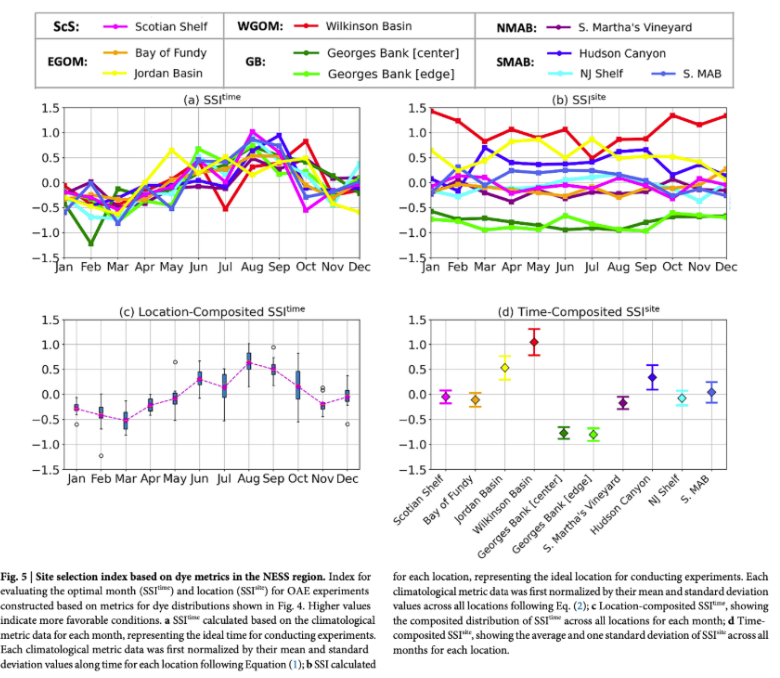
The study explores how physical ocean circulation influences the effectiveness of marine-based carbon dioxide removal via Ocean Alkalinity Enhancement (OAE). The authors used passive tracer simulations on the U.S. Northeast Shelf (2009-2017) to assess how added alkalinity might disperse, dilute, and be retained in different ocean settings. The authors develop a “site selection index” (SSI) integrating metrics such as spreading, concentration decay, and surface to gas-exchange velocities. Their results show strong seasonality (summer vs. winter) and identify one location, Wilkinson Basin, as particularly favourable for OAE deployment within their tested domain. The work provides a framework to guide future field trials and helps establish how ocean physics should feed into OAE planning and monitoring.
The authors employ a physics-first approach to OAE site-selection. They focus on the fundamental physical fate of an added tracer (as a proxy for alkalinity): how far it spreads, how quickly it dilutes, how long the elevated concentration persists, and how the ocean surface gas exchange conditions evolve. By conducting monthly releases of a passive dye in a high‐resolution model across ten locations on the Northeast Shelf, they capture real spatio-temporal variability in circulation and mixing for a full 9-year period (2009-2017). This is novel in the OAE literature, which often emphasises chemical reaction rates or alkalinity dissolution, but less often the large-scale hydrodynamic constraints. Their “site selection index” (SSI) is a synthetic metric combining multiple physical tracer metrics into a single score for comparing sites and months across a region. This provides a transferable tool for other regions beyond their test domain.
The results of this study highlight a notable seasonality: tracer retention and higher concentrations are consistently better in summer months than in winter, owing to weaker mixing and slower dilution in warmer, more stratified conditions. Among the ten candidate sites on the U.S. Northeast Shelf, Wilkinson Basin emerges as the top performer: it has a larger spreading area for the tracer (suggesting wide influence), higher upper‐ocean tracer concentrations (implying good retention), and longer decay times (which means the added alkalinity would persist longer before dilution). On the other hand, other sites perform much less favourably, especially in winter. The authors emphasize that this physical screening is only the first step: chemical dissolution rates, ecological impacts, infrastructure logistics, and monitoring/verification must follow. However, by excluding obviously poor sites on hydrodynamic grounds, it is possible to focus resources more effectively.
Here is a list of the main takeaways of this paper:
- Physical ocean circulation (mixing, transport, dilution) exerts a first-order control on how added alkalinity will behave in the marine environment, hence on OAE effectiveness.
- The authors developed a site selection index (SSI) combining tracer spreading, concentration, decay, and gas‐exchange velocity to rate sites for OAE suitability.
- Seasonal differences matter: summer conditions (stronger stratification, weaker mixing) are far more favourable than winter for maintaining elevated alkalinity and CO₂ uptake.
- Among the tested locations on the U.S. Northeast Shelf, Wilkinson Basin stood out as the most favourable release site in terms of physical tracer behaviour.
- This physics-based screening framework provides a scalable tool to guide OAE site selection globally, complementing subsequent chemical, biological, logistical evaluations.
Read the full paper here: Site selection for ocean alkalinity enhancement informed by passive tracer simulations