Weekly CDR Publication Deep-Dive (7 November 2025):
Global carbonate chemistry gradients reveal a negative feedback on ocean alkalinity enhancement
This week, we deep dive into a paper recently published in Nature Geoscience. The study was conducted by N. Lehmann and L. T. Bach, both affiliated with the Institute for Marine and Antarctic Studies of the University of Tasmania, in Hobart (Australia).
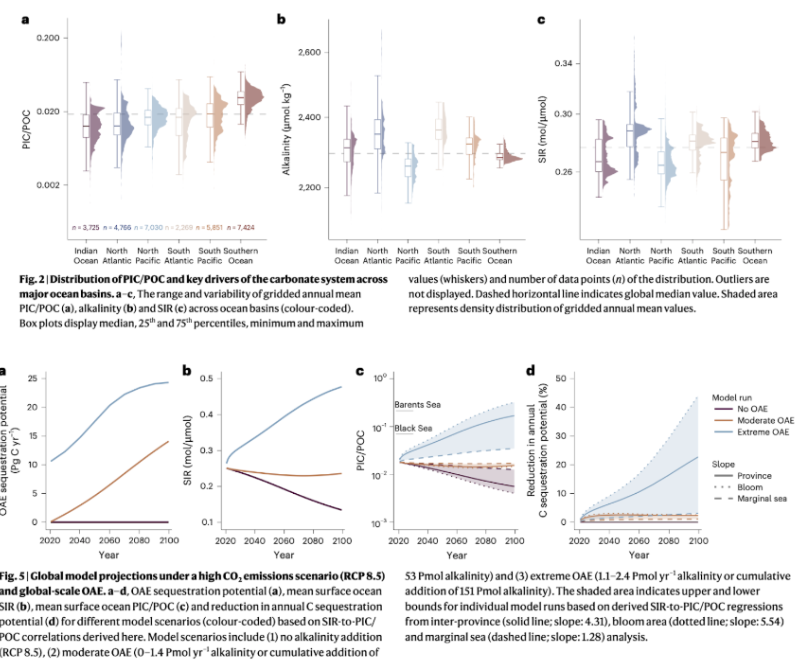
This study provides the first global-scale evidence that natural gradients in ocean carbonate chemistry can influence the efficiency of ocean alkalinity enhancement (OAE) — a proposed carbon dioxide removal technique. Using satellite data, the authors show that higher seawater alkalinity and bicarbonate availability stimulate the proliferation of calcifying phytoplankton, notably coccolithophores. This increased biotic calcification acts as a negative feedback, partially offsetting OAE’s CO₂ sequestration benefits. Model projections suggest that extreme OAE could reduce carbon removal efficiency by up to 29% by 2100, while moderate enhancement may only counteract acidification effects. These findings highlight the need to account for large-scale ecological feedback when evaluating marine CDR methods.
This paper bridges the physiological understanding of coccolithophore calcification with global observational data to assess how natural carbonate chemistry patterns can affect the potential of ocean alkalinity enhancement (OAE). By analysing satellite-derived data on particulate inorganic to organic carbon ratios (PIC/POC) across 54 ocean biogeochemical provinces, the study identifies consistent positive correlations between carbonate chemistry parameters — particularly the substrate–inhibitor ratio (SIR = [HCO₃⁻]/[H⁺]) — and the relative abundance of calcifying organisms. These findings suggest that regions with elevated bicarbonate and reduced proton concentrations tend to favour coccolithophore growth over non-calcifying phytoplankton such as diatoms. This mechanism reflects both the enhanced availability of carbon substrate for calcification and decreased physiological inhibition from ocean acidity, as evidenced by bloom-rich zones in the North Atlantic and subpolar regions.
Building on these empirical relationships, the authors applied the observed SIR–PIC/POC correlations to Earth system model projections of OAE under high-emission scenarios (RCP 8.5). While moderate alkalinity addition (<1.4 Pmol yr⁻¹) largely stabilizes current calcification levels by compensating acidification, extreme OAE (>1.1–2.4 Pmol yr⁻¹) amplifies coccolithophore proliferation and reduces cumulative CO₂ removal efficiency by 2–29% by 2100. This quantitative estimate represents the first global assessment of biological feedbacks that could constrain OAE performance. The results underscore that large-scale ecological and biogeochemical interactions — particularly involving calcifiers — can fundamentally alter the net carbon sequestration benefit of ocean-based CDR, emphasizing the need for integrated ecological risk–benefit evaluations in OAE deployment strategies.
Here is a list of the main takeaways of this paper:
- Increased alkalinity enhances calcifier activity, partly offsetting OAE’s CO₂ removal efficiency through higher biotic calcium carbonate production.
- Data on PIC/POC ratios from 20 years of MODIS global-scale satellite data reveal strong links between carbonate chemistry, nutrient balance, and coccolithophore dominance.
- The key chemical driver is the substrate–inhibitor ratio (SIR = [HCO₃⁻]/[H⁺]), which best predicts calcification responses across global oceans, bloom zones, and marginal seas.
- Under extreme OAE scenarios, biological feedbacks may reduce carbon sequestration by up to 29% by 2100; moderate OAE causes only minor (1–3%) reductions.
- Sustainable OAE policy design must consider ecological thresholds to avoid stimulating excessive calcification that undermines long-term CO₂ removal goals.
Read the full paper here: Global carbonate chemistry gradients reveal a negative feedback on ocean alkalinity enhancement