Half of land use carbon emissions in Southeast Asia can be mitigated through peat swamp forest and mangrove conservation and restoration
This week, we deep dive into a paper recently published in Nature Communications. The study was led by Sigit D. Sasmito, affiliated with the NUS Environmental Research Institute and the Department of Geography of the National University of Singapore (Singapore), and the Center for Tropical Water and Aquatic Ecosystem Research of James Cook University in Douglas (Australia).
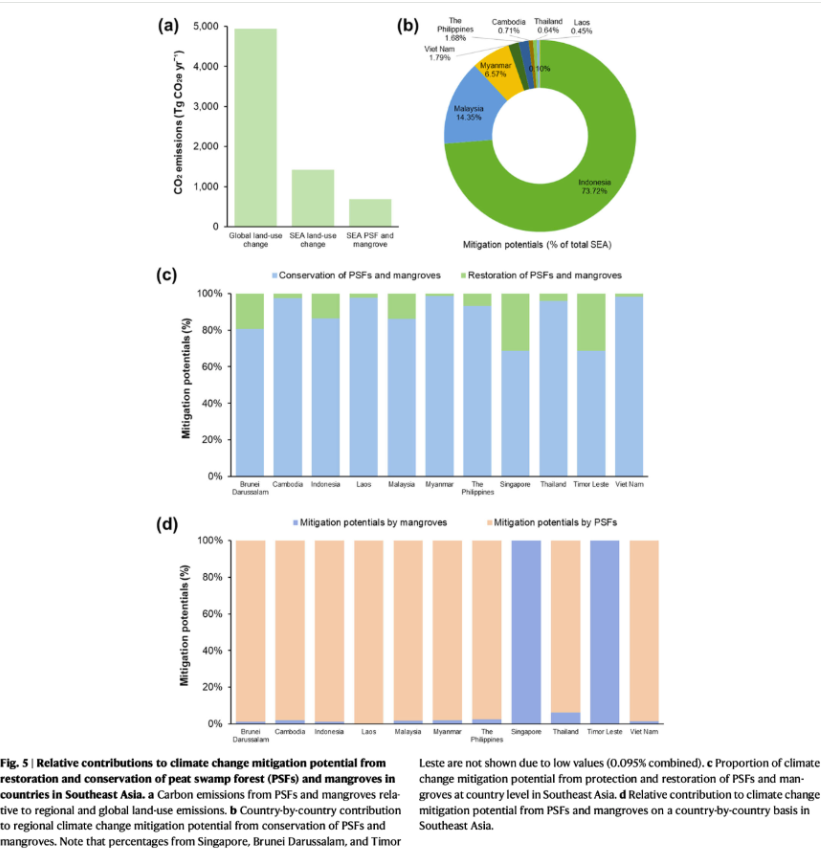
This study presents a new region-wide assessment finding that in Southeast Asia, about 48% of land‐use change emissions derive from deforestation and degradation of peat swamp forests (PSFs) and mangroves between 2001-2022. The authors show that although these ecosystems occupy only ~5.4% of the land area, their carbon emissions are disproportionately high: around ~692 teragrams of CO2 equivalent emissions per year (TgCO2eyr−1) from PSFs and mangroves, with minor regrowth removal. Importantly, this study shows an additional mitigation potential of ~94 TgCO2eyr−1 if degraded PSFs and mangroves are restored, highlighting how protecting and restoring these carbon‐dense wetlands offers a cost-effective, nature-based pathway for climate mitigation in the region.
This study makes a significant contribution by combining high-resolution spatial data across the entire Southeast Asia region (covering multiple countries) and coupling land-use change of peat swamp forests and mangroves with carbon and methane emissions estimates for the period 2001-2022. Prior work had addressed individual peatland or mangrove systems, but this study contributes with a new comprehensive regional quantification and breakdown by country (e.g., Indonesia contributing ~73% of those emissions), including a detailed breakdown of replacement land-uses (plantations, aquaculture, fire‐impacted peat, etc.) and their emissions, thus providing granular evidence for policy-relevant interventions.
In terms of results, the paper reports that PSFs alone contributed ~98% of the ~691.8 ± 97.2 TgCO2eyr−1 from these wetland types, whereas mangroves contributed a much smaller share. Authors estimate that natural secondary regrowth removes only ~16.3 ± 2.0 TgCO2eyr−1 (much smaller than the emissions), revealing a large gap between loss and recovery. Most strikingly, the “restoration potential” (i.e., the emissions that could be avoided or removed by restoring degraded PSFs and mangroves) is estimated at ~94.4 ± 7.4 TgCO2eyr−1. This implies that by directing efforts at these ecosystems, Southeast Asian countries could tackle nearly half of their land‐use change emissions, making these habitats crucial for meeting climate goals.
Here is a list of the main takeaways of this paper:
- Peat swamp forests and mangroves in Southeast Asia emit about 691.8 ± 97.2 TgCO2eyr−1 through land-use change, representing ~48% of regional land-use emissions.
- Although they cover only ~5.4% of the land area, PSFs and mangroves are disproportionately large sources of emissions due to their carbon-dense soils.
- Natural secondary regrowth of these ecosystems only removes ~16.3 ± 2.0 TgCO2eyr−1, far lower than the emissions, highlighting the restoration gap.
- Restoration and conservation of these ecosystems could offer an additional mitigation potential of ~94.4 ± 7.4 TgCO2eyr−1, representing a major climate‐mitigation opportunity.
- Countries such as Indonesia (≈ 73% of emissions), Malaysia (14%), Myanmar (7%), and Vietnam (2%) account for over 90% of these emissions from PSFs and mangroves—highlighting geographic priorities.
Read the full paper here: Half of land use carbon emissions in Southeast Asia can be mitigated through peat swamp forest and mangrove conservation and restoration