This week, we deep dive into a paper recently published in Earth’s Future. The study was led by W. Yao and M. Morganti, affiliated with - respectively - the GEOMAR Helmholtz Centre for Ocean Research in Kiel and the Leibniz Institute for Baltic Sea Research (IOW) in Rostock, Germany.
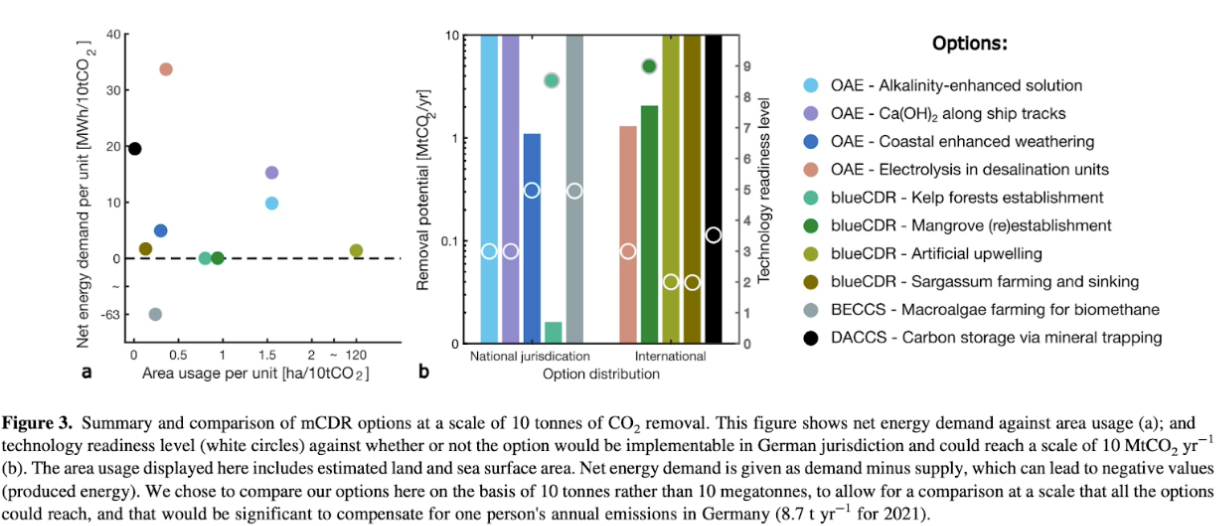
This paper investigates how marine carbon dioxide removal (mCDR) and marine carbon storage (mCS) technologies might be deployed in German waters to remove 10 Mt CO₂ per year, equivalent to ~8–22 % of projected residual emissions in 2045. The authors screen ten candidate methods relying on alkalinity enhancement, blue carbon enhancement, and subsea geological storage. For each method, they assess the resource, infrastructure, environmental, and monitoring needs under site-specific constraints. They find that only about half of the options are feasible within German jurisdiction, and only three could plausibly meet the full 10 Mt CO₂ target. Results underscore that local conditions and material/energy demands pose major constraints, calling for more regionally grounded feasibility studies.
One of the key original contributions of this work is its site-specific perspective on the evaluation of marine CDR/CS options. Unlike prior studies, which tend to estimate global potentials or generic capacities, this paper grounds its analysis in Germany’s marine jurisdiction (North Sea, Baltic Sea) and forces every candidate method to confront realistic constraints of local bathymetry, material supply chains, infrastructure, legal boundaries, energy availability, monitoring capabilities, and environmental impact risks. This allows the authors to reveal that scaling up mCDR in a real national marine setting is far more constrained than what global or idealized models suggest. In addition, rather than exploring only marginal or incremental deployment, in this paper, each option is evaluated with respect to a very tightly defined challenge, that of achieving 10 Mt CO₂ removals per year.
In terms of results, the authors classify ten candidate mCDR/mCS options into three classes: (i) ocean alkalinity enhancement (chemical buffering), (ii) blue carbon/ecosystem enhancement, and (iii) geological or biomass-based storage approaches. Their analysis shows that only five of the ten methods could be implemented within Germany’s jurisdiction, given spatial, resource, and logistical constraints; and of those, only three appear capable of reaching the aspirational 10 Mt CO₂ annual removal target: electrolytic production and addition of alkalinity‐enhanced solution from silicate rock; production and spread of Ca(OH)2 along ship tracks in the North Sea, and biomass from macroalgae farming for biomethane production combined with carbon storage in saline aquifers in the North Sea. For example, some alkalinity enhancement approaches would require massive volumes of alkalinity reagents and distribution over large areas, making them unfeasible under local transport or footprint constraints. Similarly, options relying on macroalgae or kelp cultivation confront ecological, nutrient, and monitoring uncertainties at scale. The authors also flag that cost estimates, environmental side effects, and monitoring uncertainties remain major open questions, implying that even the “feasible” options carry significant strings and risks.
Here is a list of the main takeaways of this paper:
- The effectiveness of marine CDR/CS depends critically on site-specific constraints (bathymetry, supply chains, infrastructure) rather than on generic theoretical potentials.
- Out of ten evaluated methods, only five are implementable within Germany’s marine jurisdiction, and only three could plausibly reach the 10 Mt CO₂ per year target.
- Alkalinity enhancement, blue carbon growth, and geological storage approaches each bring very different resource, spatial, and monitoring burden trade-offs.
- Even technically feasible options face uncertainties in environmental side effects, monitoring frameworks, and legal/political acceptability.
- The approach of forcing regionally grounded, high-bar targets (here 10 Mt CO₂ yr⁻¹) offers a valuable template for assessing marine CDR in other national/regional contexts.
Read the full paper here: Exploring Site-Specific Carbon Dioxide Removal Options With Storage or Sequestration in the Marine Environment – The 10 Mt CO2 yr−1 Removal Challenge for Germany.