Land availability and policy commitments limit global climate mitigation from forestation.
This week, we deep dive into a paper recently published in Science. The study was led by Yijie Wang, affiliated, among others, to the School of Atmospheric Sciences, the Key Laboratory of Tropical Atmosphere-Ocean System and the Key Laboratory for Climate Change and Natural Disaster Studies of Sun Yat-sen University, in China.
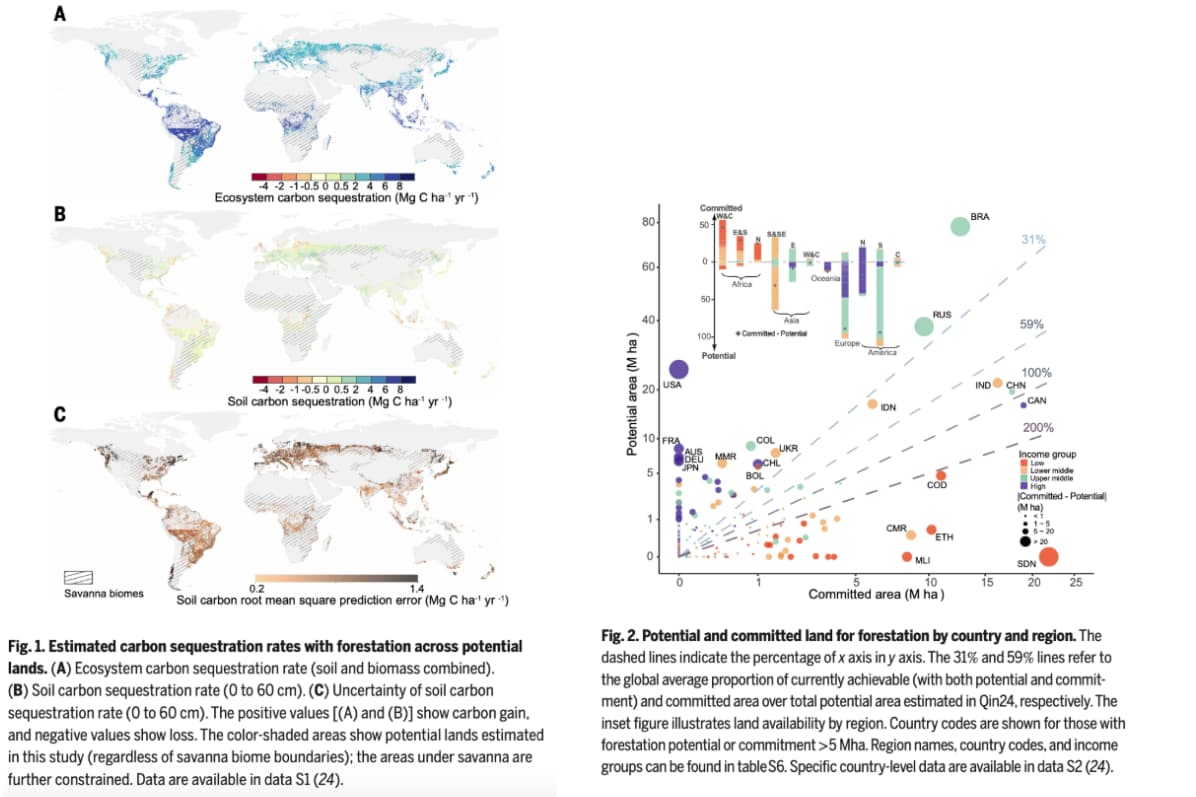
Forestation (afforestation and reforestation) is often highlighted as a key strategy for climate mitigation, but its global potential is more limited than many earlier estimates suggested. Wang et al. provide new global maps of soil carbon changes due to forestation, accounting for both gains and losses, and applying realistic land-availability constraints that include biodiversity, albedo, and water considerations. The authors find a potential for forest carbon sequestration much lower than previous estimates and a substantial gap between technical and political potential when considering the land that was already pledged under existing national commitments.
The originality of this study lies in refining forestation potential estimates through two key advances. First, they incorporate comprehensive soil carbon dynamics, including situations where soils can actually lose carbon after forest establishment. This correction is critical, as many earlier studies focused only on biomass or assumed net soil carbon gains, thereby overstating the sequestration potential. Second, they impose environmental and ecological constraints on land availability. Not all “available” land can be safely converted to forest without negative consequences for biodiversity, surface reflectivity (albedo), or water resources. This spatially explicit approach substantially reduces the theoretical forestation area compared to overly optimistic scenarios.
In terms of results, the authors find that, once ecological safeguards are applied, about 389 million hectares remain globally suitable for forestation, with the capacity to store ~39.9 PgC by 2050. In contrast, if restricted to land already pledged in national commitments, the available area shrinks to ~120 million hectares, corresponding to only ~12.5 PgC of potential sequestration. This three-fold difference underscores how current policies fall short of the theoretical maximum. The study concludes that bridging this gap will require more ambitious pledges, stronger policy frameworks, and mechanisms to avoid unintended negative impacts, such as biodiversity loss, altered albedo, or water stress. Ultimately, forestation can play a meaningful but bounded role in global climate mitigation.
Here is a list of the main takeaways of this paper:
- Soil carbon dynamics are critical: forestation can both store and release carbon in soils, meaning net gains are lower than many earlier estimates.
- After accounting for biodiversity, albedo, and water constraints, ~389 million hectares remain globally suitable for forestation, with ~39.9 PgC potential by 2050.
- Based on current national pledges, the realistically committed forestation area is ~120 million hectares, corresponding to ~12.5 PgC potential by 2050.
- Achieving higher potentials will require stronger political commitments and safeguards against ecological side effects such as biodiversity loss or water stress.
- Previous optimistic projections likely overestimated forestation’s mitigation role by ignoring soil carbon losses, ecological trade-offs, and limited political commitments.
Read the full paper here: Land availability and policy commitments limit global climate mitigation from forestation.