Low-cost negative emissions by demand-side management for adsorption-based direct air carbon capture and storage
This week, we deep dive into a paper recently published in Carbon Neutrality. The study was led by P. Postweiler from the Institute of Technical Thermodynamics of RWTH Aachen University in Aachen (Germany).
This paper investigates how demand-side management (DSM) can lower the costs of direct air carbon capture and storage (DACCS) using adsorption processes. The authors integrate a dynamic process model with real and forecasted data on German electricity prices and grid emissions. By modifying the standard DACCS cycle — introducing pauses and flexible air/steam flows — the system can adjust its operation to favorable electricity conditions. Results show that flexible operation can reduce the net carbon removal cost by up to ~20% compared to stationary operation, especially under future scenarios with volatile electricity markets. DSM thus emerges as a promising way to cut DACCS costs without relying on external energy storage.
The paper proposes a novel approach, combining a time-resolved process simulation with grid emission intensity and price dynamics to evaluate flexible DACCS operation. Prior research usually assumes continuous, steady-state operation, neglecting the large fluctuations in electricity supply and carbon intensity in real grids. Here, the authors design cycle modifications that enable temporary pauses, adjusted airflows when the filter grabs CO2 from the air and varied steam flows when the filter lets CO2 go so it can be collected — effectively allowing the plant to “follow” the grid and operate more intensively when power is cheap and clean. Crucially, this strategy does not require energy storage, but instead leverages process flexibility.
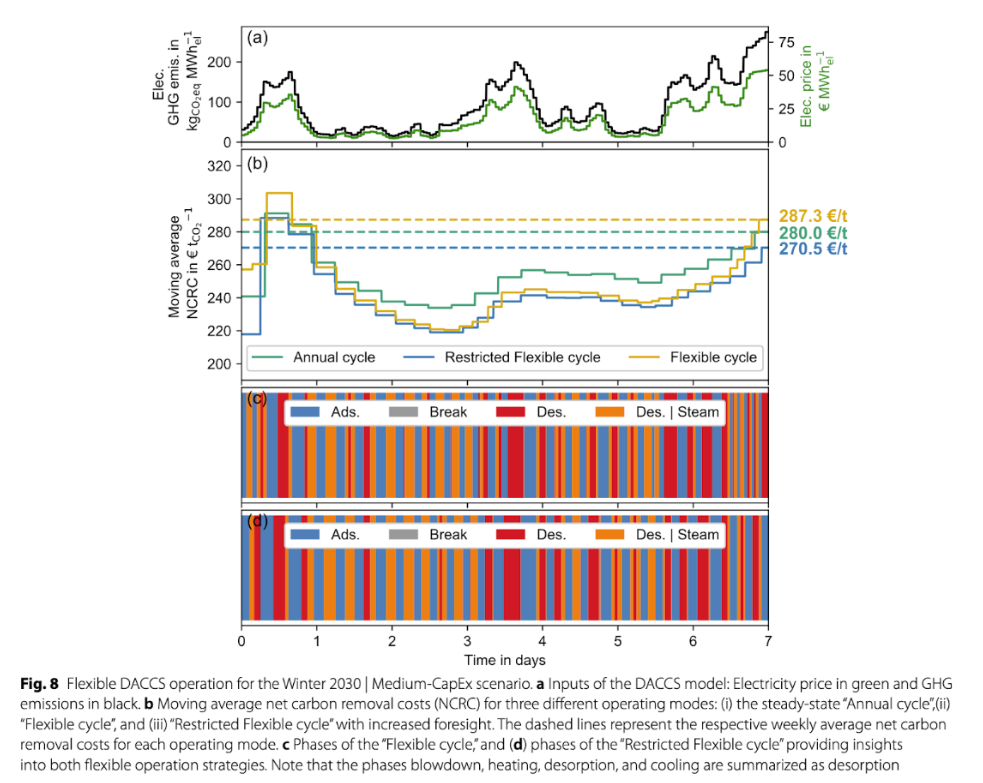
The main results show significant potential cost savings. In Germany’s 2030 grid scenarios, flexible DACCS can cut net removal costs by ~8–12%, depending on capital expenditure levels. For instance, in a representative summer week with medium capital expenditure (i.e., the money spent on building or upgrading facilities, equipment or infrastructure) costs fall from ~€528/tCO₂ (stationary operation) to ~€488/tCO₂ (flexible operation). With lower CapEx assumptions, the reduction is even greater, reaching nearly 12%. In 2040 scenarios, where electricity supply and prices are expected to be far more volatile due to higher renewable penetration, the benefits of DSM become stronger: net removal costs decline by up to ~20%. Importantly, the study also finds that flexible operation can reduce not only costs but also the net carbon footprint, since more of the DACCS energy demand is shifted to times of low grid emissions. However, the gains are not uniform: in winter 2030, with fewer renewable fluctuations, flexible operation can even slightly worsen performance compared to stationary operation. This demonstrates that the effectiveness of DSM hinges on grid variability and on the ability to anticipate favorable conditions through accurate forecasting.
Here is a list of the main takeaways of this paper:
- Flexible operation of adsorption-based DACCS can reduce net carbon removal costs by up to ~20% versus continuous operation, particularly in future volatile electricity markets.
- Cycle modifications (pauses, adjusted air and steam flows) enable load shifting without the need for external energy storage.
- Capital expenditure (CapEx) strongly influences the benefits of flexibility: with lower CapEx, productivity gains matter most; with higher CapEx, downtime minimization becomes critical.
- Future grids (e.g., Germany 2040) with higher renewable penetration offer the greatest opportunities for DSM-enabled cost savings.
- Forecast quality matters: when electricity variability is low or poorly predictable, flexibility can even increase costs compared to stationary operation.
Read the full paper here: Low-cost negative emissions by demand-side management for adsorption-based direct air carbon capture and storage.