Efficacy of individual and combined terrestrial and marine carbon dioxide removal
This week, we deep dive into a paper recently published in Environmental Research Letters. The study was led by Anusha Sathyanadh, working at the Industrial Ecology Programme of the Department of Energy and Process Engineering at the Norwegian University of Science and Technology in Trondheim (Norway).
This paper tests how much carbon dioxide removal (CDR) can be achieved when scaling up a land-based option (BECCS) and a marine option (ocean alkalinity enhancement, OAE)—both separately and as a portfolio. Using the Norwegian Earth System Model, the authors run an overshoot-style scenario with large, ramped deployments through 2100. The headline result is that combined BECCS+OAE delivers a largely additive CO₂ removal outcome, rather than one method strongly “cannibalizing” the other. They quantify CDR effectiveness for each approach and show that, while atmospheric CO₂ is reduced, global mean temperature changes remain negligible in these experiments. At the same time, the model reveals non-linear feedbacks (notably on land/soil carbon sinks) that matter for portfolio design.
In this paper, the authors move beyond “single-solution” assessments and pose a very practical portfolio question: if major terrestrial and ocean CDRs are deployed simultaneously at scale, will the result be the sum of their parts—or do Earth-system feedbacks erode their effectiveness? The authors implement idealized but explicitly specified ramp-up pathways in NorESM, including a large additional bioenergy crop area for BECCS and substantial CaO-based alkalinity addition for OAE, focused within major EEZs (Europe, the US, and China). This setup allows a direct comparison of (i) BECCS-only, (ii) OAE-only, and (iii) combined BECCS+OAE, isolating interaction effects that are often assumed away in policy discussions of “CDR portfolios”.
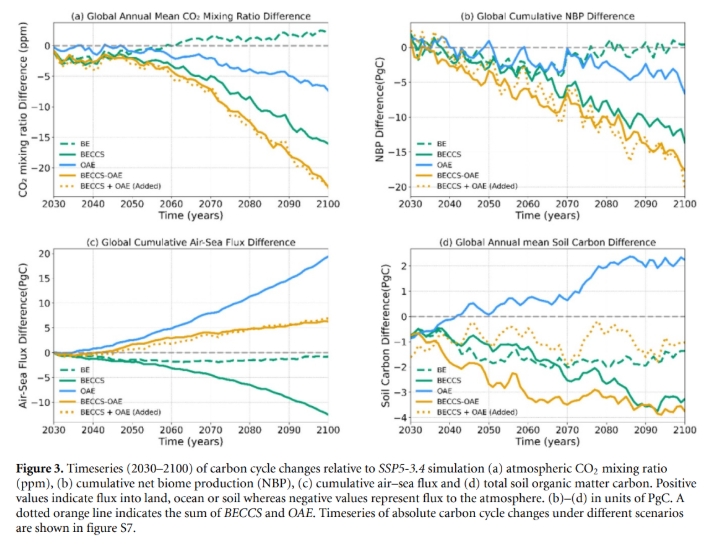
The combined simulation shows a largely additive carbon removal effect over 2030–2100: OAE alone sequesters about 7 ppm atmospheric CO₂ (with ~82.3 Gt CaO deployed) and BECCS alone reduces about 16 ppm, with effectiveness metrics reported as ~0.08 ppm per Gt CaO for OAE and 3.1 ppm per million km² of bioenergy crops for BECCS. Importantly, the efficiency of each approach is not strongly degraded by concurrent deployment, but the model still produces distinct non-linear interactions, including declines in land and soil carbon sinks in the combined case—an example of why “additive CO₂ removal” does not automatically imply “no side-effects.” Across experiments, the simulations show negligible effects on global annual-mean temperature, reinforcing that even sizeable net-negative emissions in this setup do not translate into large near-term global-mean cooling. The authors conclude that portfolio planning should treat near-additivity as plausible, while explicitly accounting for land/ocean sink feedbacks and the continued need for deep emissions cuts and enabling policy.
Here is a list of the main takeaways of this paper:
- The study compares BECCS and OAE at scale, both individually and as a combined land–ocean CDR portfolio in an Earth system model.
- In the combined scenario, atmospheric CO₂ removal is largely additive, suggesting limited “competition” between the two methods for CO₂ drawdown.
- Reported effectiveness: OAE removes ~7 ppm (with ~82.3 Gt CaO) and BECCS ~16 ppm over 2030–2100 under the study’s deployment design.
- Even with near-additive removal, the model shows non-linear feedbacks, including reduced land/soil carbon sinks in the combined case.
- Across simulations, global annual-mean temperature effects are negligible, underscoring that CDR portfolios complement, rather than replace, rapid emissions reductions.
Read the full paper here: Efficacy of individual and combined terrestrial and marine carbon dioxide removal