This week, we deep dive into a paper recently published in Nature Communications. The study was led by Yiannis Moustakis, from the Ludwig-Maximilians-Universität in Munich, (Germany).
This study explores whether combining different carbon dioxide removal (CDR) strategies reduces their effectiveness. Using Earth System Model simulations, the authors tested large-scale deployment of afforestation/reforestation (AR) and ocean alkalinity enhancement (OAE), separately and in combination. They found that carbon removal efficiency—measured as the share of captured CO₂ remaining out of the atmosphere—remains consistently high at ~85–87% regardless of scale or method. Importantly, the effects of AR and OAE are additive, meaning that combining them achieves nearly the same removal as the sum of each alone. This finding provides strong evidence that diversifying CDR portfolios does not come at the cost of effectiveness.
In this paper, Earth System Models are used for the first time to examine the co-application of terrestrial and marine CDR methods under realistic deployment scales over the 21st century. Previous work largely focused on individual methods in isolation, leaving open the question of whether interactions between them would lead to diminishing returns. By simulating 42 combinations of AR (up to 927 million hectares) and OAE (up to 18 petamoles), the study shows that efficiency does not decrease when the two approaches are applied together. This fills an important research gap and provides scientific backing for a portfolio approach to CDR that balances land-based and ocean-based options.
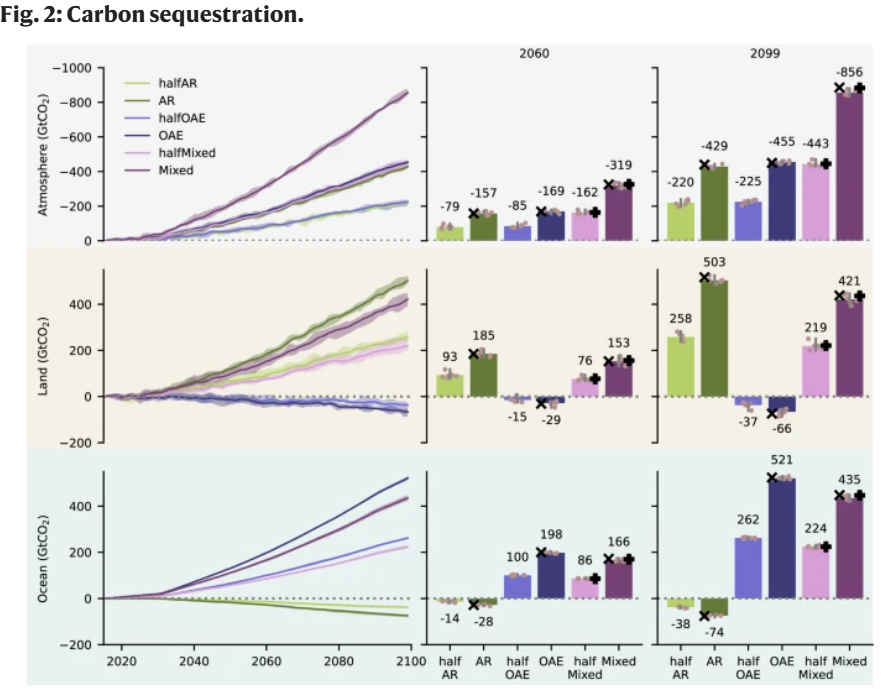
The simulations reveal a near-linear scaling of carbon removal efficiency across both methods. AR could reduce atmospheric concentrations by up to 429 GtCO₂, while OAE could contribute 503 GtCO₂; combined, they achieve 856 GtCO₂, with no penalty in effectiveness from interaction effects. Even partial deployment—halving both interventions—produced additive results. The robustness of the ~85–87% efficiency figure across scales underscores the resilience of these methods when combined. These findings have significant implications for policy: they demonstrate that diversifying CDR across ecosystems is not only feasible but also crucial to alleviate pressure on land resources while still achieving large-scale removals. At the same time, the authors emphasize that CDR should complement, not replace, rapid emission reductions.
Here is a list of the main takeaways of this paper:
- The study shows that combining land and marine CDR does not reduce efficiency, with both methods retaining ~85–87% effectiveness.
- Afforestation/reforestation and ocean alkalinity enhancement scale linearly, delivering additive carbon removal benefits.
- Maximum reductions are 429 GtCO₂ (AR), 503 GtCO₂ (OAE), and 856 GtCO₂ when combined under large-scale deployment.
- Findings provide strong support for portfolio approaches, easing land-use pressures by safely integrating ocean-based methods.
- The paper underlines that CDR complements but cannot substitute rapid emissions cuts, reinforcing its role in Paris-aligned pathways.
Read the full paper here: No compromise in efficiency from the co-application of a marine and a terrestrial CDR method.