Scaling up enhanced rock weathering for equitable climate change mitigation
This week, we deep dive into a paper recently published in Communication Sustainability. The study was led by Ying Tu, affiliated with the Department of Global Development of Cornell University, in Ithaca (USA).
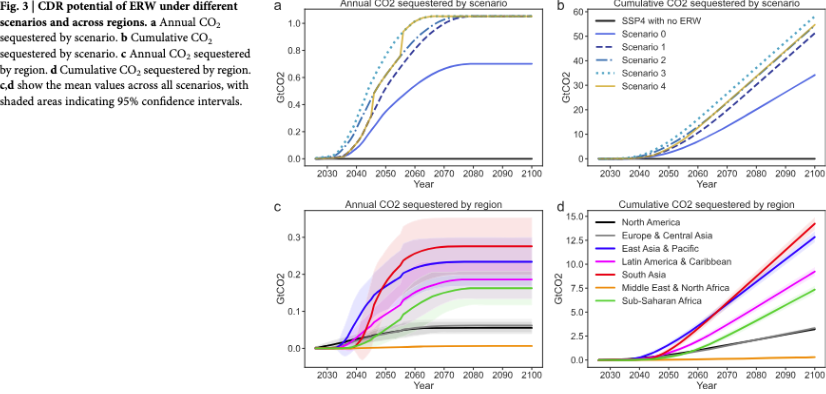
Enhanced rock weathering (ERW)—spreading finely crushed silicate rocks on croplands—could become a meaningful, durable CO₂ removal option, but its real-world impact depends on how quickly and where it gets adopted. This paper projects ERW scale-up through 2100 by blending historical “technology diffusion” patterns with a coupled human–nature feedback model to generate spatially explicit adoption trajectories. Across five scenarios (varying policy ambition, societal responsiveness, and implementation capacity), global ERW removal reaches ~0.35–0.76 GtCO₂/yr by 2050 and ~0.7–1.1 GtCO₂/yr later in the century. Early deployment is led by high-income regions, but large emerging economies (notably India and Brazil) overtake by mid-century due to faster uptake and favorable conditions. A central message is equity: the share of removal from low- and lower-middle-income countries rises markedly over time, contingent on enabling policies and capacity-building.
In this paper, the authors move beyond “static potential” estimates (how much CO₂ ERW could remove if widely applied) and instead model adoption dynamics—who adopts, how fast, and under what social and policy conditions. They combine historical analogs of technological diffusion (capturing slow initial uptake and later acceleration) with a coupled human–nature feedback framework that links climate risk, societal response, and deployment capacity to produce country-level, spatially explicit projections through 2100. This framing is important because ERW is not just a geochemical/engineering question: its climate contribution hinges on institutions, investment, infrastructure, and public/political willingness to implement at scale—factors that vary sharply across regions and income groups.
In terms of results, the scenario ensemble yields a moderate-but-nontrivial global CDR contribution: ~0.35–0.76 GtCO₂ per year by 2050 and ~0.7–1.1 GtCO₂ per year by late century (with cumulative removal on the order of a few dozen gigatons by 2100 under their core assumptions). The distribution of that removal shifts over time. High-income regions dominate early deployment, but by mid-century countries such as India and Brazil become leading contributors, reflecting both accelerated adoption pathways and favorable biophysical settings for ERW effectiveness. The equity angle is explicit: low- and lower-middle-income countries face adoption lags (estimated at roughly a decade-plus relative to early leaders), yet with targeted interventions their share of cumulative CO₂ removal grows from roughly a quarter in the 2040 timeframe to around ~60% by 2100—implying that ERW scale-up could, under the right governance and finance, support a more inclusive global mitigation transition rather than reinforcing existing disparities.
Here is a list of the main takeaways of this paper:
- Adoption—not just technical potential—determines impact: the study explicitly models ERW diffusion over time and across countries, rather than assuming uniform uptake.
- Plausible mid-century contribution is meaningful but not dominant. Global ERW is projected at ~0.35–0.76 GtCO₂/yr by 2050 across scenarios.
- Late-century outcomes depend strongly on social/policy conditions. Projections diverge across scenarios, reaching ~0.7–1.1 GtCO₂/yr later in the century.
- Leadership shifts geographically over time. High-income regions lead early, but India and Brazil are projected to overtake by mid-century due to faster uptake and favorable conditions.
- Equity can improve—but only with enabling support. Low- and lower-middle-income countries face adoption lags, yet their share of cumulative removal is projected to rise toward ~60% by 2100 with targeted cooperation and capacity-building.
Read the full paper here: Scaling up enhanced rock weathering for equitable climate change mitigation