A machine learning framework to assess global mangrove forestation potential under current and future climate scenarios
This week, we deep dive into a paper recently published in Environmental Research. The study was led by Guohao Li, from the School of Environmental Science and Engineering of Tianjin University, in Tianjin (China).
This study develops an interpretable machine learning framework to assess global mangrove cover potential under current and future climate scenarios. Using 48 environmental variables spanning climate, soil, topography, and marine factors, the authors estimate a theoretical global mangrove cover potential of 475,671 km², which reduces to 156,682 km² when socioeconomic and ecological land-use constraints are applied. Soil saturated water content and distance to sea emerge as the dominant environmental drivers. While climate change generally expands potential suitable areas, sea-level rise—especially under SSP5-8.5—substantially offsets gains. The study estimates a global mangrove forestation carbon storage potential of 6.9 GtC, highlighting significant mitigation opportunities.
A major contribution of this study lies in its conceptual and methodological distinction between mangrove cover potential (biophysical maximum under natural conditions) and mangrove forestation potential (realistic expansion after excluding ecological and socioeconomic land-use conflicts). This distinction addresses a key limitation of previous global forest restoration assessments, which often treated mangroves as generic forests and relied on limited marine data. Here, the authors integrate 48 harmonized global covariates—including underutilized marine drivers such as freshwater discharge and distance to sea—within a random forest framework enhanced by SHAP and PDP interpretability tools. Model performance is notably strong (10-fold cross-validation R² ≈ 0.91; OOB ≈ 90.6%), with low average pixel-level uncertainty (1.15%), lending robustness to the spatial predictions. The resulting 1-km global map of potential mangrove cover provides unprecedented spatial granularity for restoration planning.
In terms of results, the study estimates 475,671 km² of global mangrove cover potential under undisturbed biophysical conditions, of which 156,682 km² remains available for forestation once existing land uses and ecological constraints are removed. The largest forestation opportunities are concentrated in the Tropical Northwestern Atlantic, Amazonia, and Indonesia. Climate projections (SSP1-2.6 and SSP5-8.5) suggest poleward expansion of suitable areas; however, sea-level rise under SSP5-8.5 alone could reduce current forestation potential by 26,820 km². Critically, only 19,361 km² of current forestation potential overlaps with areas projected to improve across both scenarios, indicating limited synergistic climate benefits. The estimated global carbon storage potential of mangrove forestation reaches 6.9 GtC (including soil carbon), with Indonesia, Brazil, Australia, Mexico, and the Philippines contributing the largest national shares. This positions mangrove restoration as a substantial, though geographically uneven, nature-based mitigation pathway.
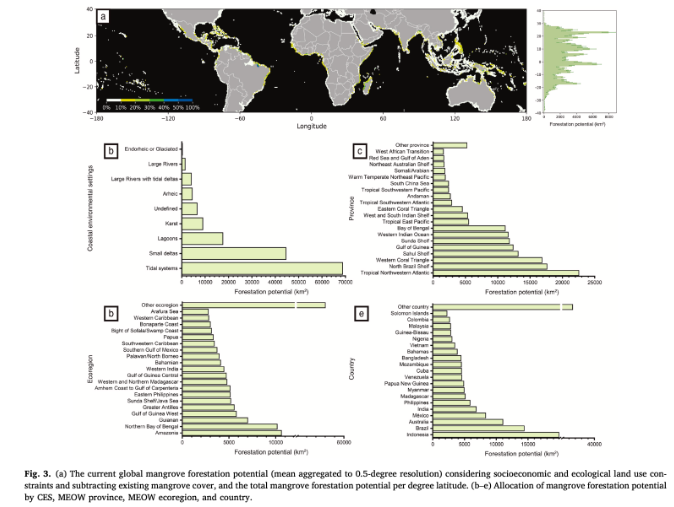
Here is a list of the main takeaways of this paper:
- Global mangrove cover potential reaches 475,671 km², but only 156,682 km² is realistically available for forestation under sustainability constraints.
- Soil moisture and coastal proximity are decisive: soil saturated water content and distance to sea are the strongest predictors of mangrove cover potential, revealing key hydrological and geomorphological controls.
- While warming enables poleward expansion, SSP5-8.5 sea-level rise could reduce current forestation potential by 26,820 km².
- Only 19,361 km² of present forestation potential coincides with areas projected to improve in both climate scenarios, limiting synergistic effects.
- Large but uneven carbon mitigation potential: mangrove forestation could store 6.9 GtC globally, with Indonesia and Brazil leading national carbon storage potential
Read the full paper here: A machine learning framework to assess global mangrove forestation potential under current and future climate scenarios