The potential of enhanced rock weathering for CO2 removal and soil organic carbon storage via organo-mineral aggregation: the trade-off induced by basaltic rock particle size
This week, we deep dive into a paper recently published in Biogeochemistry. The study was led by Puu-Tai Yang, affiliated with the Institute for Agro-Environmental Sciences of the National Agriculture and Food Research Organization in Tsukuba (Japan).
This study investigates how basaltic rock particle size influences CO₂ removal (CDR) via enhanced rock weathering (ERW) and soil organic carbon (OC) storage. Under laboratory conditions simulating soil environments, the authors find that coarse basaltic particles weather faster and thus may be better for CDR. In contrast, fine particles promote organo-mineral aggregation, stabilizing organic matter (OM) but reducing reactive weathering. Surprisingly, fine particles lead to greater OC accrual in aggregates — often far exceeding the actual CO₂ removal potential from weathering. This reveals a trade-off between CDR efficiency and soil OC stabilization driven by rock size. The results suggest current ERW models may overestimate CDR potential if they ignore organo-mineral interactions.
Enhanced rock weathering has emerged as a promising CDR strategy because silicate minerals (like basalt) react with CO₂-bearing solutions, potentially locking atmospheric carbon into dissolved bicarbonate or pedogenic carbonates. Traditional models generally assume that finer crushed rock enhances weathering rates and thus increases CDR potential because of greater surface area. However, in real soils, finely weatherable particles don’t exist in isolation — they interact with living organisms, organic matter, and soil minerals, which can significantly influence both weathering and carbon stabilization mechanisms. This study fills an important gap by experimentally testing how particle size influences not just weathering, but also organo-mineral aggregation and organic carbon storage, under conditions that mimic real soil environments. Such a mechanistic approach, integrating both abiotic and biologically induced processes, adds original insight into the complex interplay between rock weathering and soil carbon dynamics — beyond what simple surface-area rules would predict.
The authors demonstrate that coarse basaltic rock (106–150 µm) shows faster weathering both in sterile (abiotic) and biologically active soil mixtures compared to finer fractions. This supports the idea that in some contexts, larger particles might be more effective for sustained CDR because their surfaces remain accessible for longer, even if their specific surface area is lower. In contrast, fine basaltic particles (20–38 µm) strongly enhance organo-mineral aggregation, binding organic matter into meso-density fractions and increasing soil OC storage by an order of magnitude greater than the CO₂ removal achievable through weathering alone. These aggregates form through physical contact, increased reactive surface area, and release of metal(loid)s that The potential of enhanced rock weathering for CO2 removal and soil organic carbon storage via organo-mineral aggregation: the trade-off induced by basaltic rock particle size
This week, we deep dive into a paper recently published in Biogeochemistry. The study was led by Puu-Tai Yang, affiliated with the Institute for Agro-Environmental Sciences of the National Agriculture and Food Research Organization in Tsukuba (Japan).
This study investigates how basaltic rock particle size influences CO₂ removal (CDR) via enhanced rock weathering (ERW) and soil organic carbon (OC) storage. Under laboratory conditions simulating soil environments, the authors find that coarse basaltic particles weather faster and thus may be better for CDR. In contrast, fine particles promote organo-mineral aggregation, stabilizing organic matter (OM) but reducing reactive weathering. Surprisingly, fine particles lead to greater OC accrual in aggregates — often far exceeding the actual CO₂ removal potential from weathering. This reveals a trade-off between CDR efficiency and soil OC stabilization driven by rock size. The results suggest current ERW models may overestimate CDR potential if they ignore organo-mineral interactions.
Enhanced rock weathering has emerged as a promising CDR strategy because silicate minerals (like basalt) react with CO₂-bearing solutions, potentially locking atmospheric carbon into dissolved bicarbonate or pedogenic carbonates. Traditional models generally assume that finer crushed rock enhances weathering rates and thus increases CDR potential because of greater surface area. However, in real soils, finely weatherable particles don’t exist in isolation — they interact with living organisms, organic matter, and soil minerals, which can significantly influence both weathering and carbon stabilization mechanisms. This study fills an important gap by experimentally testing how particle size influences not just weathering, but also organo-mineral aggregation and organic carbon storage, under conditions that mimic real soil environments. Such a mechanistic approach, integrating both abiotic and biologically induced processes, adds original insight into the complex interplay between rock weathering and soil carbon dynamics — beyond what simple surface-area rules would predict.
The authors demonstrate that coarse basaltic rock (106–150 µm) shows faster weathering both in sterile (abiotic) and biologically active soil mixtures compared to finer fractions. This supports the idea that in some contexts, larger particles might be more effective for sustained CDR because their surfaces remain accessible for longer, even if their specific surface area is lower. In contrast, fine basaltic particles (20–38 µm) strongly enhance organo-mineral aggregation, binding organic matter into meso-density fractions and increasing soil OC storage by an order of magnitude greater than the CO₂ removal achievable through weathering alone. These aggregates form through physical contact, increased reactive surface area, and release of metal(loid)s that act as binding agents. The results reveal a clear trade-off: fine particles stabilize organic carbon, potentially boosting soil fertility and long-term carbon storage, but simultaneously impede further weathering and reduce the effective carbon removal capacity. Therefore, models that ignore aggregation processes may overestimate the net CDR benefits of basalt ERW in natural soils, highlighting the need to integrate organo-mineral interactions into predictive frameworks.
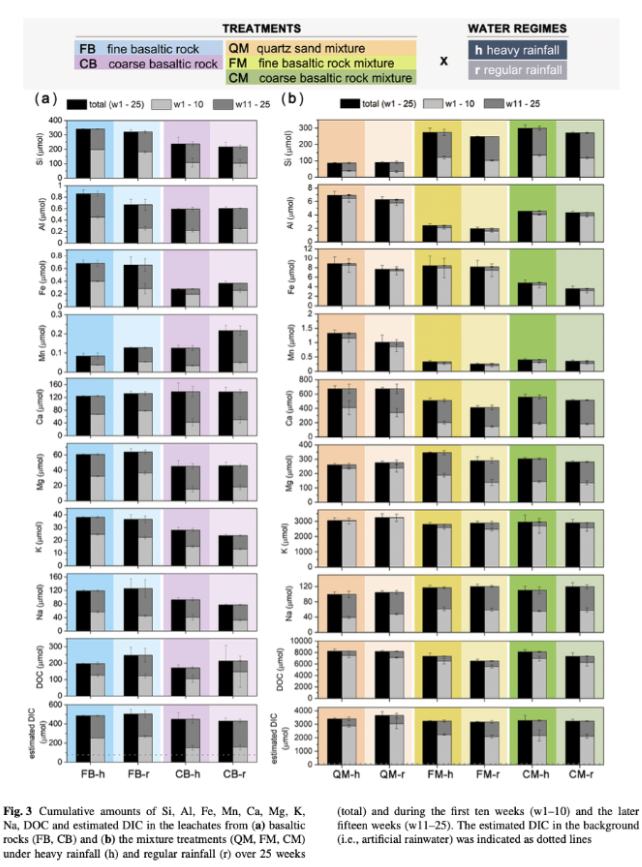
Here is a list of the main takeaways of this paper:
- Particle size matters: coarse basaltic particles weather faster in both abiotic and biologically active settings, suggesting better removal per unit rock in soil environments.
- Fine particles strongly promote soil organic carbon accrual through aggregation far beyond the carbon removed by weathering alone.
- There’s a fundamental trade-off between enhanced weathering (CDR) and organic carbon stabilization, controlled by particle size.
- Model implications: Current ERW models likely overestimate CO₂ removal potential if they neglect soil aggregation and OM interactions.
- Soil dynamics are complex: Biological activity and soil water regimes influence both weathering and aggregation, underscoring the need for integrated experimental and model approaches.
Read the full paper here: The potential of enhanced rock weathering for CO2 removal and soil organic carbon storage via organo-mineral aggregation: the trade-off induced by basaltic rock particle size