UPTAKE Webinar Series: Technology, Geography and Collaboration Networks: Assessing Global Innovation and Research Funding Patterns for Carbon Removal

The next webinar on the latest published papers on carbon dioxide removal (CDR) research will focus on the paper ‘Technology, Geography and Collaboration Networks: Assessing Global Innovation and Research Funding Patterns for Carbon Removal’.

:studio_microphone:Speakers: Livia Fritz, University of Geneva, Finn Müller-Hansen, Potsdam Institute for Climate Impact Research (PIK)

:studio_microphone: Moderator: Kavita Surana, Vienna University of Economics and Business

:spiral_calendar: 11 March 2026, 2 pm - 3pm I ZOOM, online

Register in advance :backhand_index_pointing_right: here.

Abstract:

In addition to strong global emission cuts, experts see the rapid upscaling of carbon dioxide removal (CDR) as paramount for reaching the Paris agreement target. A comprehensive view of research and innovation dynamics is crucial for the rigorous assessment of the potentials of CDR options and for guiding strategies to close knowledge gaps. Here, we investigate funding patterns in CDR research across time, geographies and fields of research and identify key organizations and actors in collaboration networks. We use comprehensive search queries and machine learning to identify more than 6000 research grants on twelve different CDR options. Research funding increased strongly over the past 30 years (21% p.a.), more than funding for climate science and technology. In comparison to carbon capture and storage, CDR receives a higher number of grants, but less total funding, estimated at 4.2 bn$. Funding is highly concentrated in Europe and North America and mostly directed towards natural, engineering and agricultural science, with little but increasing support for social science. European funding seems to encourage research in larger consortia. However, our analysis finds little funding specifically targeted at CDR, highlighting potentials for strategic initiatives for accelerating innovation in CDR.

The webinar format will consist of a 20-minute presentation and a 10-minute discussion with an invited expert stakeholder, followed by a 30-minute open discussion (1 hour total).
Looking forward to this discussion today.
What do you think is the underlying reason on why CDR has received a higher number of grants in comparison to CCS although it has received less total amount of funding?

If you missed the webinar, the full record is available here :backhand_index_pointing_down:

During the webinar, the session focused on global research funding patterns for Carbon Dioxide Removal (CDR), examining how funding is distributed across technologies, regions, disciplines, and collaboration networks. The presentation highlighted the importance of research funding as an early-stage driver of innovation and explored what current funding trends may imply for the future scale-up, governance, and legitimacy of CDR.

Key takeaways:

  • Research funding for CDR has increased over time, but still represents only a relatively small share of broader climate and cleantech research funding, underlining that CDR remains a growing but still limited field of strategic investment.
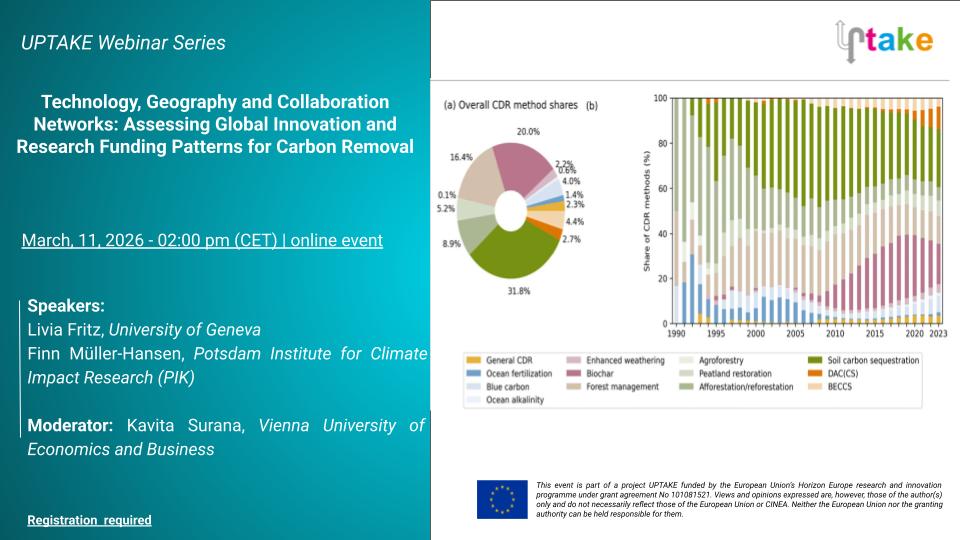
  • Funding is concentrated in a few methods, with the largest shares going to forest-based CDR, soil carbon sequestration, and biochar, while more novel approaches such as DAC and BECCS have grown more strongly in the past 10–15 years.
  • The analysis showed a strong geographical concentration in the Global North, particularly in the US and Europe, with comparatively little funding reaching organizations in the Global South, despite the fact that many CDR deployment scenarios assume large-scale implementation there.
  • Across disciplines, most funding goes to natural sciences, agricultural sciences, and engineering, while social sciences and humanities remain comparatively underfunded and often play only a limited role within larger technical consortia.
  • Collaboration patterns suggest that most partnerships take place within regions rather than across them, and that there is still relatively limited collaboration between research and practice, especially compared with adjacent fields such as CCS.
  • The discussion highlighted the need for more strategic and targeted funding programmes, stronger Global North–Global South partnerships, and greater support for interdisciplinary and social science research to better address governance, justice, legitimacy, and deployment-related trade-offs as CDR moves closer to real-world implementation.