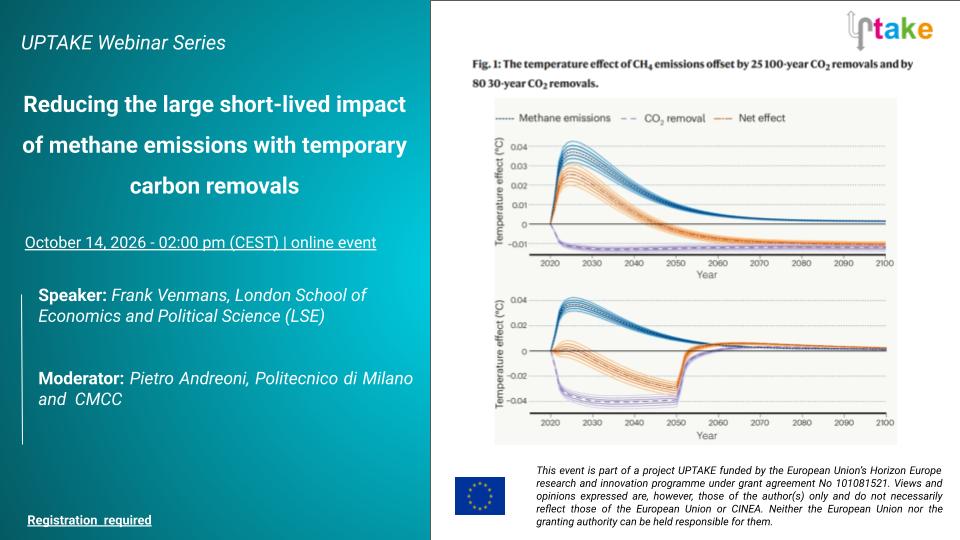
The next webinar on the latest published papers on carbon dioxide removal (CDR) research will focus on the paper Reducing the large short-lived impact of methane emissions with temporary carbon removals
 Speaker: Frank Venmans, Grantham Institute on Climate Change at The London School of Economics and Political Science (LSE)
Moderator: Pietro Andreoni, Politecnico di Milano and CMCC Foundation
 14 October 2026, 2 pm - 3pm (CEST) I ZOOM, online
Register in advance  here.
Abstract:
Methane has a much larger short-term warming effect than CO2, even though CO2’s effect is smaller but far more persistent over time. This paper argues that offsetting methane emissions with temporary, time-matched CO2 removals, rather than with permanent removals calibrated to an arbitrary time horizon, avoids unfairly transferring climate damages between generations. Using a welfare-based equivalence approach, the authors estimate that around 87 one-tonne, 30-year temporary CO2 removals are needed to offset the damages caused by 1 tonne of methane, and show this ratio stays fairly stable regardless of the discount rate, damage assumptions, or emissions scenario used. They conclude that 20–30 year monitoring periods for nature-based removal projects are more credible and easier to enforce than long-term commitments, offering a practical route for integrating temporary CO2 removal into methane-offset strategies.
The webinar format will consist of a 20-minute presentation and a 10-minute discussion with an invited expert stakeholder, followed by a 30-minute open discussion (1 hour total).
The webinar explored how temporary carbon dioxide removals can be used to compensate for methane emissions , based on research presented by Frank Venmans from the London School of Economics and Political Science. The discussion focused on matching the duration of carbon storage with methane’s relatively short-lived warming effect, as well as the economic valuation and practical implications of temporary removals.
Key takeaways:
- Temporary carbon removals have a positive climate and economic value , even if the stored carbon is eventually released back into the atmosphere.
- Methane emissions and temporary CO₂ removals operate over similar time horizons , making temporary storage particularly suitable for compensating methane’s short-lived warming impact.
- Contracts lasting around 30 years can minimise the transfer of warming impacts between generations. Shorter or longer durations may also be appropriate depending on the project.
- The proposed welfare-based approach and Global Warming Potential (GWP) calculations produce similar equivalence ratios , although the welfare-based method accounts for factors such as future climate damages and discounting.
- The risk of carbon storage failure matters when calculating the amount of removal required. The framework can account for risks and changing carbon stocks in projects such as forests, soils and wood products.
- The distinction between biogenic and fossil methane is important : fossil methane also produces a lasting CO₂ effect when it oxidises, requiring additional compensation beyond its short-term warming impact.
Additional resource: Frank Venmans also shared an Excel tool that allows users to enter a project’s carbon storage trajectory and calculate its social value. The file, value of an offset.xlsx , is available on GitHub.