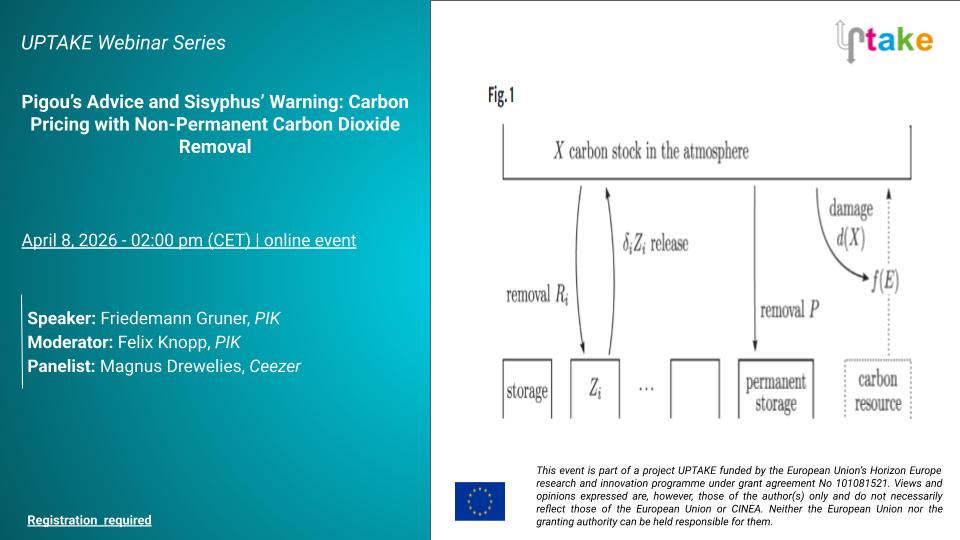
This paper develops a welfare and public economics perspective on optimal policies for carbon removal and storage (CDR) in permanent and non-permanent sinks. Non-permanent CDR reduces mitigation costs, even though the stored carbon is released into the atmosphere eventually. It may serve as bridge technology until permanent CDR becomes available. In contrast to permanent removals, non-permanent CDR does not reduce the optimal long-run temperature level. Its valuation differs from the social cost of carbon since a social cost of carbon removal arises from marginal damages caused by emissions released from non-permanent storage. We discuss three policy regimes that ensure optimal deployment of non-permanent CDR in terms of their informational and institutional requirements for monitoring, liability, and financing.
The webinar format will consist of a 20-minute presentation and a 10-minute discussion with an invited expert stakeholder, followed by a 30-minute open discussion (1 hour total).
During the webinar, the session focused on how non-permanent Carbon Dioxide Removal (CDR) should be valued and priced, and what role it can play in long-term climate mitigation. The discussion examined the economic differences between permanent and non-permanent carbon removal, highlighted the policy challenges created by different storage durations, and connected these theoretical insights to current developments in the voluntary carbon market.
Key takeaways:
Non-permanent CDR can generate climate benefits, but its value is lower than that of permanent CDR because stored carbon may be released again in the future and often requires ongoing maintenance and risk management.
The presentation introduced the idea that non-permanent removal creates not only benefits today, but also future costs, including the climate damages associated with re-release and the costs of maintaining the sink over time.
A central result was that non-permanent CDR is most useful during the transition period, as it can temporarily reduce atmospheric CO₂ and lower cumulative damages while more durable mitigation and permanent CDR scale up.
In the long run, however, non-permanent CDR may increasingly be needed just to offset its own release emissions, meaning it cannot substitute for permanent removal in achieving durable climate stabilization.
The discussion also emphasized that permanence is not a simple binary distinction, but rather a continuum of storage durations, and that this is increasingly reflected in market practice and pricing.
From a policy perspective, the session highlighted the need for instruments that account for the cost of non-permanence, for example through differentiated subsidies, storage-based incentives, or pricing schemes that reflect reversal risks and long-term maintenance obligations.
From a market perspective, buyers appear to be gradually moving from avoidance credits to non-permanent removals and then toward more permanent removals, although permanent CDR still remains far more expensive and limited in near-term supply.
A broader conclusion from both the theoretical and practical discussion was that voluntary demand alone is unlikely to deliver the scale of permanent CDR needed, and that clearer policy guidance and stronger compliance-based incentives will likely be required.
If you’d like to continue the discussion, feel free to share your questions or reflections below.
 Speaker: Friedemann Gruner, PIK
 8 April 2026, 2 pm - 3pm I ZOOM, online
 here.
here.