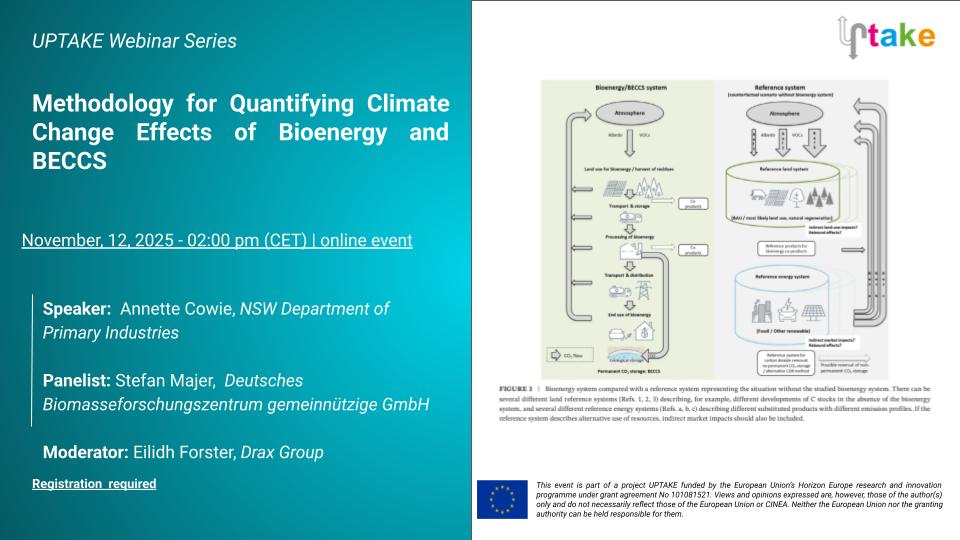
During the webinar, the session focused on the role of biomass-based systems, especially bioenergy with carbon capture and storage (BECCS), in delivering reliable and sustainable Carbon Dioxide Removal (CDR). The presentation introduced methodological guidance for assessing biomass emissions, highlighted the diversity of biomass systems across regions, and discussed how life-cycle approaches, counterfactuals and time-dynamics shape the credibility of claimed removals.
Some key takeaways from the moderated discussion with the participation of invited experts:
Biomass systems differ widely, making standardized assessment complex.
Panelists emphasized that sustainability outcomes depend heavily on local conditions, feedstock type, land-use history and management practices. There is no “one size fits all”. A biomass pathway can lead to very different climate results depending on counterfactual land use and the reference baseline.
Time dynamics matter for climate benefits.
Speakers noted that many biomass systems have complex temporal dynamics: carbon is stored in biomass, but emissions and uptake occur at different times. This means that evaluating climate outcomes requires long-term system boundaries rather than short-term emission snapshots.
The importance of counterfactual scenarios and substitution effects.
Assessing biomass benefits requires understanding what would happen without the biomass use. Depending on the alternative energy source or land use, biomass can either provide meaningful mitigation or deliver limited or no climate benefit.
MRV for biomass-based removals must be rigorous and transparent.
Although not yet fully standardized, panelists agreed that credible MRV frameworks must account for land-use impacts, permanence of storage, supply-chain emissions and potential leakage. Approaches relying solely on point-of-combustion emissions are insufficient for CDR.
Policy frameworks need to better distinguish between renewable energy and carbon removal.
Experts highlighted that current policies often reward bioenergy as a renewable energy source, not as a carbon removal pathway. This does not incentive bioenergy with carbon capture and storage (CCS), where actual removals occur.
Clear demand signals for permanent CO₂ storage are essential.
Speakers stressed that without explicit policy drivers for carbon removal, bioenergy with CCS will struggle to scale. Targeted incentives for long-term storage, harmonized sustainability criteria and clear accounting rules for CDR are key steps forward.
Cowie_UPTAKE_Nov12_presentation.pdf (6.1 MB)
 Speaker: Annette Cowie, Senior Principal Research Scientist, Climate at NSW Department of Primary Industries
 12 November 2025, 2 pm - 3 pm I ZOOM, online
 here.
here. The webinar format will consist of a 20-minute presentation and a 10-minute discussion with an invited expert stakeholder, followed by a 30-minute open discussion (1 hour total).