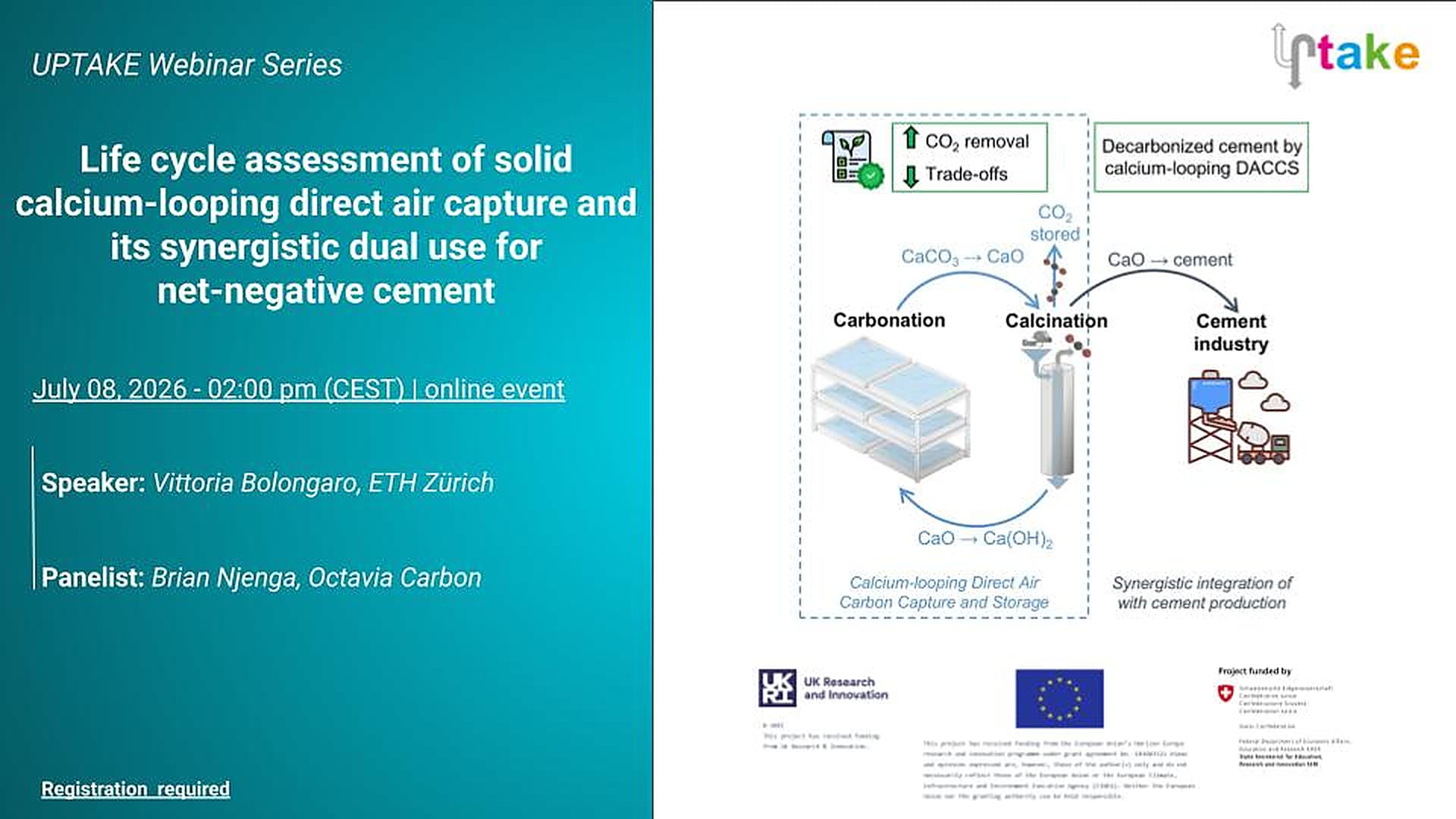
Calcium-looping direct air carbon capture and storage (DACCS) is a mature technology with potential for gigatonne-scale carbon dioxide removal (CDR), yet its environmental impacts remain insufficiently quantified. Here, we present the first prospective life cycle assessment of large-scale calcium-looping DACCS based on primary industrial data. Our results show high net CDR efficiencies of 85%–96% by 2050. Removing 1 Gt of CO2 would use less than 2.8% of the world’s safe operating space defined by the planetary boundaries. Hotspots, including particulate matter and water toxicity, mainly arise from the energy supply chain rather than the capture process. We also demonstrate promising synergies with cement production: cycling the calcium-based sorbent through the direct air capture (DAC) unit once before use as cement feedstock yields a carbon footprint of −0.15 tCO2-eq. per tonne of cement. These findings establish calcium-looping DACCS as both a competitive CDR pathway and a powerful tool for cement decarbonization.
The webinar format will consist of a 20-minute presentation and a 10-minute discussion with an invited expert stakeholder, followed by a 30-minute open discussion (1 hour total).
The webinar focused on the environmental performance of solid calcium-looping direct air capture and storage (DACCS), with particular emphasis on its integration with cement production. The central theme was that calcium-looping DACCS can achieve high net CO2 removal on its own, and that integrating it with cement production (by sharing limestone feedstock and calcination infrastructure) can cut cement’s carbon footprint and potentially make cement production net-negative. The webinar also highlighted the value of close collaboration between academia and industry in producing more realistic assessments of emerging carbon removal technologies.
First the speaker presented a prospective life cycle assessment of calcium-looping direct air capture and storage (DACCS), covering both the standalone DACCS system and its integration with cement production. The research was carried out in close collaboration with Heirloom Carbon Technologies, the company commercialising calcium-looping DACCS, and combined scaled-up data from Heirloom’s first commercial plant with prospective scenarios for future electricity systems and industrial supply chains to project the performance of larger, mature facilities. This partnership helped ground the study in data from an operating plant, informing how first-of-a-kind and nth-of-a-kind plants might perform under future deployment conditions.
The assessment showed that integrating calcium-looping DACCS with cement production, by sharing limestone feedstock and calcination infrastructure, can substantially cut cement’s carbon footprint and enable net-negative cement production. For the standalone DACCS system, results showed that carbon removal efficiency depends strongly on the carbon intensity of the energy supply, improving substantially as electricity systems become increasingly decarbonized. The presentation emphasized that prospective life cycle assessment can help identify the most promising technology configurations before large-scale deployment and highlight where environmental trade-offs may arise.
Drawing on his experience at Octavia Carbon, Brian Njenga reflected on how prospective life cycle assessment can support the deployment of commercial DAC projects by identifying environmental hotspots and helping developers understand where better operational data are needed. Much of the discussion centred on the relationship between academic life cycle assessment and measurement, reporting and verification (MRV). Njenga noted that while prospective LCA is valuable for evaluating future deployment pathways, robust MRV relies on primary operational data and transparent verification once projects are in operation. Together, the speakers emphasised that collaboration between researchers and technology developers is essential for bridging prospective modelling with real-world implementation. Njenga also highlighted the need for more regionalised datasets, noting that existing life cycle databases do not always adequately represent regions such as Africa, despite their significant potential for low-carbon DAC deployment supported by abundant renewable energy resources (e.g. geothermal energy).
Audience questions centred on how the proposed calcium-looping DAC integration should be positioned within cement decarbonisation pathways. Responding to a question on whether the concept had been benchmarked against conventional point-source carbon capture at cement plants, Vittoria Bolongaro explained that the paper does not compare the two approaches directly. Instead, she offered that the integrated system is best understood as a potential upgrade path from cement CCS. In the paper’s model, the baseline case (N=0) electrifies the cement kiln’s calcination step and separates the resulting calcination CO2, a setup functionally similar to a calcium-looping CCS retrofit. Cycling additional calcium oxide through the DAC unit (N>0) then adds atmospheric carbon removal on top of that baseline, opening a path to net-negative cement that point-source capture alone cannot reach. In closing the session, the moderator noted that several audience questions could not be addressed due to time constraints, including questions on the wider co-benefits of the integrated system and whether by-products could be utilised in applications such as agriculture or enhanced rock weathering to further increase environmental and climate benefits. The participants were invited to continue the discussion through the project’s stakeholder platform.
 Speaker: Vittoria Bolongaro, ETH Zürich
 8 July 2026, 2 pm - 3pm (CEST) I ZOOM, online
 here.