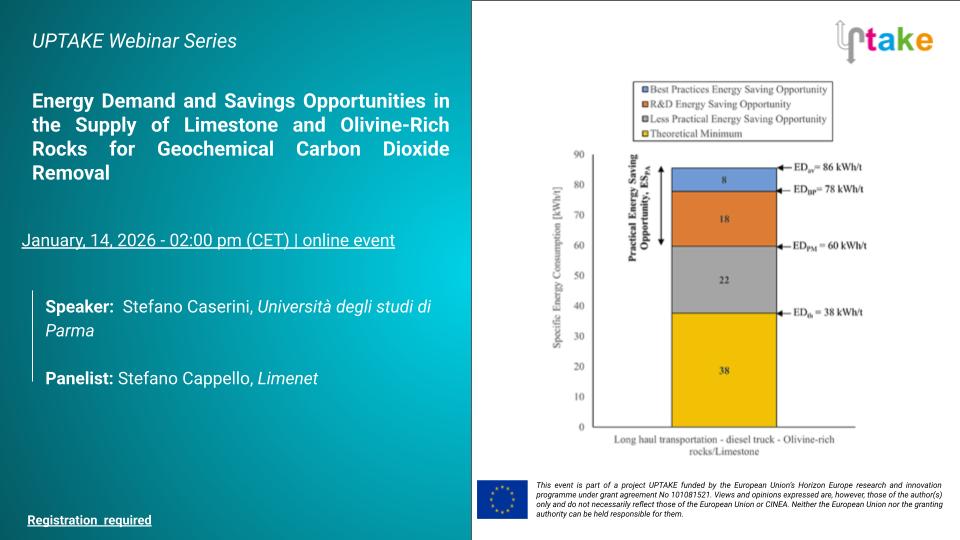
The large-scale implementation of geochemical Carbon Dioxide Removal (CDR) approaches such as Enhanced Weathering (EW) and Ocean Liming (OL) will require the extraction and processing of large amounts of limestone and olivine-rich rocks. Based on a literature review, surface mining, comminution, their related sub-stages, and long-haul transportation have carefully been surveyed to elucidate the order of magnitude of the energy demand, the technical challenges posed by each operation, and the potential energy-savings achievable by applying opportune strategies. This work confirms the significant energy-saving opportunities in fine and ultrafine grinding (one of the most energy-consuming activities along the raw material supply chain) as underlined by previous studies, and, in addition, it focuses on limestone and olivine-rich rocks providing new outcomes, it analyses data from a climate change perspective and extends calculations and discussion to transportation. The results show that the implementation of energy-saving strategies (cutting-edge energy efficiency solutions and best practices) to comminute such materials for OL and EW purposes in the near-medium term (2025–2050) would reduce the average electricity demand by 33%–65% in case of low carbon removal target (up to 27 MtC yr−1) and substantial energy efficiency improvement, and by 33%–36% in case of high carbon removal target (up to 69 MtC yr−1) and poor energy efficiency improvement.
The webinar format will consist of a 20-minute presentation and a 10-minute discussion with an invited expert stakeholder, followed by a 30-minute open discussion (1 hour total).
During the webinar, the session focused on the energy demand and scaling challenges of mineral-based Carbon Dioxide Removal (CDR), with particular attention to ocean alkalinity enhancement and enhanced weathering. The discussion explored how energy intensity, process efficiency, and supply-chain constraints influence the feasibility and scalability of these geochemical CDR pathways, drawing on both analytical research and emerging industrial experience.
Some key takeaways from the discussion:
Mineral-based CDR is intrinsically energy-intensive. Large-scale deployment of ocean alkalinity enhancement and enhanced weathering would require gigaton-scale extraction, processing, and grinding of limestone and olivine-rich rocks. Energy demand—particularly for fine and ultra-fine grinding—emerges as the dominant bottleneck across the supply chain.
Significant energy-saving potential exists along the supply chain. Detailed analysis of mining, comminution, and transport stages shows that practical energy savings of up to 35–55% could be achieved through best practices, technological learning, and targeted R&D, especially in grinding processes.
Future feasibility depends on energy system decarbonisation. While current mining and processing largely rely on fossil-based electricity, speakers stressed that long-term viability assumes a largely decarbonised power system, with electric calciners potentially operating flexibly during periods of renewable electricity surplus.
Limestone availability is not a binding constraint at global scale. Geological assessments indicate vast limestone resources, including large volumes located close to coastlines. In addition, a substantial share of finely ground limestone currently discarded by quarries could be repurposed, reducing competition with cement and lime industries.
Industrialisation is already underway, but at early TRLs. LimeNet presented pilot-scale demonstrations combining electric calcination, CO₂ capture, and bicarbonate storage, with current technology readiness levels ranging from TRL 5–7 depending on the process component. Costs remain high at pilot scale but are expected to decline with scale, learning, and cheaper electricity.
Costs are dominated by electricity prices and scale. Current pilot estimates exceed €1,000 per tonne of CO₂ removed, while future large-scale deployments could potentially reach the €100–250/tCO₂ range under favourable energy cost assumptions—still above conventional mitigation options but relevant for residual emissions.
Environmental risks are manageable but require careful design. Marine impacts depend strongly on discharge rates and local concentrations. While ocean alkalinity enhancement can counteract acidification, improper deployment could lead to local pH spikes or carbonate precipitation, underlining the need for controlled dispersion and robust MRV.
Regulation and permitting are the main near-term barriers. Speakers consistently identified permitting procedures, legal uncertainty, and the absence of dedicated regulatory frameworks as the key obstacles to experimentation and scale-up, potentially deterring investment despite technological progress.
MRV is central for credibility and market uptake. Monitoring, reporting, and verification in open-ocean systems remains challenging but essential for future integration into carbon markets or compliance frameworks. Continued methodological development is needed to reduce uncertainty.
A full-chain perspective strengthens policy relevance. The webinar highlighted the importance of linking theory, modelling, industrial processes, and real-world pilots—moving mineral-based CDR from conceptual pathways toward implementable options within a broader decarbonisation strategy.
 Speaker: Stefano Caserini, Università degli studi di Parma
 14 January 2026, 2 pm - 3 pm I ZOOM, online
 here.
here.