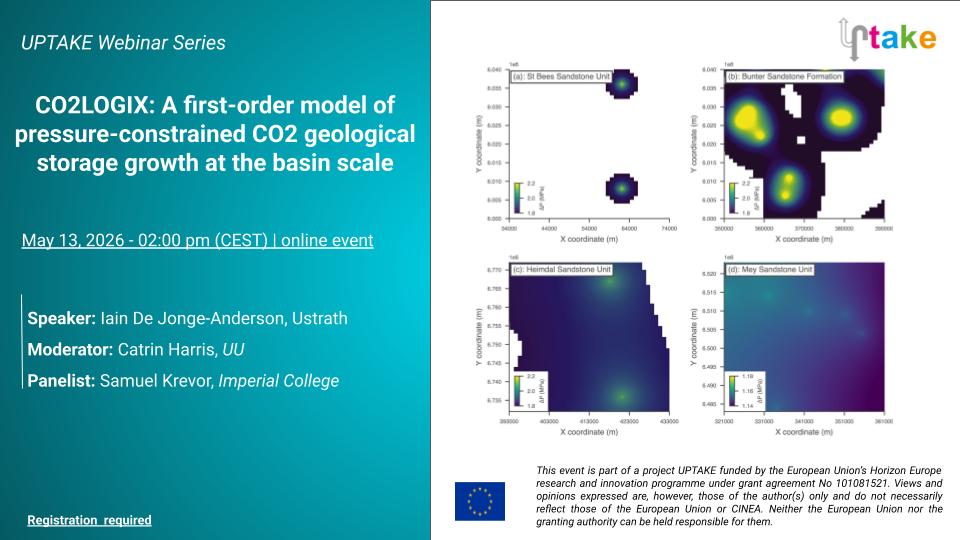
The next webinar on the latest published papers on carbon dioxide removal (CDR) research will focus on the paper CO2LOGIX: A first-order model of pressure-constrained CO2 geological storage growth at the basin scale.
 Speaker: Iain de Jonge-Anderson, University of Strathclyde
Moderator: Catrin Harris, Utrecht Univerity
Panelist: Samuel Krevor, Imperial College
 13 May, 2 pm - 3pm I CEST ZOOM, online
Register in advance  here.
here.
Abstract:
Large-scale geological CO₂ storage faces a critical but underestimated constraint: subsurface pressure buildup from injection can progressively limit storage capacity over time, yet most climate-policy frameworks, including IAMs, still rely on static capacity estimates that ignore this dynamic. The authors introduce CO2LOGIX, a computationally efficient model that simulates pressure evolution under different CO₂ injection growth scenarios. Applied to a UK case study, the model shows that unmitigated pressure reaches its upper limit after 83 years, with near-term storage rates still falling short of recommended targets. Faster growth scenarios worsen the problem, shrinking available capacity or requiring costly mitigation. The study calls for incorporating realistic pressure feedbacks into IAMs, and positions CO2LOGIX as a practical tool for managing pressure constraints in large-scale CCS deployment.
The webinar format will consist of a 20-minute presentation and a 10-minute discussion with an invited expert stakeholder, followed by a 30-minute open discussion (1 hour total).
Dear everyone!
The monthly webinar is starting very soon and we have a pleasure of introducing our today’s panelist!
Sam Krevor is a Professor and Shell/Royal Academy of Engineering Senior Research Fellow at Imperial College London. He leads the Subsurface CO2 Research Group investigating a range of issues in application to CO2 storage underground, including fundamental pore scale fluid dynamics and digital rocks, field scale reservoir simulation, and regional scale resource assessment and use. Particularly of relevance to this webinar are his contributions to CO2BLOCK – a modelling tool to predict pressure-constrained capacity for different well configurations, and his pioneering of the use of techno-economic growth curves to evaluate the scaleup of CO2 storage.
Furthermore, here are some questions posed by Samuel, which may be valuable to consider during today’s dicussion:
- Suitability of National and regional assessments: National and regional assessments are increasing around the world. How suitable are they for estimating the global storage resource base compared with self-consistent global models? Are existing approaches, such as GIS-based screening methods, fit for purpose?
- Storage capacity as limiting factor in IAMs: To what extent is storage capacity a limiting factor in IAMs, and how do projected storage demands compare with current capacity estimates?
- Importance of injectivity and scale up constraints: How much CO₂ has actually been stored to date, and how should long-term storage scale-up and injectivity constraints be represented in models?
2 Likes
This webinar focused on the engineering and technoeconomic challenges of scaling up CO2 geological storage; a key component of novel carbon dioxide removal (CDR) technologies.
The main theme was pressure-constrained geological storage. The speaker explained that although many underground storage formations can theoretically store vast quantities of CO2, the actual injection rate is limited by pressure buildup within reservoirs. This means that a more pragmatic, dynamic storage capacity depends not only on available underground space, but also on how pressure changes over time during injection.
The speaker also compared current and near-term projections of global CO2 storage activity with the levels required in climate mitigation scenarios. Existing storage projects remain far below the scale needed to meet many net-zero pathways, which assume rapid growth in storage infrastructure over the coming decades.
To address these challenges, the speaker introduced a first-order modelling approach for estimating how storage capabilities could grow under both pressure constraints and informed growth trajectories. The broader discussion highlighted the importance of understanding geological and engineering limitations when assessing the future role of CDR in climate mitigation strategies.
Other important discussion points included:
- The purpose of global geological storage estimates, how they are derived, and the uncertainty within them
- How Integrated Assessment Models might incorporate this uncertainty in climate change mitigation scenarios.
- The difference between theoretical and dynamic storage capacity.
If you’d like to continue the discussion, feel free to share your questions or reflections below.
3 Likes
Hello, the slides from this webinar can be accessed here:
UPTAKE Webinar Iain dJA.pdf (3.1 MB)
3 Likes
If you missed the latest webinar, here is the full record 
https://youtu.be/8JeD-Zve1tc
1 Like