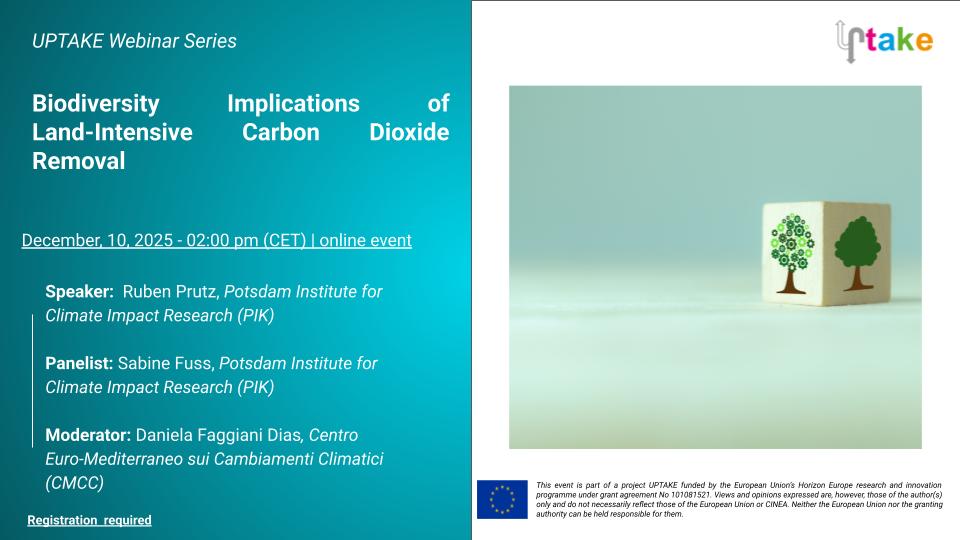
The next webinar of the latest published papers on carbon dioxide removal (CDR) research will focus on the paper ‘Biodiversity Implications of Land-Intensive Carbon Dioxide Removal’.
Pathways aligned with global climate goals typically rely on deploying billions of tonnes of carbon dioxide removal (CDR) through land-intensive approaches such as forestation and bioenergy with carbon capture and storage. However, using these methods at large scale can pose risks to biodiversity. In this study, we examine scenarios from five integrated assessment models and find that pathways consistent with limiting warming to 1.5 °C dedicate as much as 13% of global areas of high biodiversity importance to land-intensive CDR. These overlaps are unevenly distributed, with a greater share occurring in low- and middle-income countries. Recognizing potential conflicts between climate action and biodiversity conservation is essential. An illustrative analysis suggests that if today’s biodiversity hotspots were shielded from land-use change, more than half of the land assigned to forestation and BECCS in the assessed scenarios would no longer be available, unless synergies between climate and conservation goals are leveraged. Our results also point to biodiversity benefits from CDR associated with avoided warming.
The webinar format will consist of a 20-minute presentation and a 10-minute discussion with an invited expert stakeholder, followed by a 30-minute open discussion (1 hour total).
During the webinar, organised within the monthly Carbon Dioxide Removal (CDR) series by CMCC as part of the UPTAKE project, Ruben Prütz presented ongoing research on the biodiversity implications of land-intensive CDR. The presentation focused on how forestation and bioenergy with carbon capture and storage (BECCS) interact with areas of high biodiversity importance under different mitigation scenarios. The discussion was moderated by Daniela Dias, with Sabine Fuss as panelist and co-author of the study.
Some key takeaways from the discussion:
Land-intensive CDR significantly overlaps with biodiversity areas. Integrated Assessment Model (IAM) scenarios compatible with 1.5°C rely heavily on forestation and BECCS, which spatially overlap with climate refugia and biodiversity hotspots.
Ambitious climate scenarios show particularly large overlap with biodiversity areas. More stringent mitigation pathways allocate more land to CDR, including within remaining climate refugia. This reflects a risk-risk trade-off: avoiding climate damages through CDR may simultaneously create new pressures on ecosystems.
Forestation-related land allocation is unevenly distributed across regions. Model results consistently show higher shares of forestation-related land allocation in non-high-income countries, raising concerns around fairness and environmental justice—particularly as many of these regions have contributed least to historical emissions.
Net biodiversity outcomes depend strongly on assumptions about overshoot recovery. Whether CDR delivers net benefits or net harm hinges on assumptions about biodiversity’s ability to recover after peak warming. If recovery is limited, the avoided-warming benefits of CDR may not compensate for land-use impacts.
Protecting biodiversity may challenge CDR deployment. Excluding current biodiversity hotspots from land allocation could render over 50% of scenario-based land for forestation and BECCS unavailable. This does not imply that equivalent shares of CDR become infeasible, but rather that deployment would shift to less cost-effective areas or require diversification toward other mitigation options.
Models show distinct land allocation patterns. While IAMs differ substantially in terms of land allocation patterns,the study highlights areas of partial model agreement. In many of these consensus areas, CDR may be considered unsuitable from an ecosystem perspective.
The study may inform more biodiversity-sensitive scenario development. The study may inform future scenario modelling in moving from ex-post sustainability assessments toward scenarios that integrate biodiversity and other sustainability constraints directly during scenario design.
Governance and regulation are essential. The panel discussion emphasized that high-quality CDR deployment cannot rely on carbon markets alone. Regulatory instruments are needed.
 Speaker: Ruben Prutz, Potsdam Institute for Climate Impact Research (PIK)
 10 December 2025, 2 pm - 3 pm I ZOOM, online
 here.
here. The webinar format will consist of a 20-minute presentation and a 10-minute discussion with an invited expert stakeholder, followed by a 30-minute open discussion (1 hour total).