Abstract:
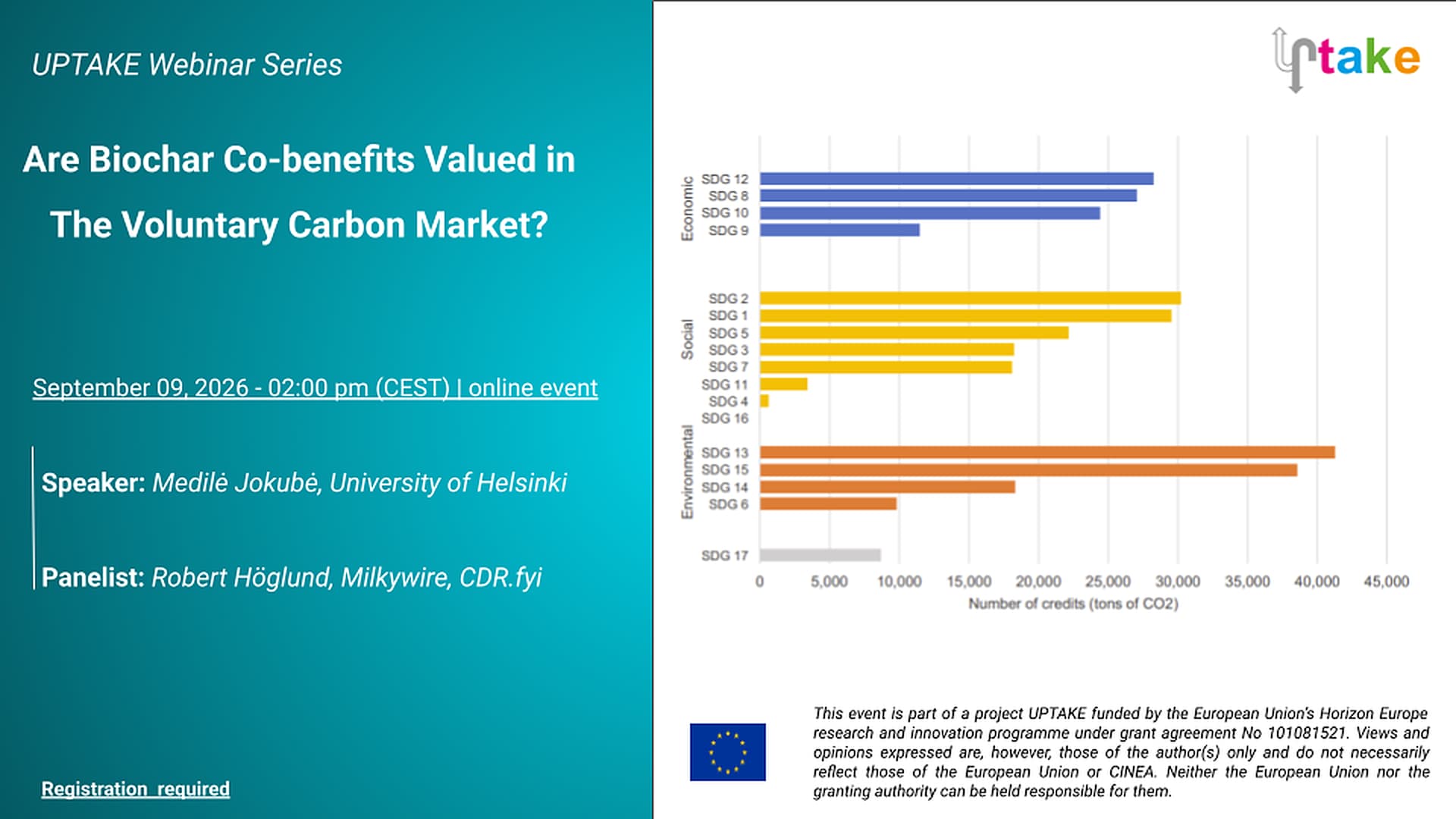
Climate mitigation pathways towards global net-zero emissions targets commonly include large-scale deployment of carbon dioxide removals. Investment in novel carbon dioxide removal technologies is currently driven by the self-steering voluntary carbon market. Here we assess whether the upscaling of biochar carbon dioxide removals via voluntary carbon market can deliver sustainable development co-benefits. We use hedonic pricing to estimate how Sustainable Development Goal claims are reflected in biochar carbon credit prices in transactions up to 2024. The results show that biochar carbon credit prices increase by 0.14% for each 1% increase in associated co-benefit claims. Grouping co-benefit claims into environmental, economic, and social pillars reveals that credits with more economic claims tend to be priced higher, while those with more environmental claims tend to be priced lower. Since the market values co-benefit claims, auditing them is critical to verify their genuine contributions and to maintain the integrity of novel carbon dioxide removals.
The webinar format will consist of a 20-minute presentation and a 10-minute discussion with an invited expert stakeholder, followed by a 30-minute open discussion (1 hour total).
The webinar explored how the voluntary carbon market values the co-benefits associated with biochar carbon removal, based on new empirical research into biochar credit prices. The discussion combined research findings with a market perspective on what drives buyers’ choices and what this could mean for the future development of novel CDR market.
Key takeaways:
• Biochar credits with more advertised SDG claims are associated with higher prices, suggesting that buyers value biochar attributes beyond carbon removal itself.
• Buyers differentiate the SDG claims. Economic co-benefits showed the strongest positive relationship with prices and environmental co-benefits were associated with a discount. While the result shows positive association for social benefits, the result is statistically weak.
• Biochar credits are therefore not perfectly substitutable: biochar project location, co-benefit claims and other characteristics can influence buyers’ willingness to pay.
• Experience from the market confirms that buyers may be willing to pay more for projects with strong economic co-benefits, particularly those supporting local livelihoods and incomes. However, this relationship is more important for the initial smaller volume purchases and may reduce as the transactions volumes increase.
• A key challenge is that most advertised co-benefits are currently not systematically verified. Since the buyers seem to be paying a premium for these claims, stronger auditing will be important to avoid SDG claim inflation and ensure their delivery.
• The voluntary carbon market plays an important role in the initial developing of novel CDR market, but both speakers suggested that larger-scale novel CDR deployment will ultimately depend on its integration into compliance markets.
 Speaker: Medilė Jokubė, University of Helsinki
 9 September 2026, 2 pm - 3pm (CEST) I ZOOM, online
 here.