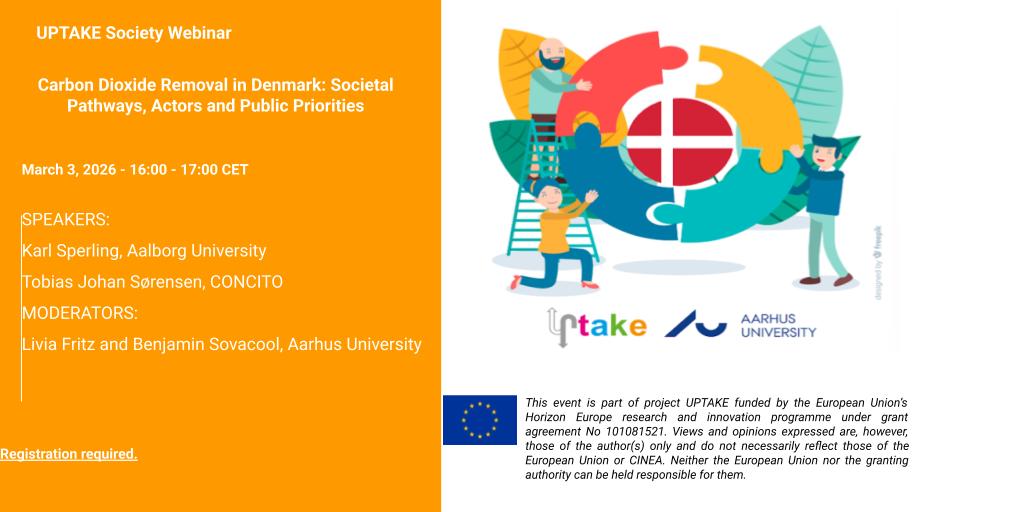
Join us next week for our webinar on " Carbon Dioxide Removal in Denmark: Societal Pathways, Actors and Public Priorities", organized by Aarhus University
3rd March | 16:00-17:00 (CET)
The Danish context combines ambitious climate policy, local energy infrastructures, high trust in institutions and active community engagement, making it a real-world laboratory for the implementation of carbon dioxide removal (CDR). As efforts to develop and deploy CDR become part of the Danish climate strategy and discussions in the media, key questions include: how do public trust and institutional frameworks influence the development and deployment of CDR options? What can we learn from experiences in other climate-related infrastructure debates?
The discussion will examine present and future trajectories for carbon dioxide removal in Denmark, how these intersect with other ongoing discussions around climate and agriculture, and then draw lessons for responsible deployment at the regional and national level.
Speakers:
Karl Sperling, Aalborg University
Tobias Johan Sørensen, CONCITO
Moderators: Livia Fritz and Benjamin Sovacool, Aarhus University
On March 3rd 2026, Aarhus University hosted the second online Webinar from the series “CDR and Society”, this time dedicated to “CDR in Denmark: Societal pathways, actors and public priorities”. Lucilla Losi, Postdoctoral researcher at Aarhus University and member of UPTAKE, kicked off the session with a brief introduction to the UPTAKE project. Her presentation was followed by two contributions from invited speakers: Tobias Sørensen, Senior Analyst at CONCITO a green think tank based in Copenhagen, and Karl Sperling, Associate Professor at the Department of Sustainability and Planning of Aalborg University. The presentations were followed by a discussion moderated by Livia Fritz, Assistant Professor at the University of Geneva, and Benjamin Sovacool, Professor at Aarhus University.
Tobias Sørensen outlined Denmark’s climate targets, focusing on the limited but growing role of carbon capture and storage. He explained how political commitments since 2019 led to subsidy schemes, tax reforms, and a major CCS tender that ultimately saw few applicants due to strict timelines and market immaturity. He highlighted challenges such as uncertain storage potential, rising biomass costs, and the need to scale diverse CDR technologies.
Karl Sperling presented local pathway analyses, focusing on biogas plants, costs, and development impacts. His findings identified local mineralization as the cheapest option, emphasized the potential to create jobs and local revenue, and highlighted the importance of engaging the local population for successful deployment.
Key takeaways from the discussion:
Societal responses to CDR in Denmark vary, with concerns about limited and late public engagement.
National political support for CCS appears broad, though often accompained by overly optimistic expectations and industry-driven interests.
Local opposition to onshore storage remains relatively low.
Politicians currently have a limited understanding of novel CDR methods, though ministries are gradually building knowledge.
Normative considerations center on legitimacy and trust for uncertain technologies, as well as issues of justice—particularly regarding who bears the costs.
Overall, early engagement, clearer regulation, and realistic expectations were identified as essential.
 Join us next week for our webinar on " Carbon Dioxide Removal in Denmark: Societal Pathways, Actors and Public Priorities", organized by Aarhus University
  3rd March | 16:00-17:00 (CET)
 Speakers:
 Register now and join the discussion