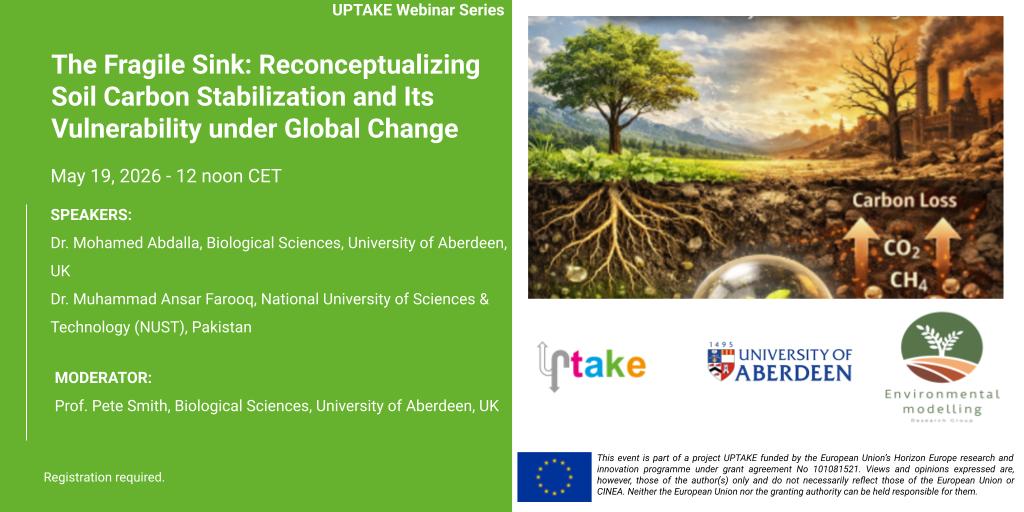
The Fragile Sink: Reconceptualizing Soil Carbon Stabilization and Its Vulnerability under Global Change
Organized by the University of Aberdeen, this webinar will explore emerging scientific perspectives on soil carbon sequestration (SCseq) and its role in climate change mitigation. While increasing soil carbon stocks is widely promoted as a strategy to remove atmospheric CO₂, recent research suggests that carbon accumulation does not necessarily guarantee long- term persistence in soils.
The webinar will introduce the “fragile sink” framework, which reconceptualizes soil carbon stabilization as a dynamic and conditional process rather than permanent storage. Drawing on recent advances in microbial ecology, mineral biogeochemistry and nutrient stoichiometry, the talk will examine how interactions between microbial metabolism, mineral protection mechanisms, and nutrient constraints regulate soil carbon persistence.
Participants will also learn how global change drivers, such as warming, elevated
CO₂, nutrient enrichment, and land-use disturbances, can accelerate internal carbon turnover. These processes may create soils that appear to store more carbon but are increasingly vulnerable to rapid carbon loss.
The webinar will discuss vulnerability frontiers where stabilization mechanisms break down, as well as the challenges of restoring stable carbon pools due to kinetic and structural constraints. Finally, the session will highlight the need to move beyond stock-based carbon accounting toward process-based strategies for protecting slow-cycling soil carbon pools.
This webinar will be particularly relevant for PhD students, researchers, modelers,
and practitioners working in soil science, climate mitigation, ecosystem modelling,
and sustainable land management.
 : May 19, 2026
 12:00 noon - 13:00 pm CET
Register here.
Webinar Programme:
12:00 noon – 12:05 pm Introduction Dr. Mohamed Abdalla, Aberdeen University
12:05 pm - 12:45 pm Speaker: Dr. Muhammad Ansar Farooq, National University of Sciences & Technology (NUST), Pakistan
12:45 pm - 13:00 pm Q&A Session Moderator: Prof. Pete Smith, Aberdeen University
13:00 pm Wrap up and closing Dr. Mohamed Abdalla, Aberdeen University