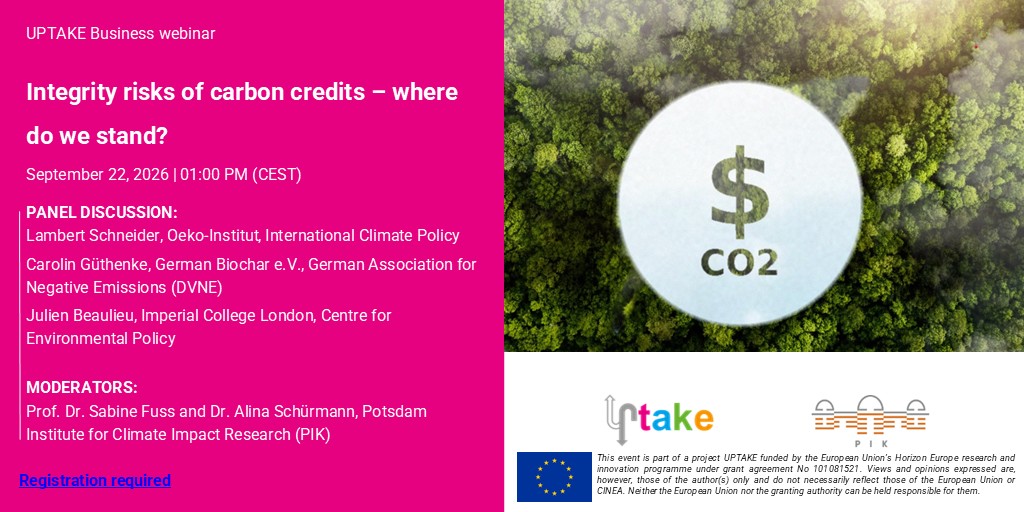
Summary of the UPTAKE Business Webinar, 22nd September, 2026
Integrity risks of carbon credits - where do we stand?
The webinar focused on the integrity risks of carbon credits, the practical challenges of scaling up carbon dioxide removal (CDR), and the increasing legal issues surrounding corporate environmental claims. The panelists evaluated past failures in ensuring carbon credit quality and structural market barriers. They also discussed how upcoming regulations, legal cases and research priorities must be aligned to ensure high-integrity carbon credits and robust market infrastructure.
Some takeaways from the discussion are:
To ensure the integrity of carbon credits, strict adherence to core conditions is required. These include additionality, accurate quantification, robust safeguards against non-permanence and double counting, and comprehensive social and environmental protections. In order to translate these principles into effective EU policymaking, regulators should base their work on the Paris Agreement Crediting Mechanism (PACM) to establish robust standards. This would involve looking into the ‘like for like’ accounting principle, resolving inconsistencies in accounting under Article 6 and ensuring fair shares in mitigation and CDR. Policymakers are facing two challenges essentially: On the one hand, they need to move fast given the immense scale and short timelines of climate action. On the other hand, they should not accept low-quality credits in a rush to act. Instead, they must deploy robust methodologies as soon as they have been proven to be reliable.
Fortunately, the carbon market has learned from previous mistakes and more rigorous and independent standards have emerged over the recent past. To leverage these advances fully, market infrastructure must evolve by harmonising fragmented registries and adopting a diversified portfolio approach that considers credit heterogeneity (e.g. due to the different permanence profiles and feedstock issues of various CDR technologies). In order to bridge the gap between theory and practice, structured, ongoing exchanges are required between academia, policymakers and industry in collaborative ‘safe spaces’.
Science must play a central role in advancing monitoring, reporting and verification (MRV) protocols, refining counterfactual baselines, and providing systematic evaluations of new standards. Empirical evidence is also crucial in legal contexts where corporate claims of ‘climate neutrality’ are increasingly being scrutinised in court. Finally, there is an urgent need for research to inform clear guidance on which specific technologies can be used and under what conditions. Without such rules, companies are increasingly resorting to ‘green hushing’, remaining silent about their climate contributions due to fear of public criticism and legal liability. Clear, actionable guidelines are therefore essential in helping businesses to understand expectations and navigate compliance and voluntary markets with confidence, which is essential for scaling CDR uptake.