In an article published at Springer Nature, ‘Understanding EU Forest Policy Governance through a Cultural Theory Lens’, Jeanne-Lazya Roux, Helga Pulzl, Metodi Sotirov and Georg Winkel have analyzed the points of views and contradictory approaches of important stakeholders in EU forest policy. In doing so, they have interviewed such stakeholders and focused on issues that are portrayed as problems, solutions that may be used to resolve them and allocation of duties. Within this context, they have employed the Cultural Theory that examines how different stakeholders portray the world and engage with the society on the basis of their viewpoints and convictions.
Key takeaways:
-
Cultural Theory categorizes policy actors into different groups based on their beliefs regarding individual freedoms and groups/entities with decision-making authority.
-
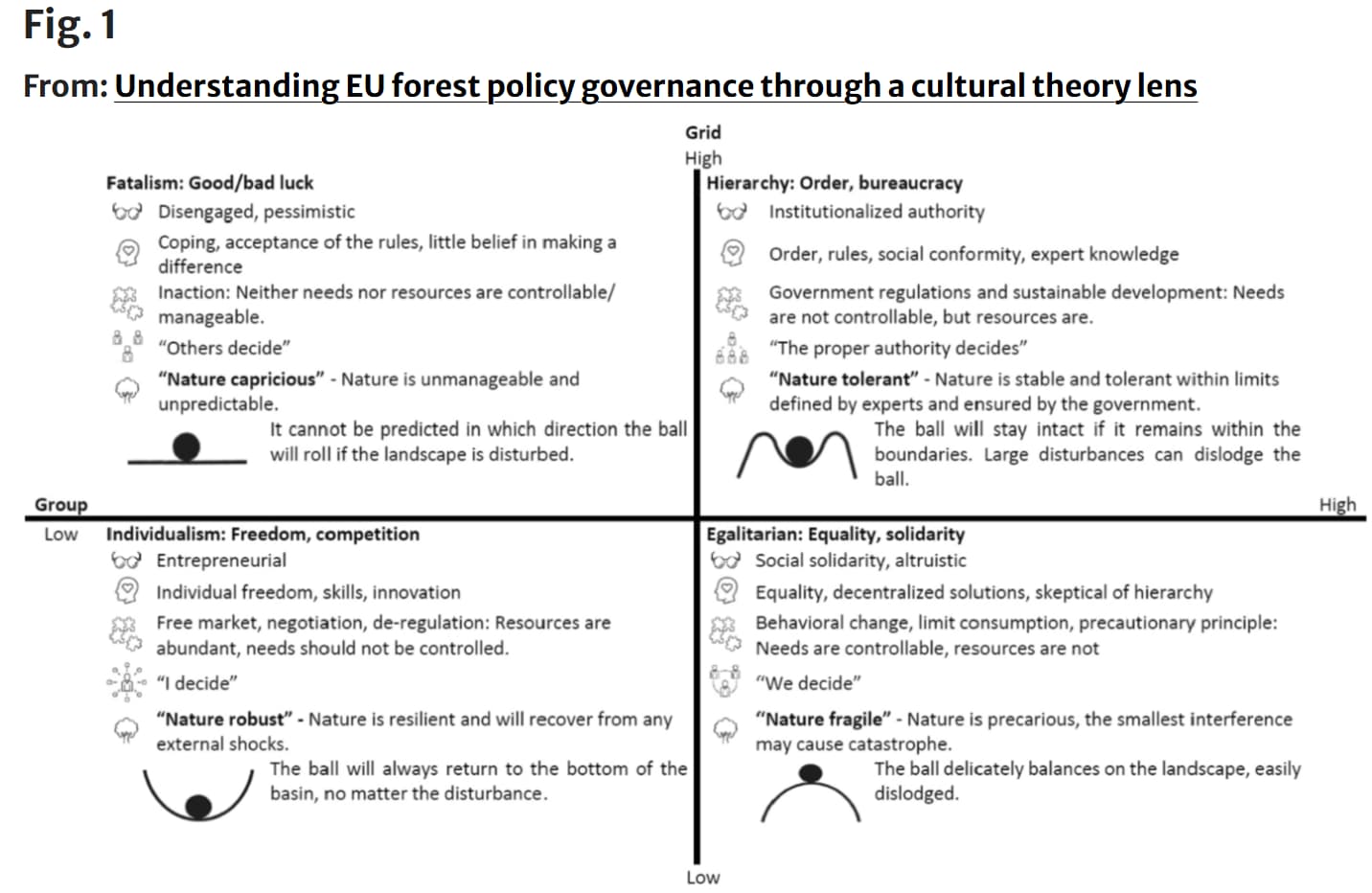
Under Cultural Theory, there are four main worldviews with political salience: egalitarianism, individualism, hierarchy and fatalism.
-
Worldviews comprise a series of social relations and cultural biases. Cultural biases are commonly held values and beliefs concerning social relations. Social relations have two aspects: a preference in relation to the extent to which human actions should be subjected to limitation (i.e. grid) and a preference concerning whether exchanges between individuals should be shaped by personal or collective convictions (i.e. group).
-
In this regard, worldviews belonging to the high grid group, fatalism and hierarchy, assert that human behavior is constrained respectively by the actions of others and governmental mandates. On the other hand, worldviews in the low grid group, individualism and egalitarianism, rely on personal or collective decisions.
-
Worldviews belonging to the high group (fatalism and hierarchy) involve a high degree of compliance with norms set by the government or other individuals while those that are in the low group (individualism and egalitarianism) are marked by a lack of respect for norms not considering the viewpoints of individuals or communities.
-
The authors conducted 47 semi-conducted interviews with three groups of stakeholders shaping EU forest policy: i) actors advocating for the conservation of nature, ii) private owners of forests and lands as well as relevant industry groups and associations and iii) governmental forest undertakings and institutions in charge of forests and a number of DGs from the European Commission.
-
The interviewees belonging to Group 1 portrayed forests as resources with public ownership that have been adversely impacted by climate change and consequent catastrophes. According to them, the condition of forests has been exacerbated by the society’s excessive reliance upon forests and their detrimental management. As a result, they are of the view that government mandated rules and regulations are of crucial importance for tackling this situation. In addition, they contend that payment should be made to forest owners that manage their forests without harming them.
-
The interviewees in Group 2, on the other hand, proposed private stewardship for ameliorating the current state of forests. These actors have cautioned against the EU policymakers’ prioritization of environmental goals over economic and social objectives. In particular, they have stated that limitations over the use of forests to achieve environmental objectives should only be imposed if forest owners are adequately compensated. In addition, they have stressed that forest owners are frequently held responsible for the deterioration of forests as a result of climate change but the situations where their actions improve the environmental conditions of forests are not acknowledged. Within this context, they have argued that forest management should be market based with limited overnmental regulations.
-
The interviewees in Group 3 have also underlined that forest owners do not receive adequate payment for the environmental services they provide. However, there was no consensus regarding whether such payments should be financed by the EU or member states. In addition, despite supporting the governmental management of forests, this group stressed that the EU does not have an overarching policy addressing forestry and other areas are portrayed as intruders on forest management. As a result, this group argued for the establishment of rules addressing all aspects of forestry in an all-encompassing manner.
-
The results obtained by the authors that conducted the interviews confirm previous research that has been made on the basis of the Cultural Theory whereby groups supporting egalitarianism, individualism and hierarchy were respectively associated with environmentalism, private forestry and state forestry.
Read the full paper here: Understanding EU forest policy governance through a cultural theory lens | Policy Sciences