In a policy publication entitled ‘The Innovation Race on Geological Carbon Removal: Who is Best Placed to Lead?’, Esin Serin, Josh Burke, Siyu Feng, Maxwell Read and Ram Suresh Kumar from the Grantham Research Institute on Climate Change and the Environment have examined data pertaining to the patenting of geological CDR methods, bioenergy with carbon capture and storage (BECCS) and direct air carbon capture and storage (DACCS). In doing so, they have explored the innovations taking place in this field to highlight the states that are suitable for pioneering the geological CDR sector.
Key takeaways:
- A considerable number of patenting and deployment of geological CDR methods have taken place in the United States. That said, European countries such as France, Germany, the UK and the Netherlands possess a high degree of specialization in relation to such methods. In this regard, countries displaying varying strengths can all benefit from the acceleration of the pace of innovation.
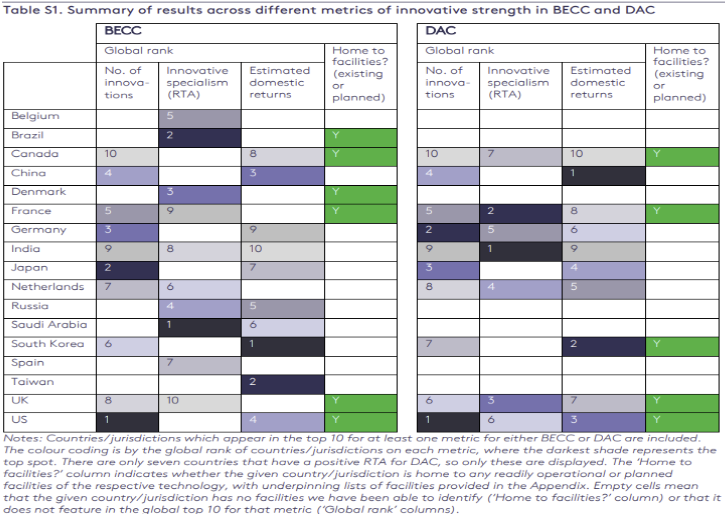
- While there is an overlap between the countries engaging in clean technology innovations and those that shape geological CDR innovations, countries possessing the highest degree of geological CDR specialization do not belong to the former group.
- The possession of innovation strength in relation to geological CDR is strongly linked to past innovations that have been made in other related sectors including oil and gas, petrochemicals and conventional energy production from biogas.
- The use of public funds to finance geological CDR activities that are at an initial stage can lead to the obtainment of considerable amounts of returns owing to the diminishing costs and growth of other innovations.
- Funds will be allocated for activities innovating geological CDR at different stages of supply chains depending on the presence of public policies facilitating investments. Countries adopting such policies will be more likely to benefit from the global CDR market.
- The risk of moral hazard should be accounted for by policymakers facilitating the deployment of geological CDR methods. Accordingly, such methods should not replace the efforts underway to reduce emissions.
- The know-how states have acquired in sectors like oil and gas that are of use for geological CDR should be utilized to enhance competitiveness in relation to similar technologies.
- Public policy support should address the exigencies of different geological CDR technologies with varying levels of maturity. Accordingly, while technologies that are yet to reach maturity can benefit from direct support, mature technologies can be supported by ensuring their incorporation to mechanisms like emissions trading schemes.
Read the policy publication here: The innovation race on geological carbon removal: who is best placed to lead? - Grantham Research Institute on climate change and the environment