In an article published at Environmental Research Communications, ‘So You Want to Build a BECCS Plant: The Patchwork Policy Context for Bioelectricity with Carbon Capture and Storage in Europe’, a group of authors led by Samantha Eleanor Tanzer have examined the current EU legal frameworks impacting bioenergy with carbon capture and storage (‘BECCS’). In doing so, they have evaluated whether these instruments contribute to or prevent the scaling of BECCS. Within this context, they have concluded that BECCS is governed by an intricate set of regulations and economic factors and the race for access to biomass affects the obtainment of the EU climate targets. Lastly, they have cautioned that it may be challenging to reach the current BECCS goals under the current legal frameworks and limited biomass supply.
Key takeaways:
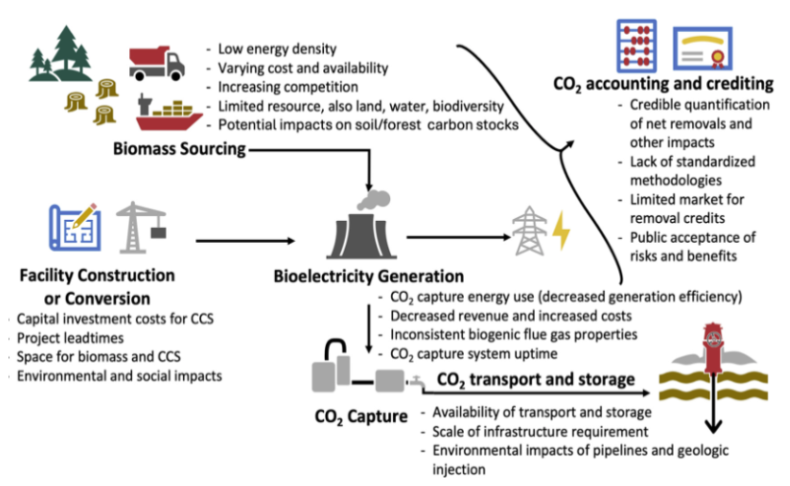
- The creation of a BECCS system by accessing biomass, generating electricity and sequestering, transferring and maintaining CO2 requires the use of technologies. BECCS has the advantages of possessing a low degree of risk, being observable and durably storing CO2. However, each aspect of BECCS brings about different impediments to realization and costs. Moreover, BECCS seeks to achieve two objectives that are not fully compatible, generating and selling energy in a commercially sound way and removing carbon with high integrity and efficiency while mitigating environmental risks.
-
In the EU, the realization of renewable generation is quite time consuming owing to the increase with the scale of projects and intricacy of legal rules pertaining to environmental reporting and sustainability norms. While these frameworks are useful for tackling environmental hazards, they considerably increase the timeframes for permit issuance, resulting in higher costs and jeopardizing the successful completion of projects. Therefore, a number of policy instruments such as the Net Zero Industry Act, Renewable Energy Directive and Commission Recommendation on Power Purchase Agreements include rules shortening the time periods within which permits can be obtained for projects contributing to the generation of renewable energy and the achievement of net zero goal. Moreover, under the Net Zero Industry Act, member states are required to accelerate the dispute resolution process launched in relation to projects contributing to the achievement of net zero goals.
-
Moreover, to help early market entrants tackle economic risks, the EU has introduced a number of funds under the framework of the Innovation Fund and Horizon Europe. Likewise, under the Renewable Energy Directive, BECCS is not subjected to the funding limitations applied to bioenergy projects that source wood.
-
Under the Renewable Energy Directive, the utilization of bioenergy must result in a 70 % decrease in emissions compared to the reliance on fossil fuel to be considered as renewable energy and benefit from advantageous rules that apply to renewable energy generation. In addition, in line with the EU Deforestation Regulation prohibiting the use of materials originating from areas suffering from deforestation, the Renewable Energy Directive limits deforestation in areas where a significant amount of carbon has been sequestered. Lastly, the Renewable Energy Directive limits the use of wood for bioenergy generation but does not address the reliance on biomass for CDR.
-
The EU Regulation on Land Use, Land-Use Change and Forestry (‘LULUCF’) establishes binding net carbon removal objectives for land use, restricting the use of biomass to ensure that a minimum level of natural carbon stock can be maintained. Notably, while the use of biomass has been subjected to such restrictions, similar rules have not been introduced for reliance on fossil fuels.
-
BECCS is subject to a number of regulations such the Emission Trading Scheme (‘ETS’), Renewable Energy Directive and Net Zero Industry Act that impact costs but do not directly alleviate the cost burden.
-
Transferring and maintaining CO2 under Environmental Impact Assessment and Emission Trading Scheme rules is a lengthy process necessitating the use of comprehensive data and financial flows. In addition, the need for inter-state agreements for transboundary transfer of CO2 can further lengthen the process. The challenges inherent in reaching the targets set out in the Carbon Capture and Storage Directive necessitates the establishment of a centralized system for transferring CO2.
-
Carbon accounting rules under the Renewable Energy Directive, Carbon Removals and Carbon Farming Regulation and LULUCF Regulation have contradictory approaches for quantifying removals. Moreover, these rules do not foresee the generation of income for BECCS developers in case of net removals, with such remuneration being limited to the voluntary carbon market.
Read the full paper here: Radware Bot Manager Captcha