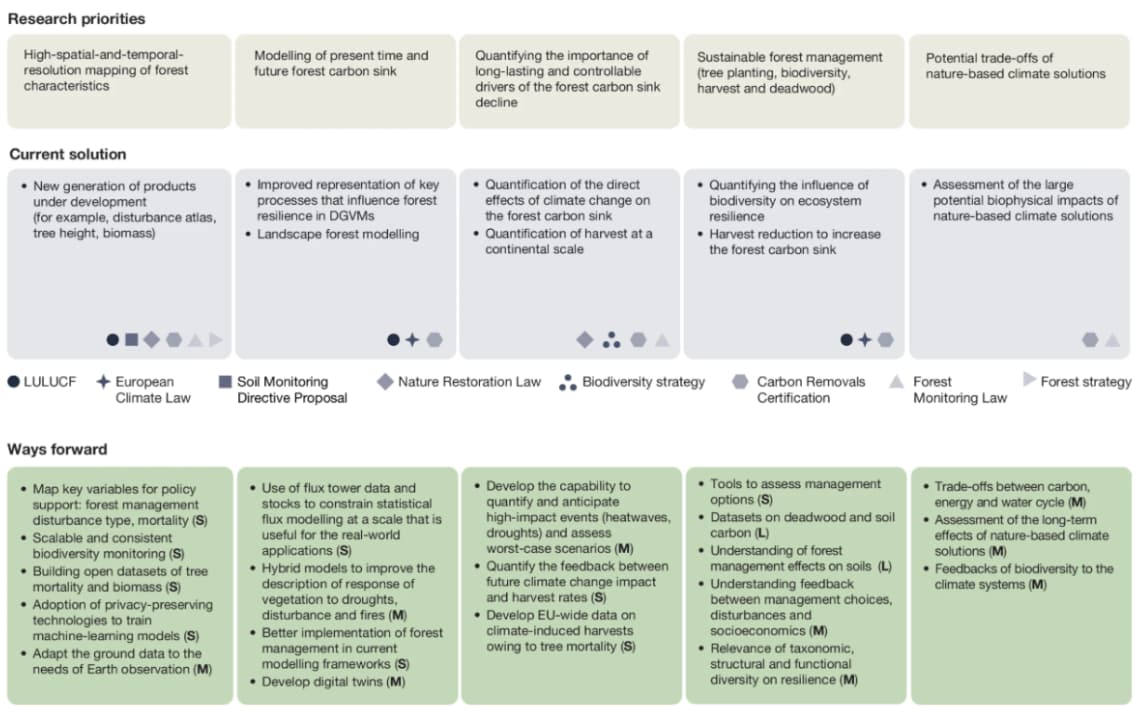
In an article entitled ‘Securing the Forest Carbon Sink for the European Union’s Climate Ambition’ published at Nature, a group of researchers led by Mirco Migliavacca have set out suggestions to enhance the observation and modelling of forests and their ability to sequester carbon in order to shape decisions regarding the management of forests in the EU. In doing so, they have chronologically ordered the measures that should be taken to facilitate the realization of the goals of the European Green Deal.
Key takeaways:
-
Forests are the resources that sequester the highest amount of carbon in Europe. Between 1990 and 2022, around 10 % of the emissions that were released in Europe was removed by forests. According to the projections of the European Union, the Land Use, Land-Use Change and Forestry (‘LULUCF’) sector will play a significant role in tackling the majority of the hard-to-abate emissions by 2050, considerably facilitating the achievement of 2040 climate targets.
-
Since 2010, the amount of forests in the EU has been declining due to reasons such as the increased use of land for agricultural purposes, completion of the lifecycle of forests as well as diminished growth due to climate change and temperature increases.
-
Notwithstanding the progress made with monitoring forest resources in the EU, data creation and sharing should occur at a faster pace, be disclosed to a greater extent and be subjected to uniform rules.
-
The types of disturbances impacting forests and their features should be better identified.
-
A framework should be established at the EU level to locate and share factors impacting forest biodiversity using remotely sensed imagery.
-
Maps demonstrating biomass-related data that have been developed cannot evaluate temporal variations taking place during extended periods of time. It is anticipated that the utilization of satellite missions and artificial intelligence will tackle this situation.
-
The location of the National Forest Inventory (‘NFI’) networks used for data monitoring is usually unknown, which hinders direct connections between ground data and high-resolution satellite data. Sharing information regarding the location of such networks is essential for having access to up-to-date information regarding the circumstances of forests.
-
The projections regarding net ecosystem CO2 fluxes should be improved for the calculation of current and future EU forest carbon sink through the use of artificial intelligence or modelling tools.
-
The significance of long-lasting and controllable factors leading to forest carbon sink reduction should be studied and calculated separately.
-
Tree species that can withstand the adverse impacts of climate change and those that are not resilient to such impacts should be determined to support decisions regarding the type of trees that are planted in different regions.
-
More research should be carried out associating forest growth and socioeconomic models to inform policy decisions on how harvesting affects the carbon sink and the social and economic aspects of the forest sector.
-
Comprehending the interplay between the rise of deadwood components in forests and wildfires is significant for shaping policy decisions. However, it is likely that this will not be achieved in the short term due to lack of sufficient data and models.
-
The interconnection between afforestration and water and biophysical cycles is underexplored. Maps using Earth system modelling should be developed to make projections regarding the use and release of water by forests and atmospheric evaporative demands.
Read the full paper here: https://www.nature.com/articles/s41586-025-08967-3/figures/5