In a recently published article, ‘Science-Policy Interface in Participatory Reforms: Integrating Forest Governance Principles into Romania’s Forestry Strategy’, a group of authors led by Nicolae Talpa have consulted scholars to support the development of Romania’s National Forest Strategy 2030. Areas where highly converging opinions were expressed concern restoration of forestry, maintenance of biodiversity, transparent management and ecological training. On the other hand, divergent views were expressed in relation to the degree to which property rights can be limited, the tools to guarantee the future provision of forest ecosystem services and the separation vs. inclusion of biodiversity in forest governance. The consultation that was guided by scientific principles illustrates that a transparent and well-planned consultation facilitates fruitful conversations even in cases where stakeholders do not have uniform opinions and trust in institutions is low. This article underscores the possible synergies between socio-economic and environmental approaches to forest governance. The results are presented based on their convergence with and divergence from the EU Forest Strategy 2030 and suggestions are set out for reinforcing participation in decision-making and the adoption of forestry policies based on scientific evidence.
Key takeaways:
- Over 200 stakeholders with diverse backgrounds participated in the consultation process, providing useful answers notwithstanding the difficulties posed by the utilization of an online tool. Around 65 % of those that were involved in the process provided replies. The views that were expressed during the consultation process were used by the drafters of Romania’s Forestry Strategy that was approved by the government in October 2022.
- The outcome of the consultations clarifies the link between specific national goals and general European priorities. The EU Forest Strategy for 2030 aims at striking a balance between environmental and socio-economic uses of forests.
- The first set of consultations concerned the broader perspective and framework principles while the second set of consultations targeted more concrete steps.
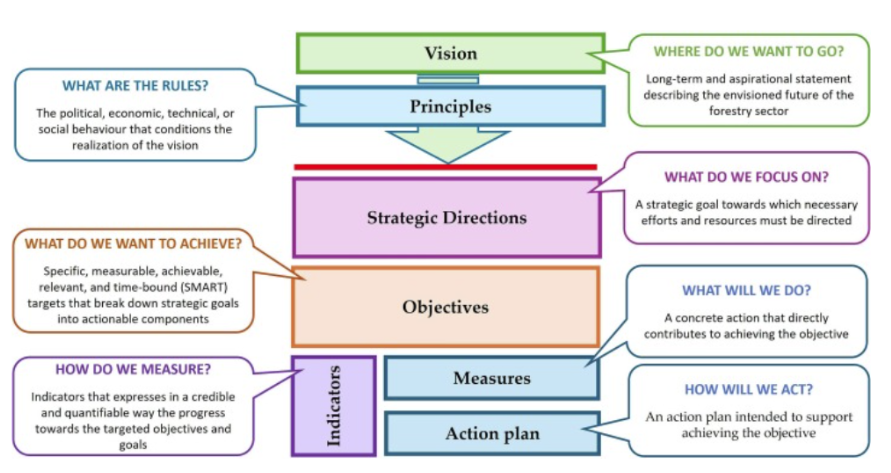
- Carried out before the final version of the EU strategy became available, the Romanian consultation illustrated both convergences with and departures from the EU goals in line with its peculiar characteristics. The Romanian stakeholders generally expressed views consistent with EU goals as far as forest restoration, biodiversity maintenance, delivery of ecosystem services and environmental neutrality are concerned. However, they stressed the significance of socio-economic outcomes, energy security and property rights. Indeed, some of the preferences of the stakeholders, such as the extended utilization of firewood, balancing property rights with environmental obligations and discussions concerning result-based versus process-driven prerequisites underscore the current trade-offs between ecological goals and socio-economic limitations. That said, the consultation set out important issues regarding which convergence is present and a strong possibility of synergies in future policy-making.
- In general, the article illustrates the significance of reinforcing the science-policy nexus through presenting scientific evidence to policymakers and assisting them with the realization of consultations that are driven by science, disclosed to the public and include various actors.
- Undertaking the consultation under a scholarly framework was significant for earning the trust of stakeholders with contrasting opinions. In preparing for the consultation process, the national forest programs in Europe were examined, enabling it to have a robust structure. The process demonstrated the ability of Romanian participants to hold fruitful discussions in a professional manner despite the limitations posed by the online format. In addition, it sent a message to the central Romanian public administration in relation to the society’s willingness to cooperate.
Read the full paper here: Science-policy interface in participatory reforms: Integrating forest governance principles into Romania's forestry strategy - ScienceDirect