In a recent report entitled ‘Principles for Responsible and Effective Carbon Dioxide Removal and Governance’, a group of authors led by Scott Doney have provided an overview regarding the schemes governing marine CDR methods and steps that should be taken by governments for the responsible development of marine CDR.
Key takeaways:
- There are three main approaches through which marine CDR methods are employed: biological, chemical and physical.
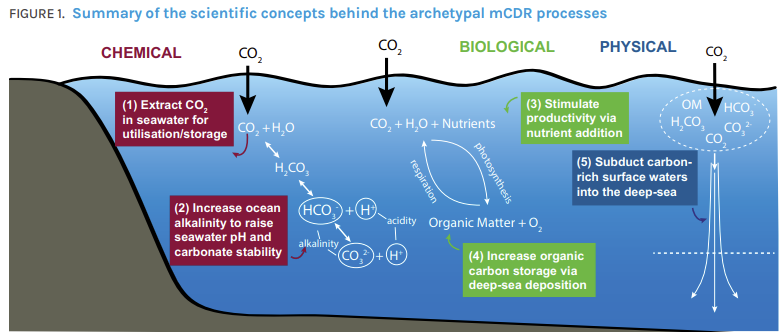
- Despite growing knowledge of marine CDR methods, many uncertainties remain about their future implementation at scales large enough to produce observable climate impacts. Technological know-how and technical competence surrounding the usefulness, environmental impacts and monitoring standards of these methods should be amplified. This step should be accompanied by the tailoring of adequate governance frameworks, funding tools and processes to ensure that the public can guide decision-making.
- Field experiments are of crucial importance for the generation of further knowledge regarding marine CDR methods. However obtaining permits and engaging with public authorities represent clear obstacles for their realization.
- International law does not regulate the activities of private entities but considerably impacts the manner in which domestic laws govern their conduct. There is no legislation at the national and international levels tailored for the exigencies of marine CDR research and deployment. That said, there are several regimes that have a bearing on marine CDR, namely the UN Convention on the Law of the Sea, the Biodiversity beyond National Jurisdiction Agreement, the London Convention and London Protocol, the Convention on Biological Diversity, the UN Framework Convention on Climate Change, the Paris Agreement and the rules of customary international law. The latter norms usually apply to all states while only the states that are parties to the conventions and agreements are bound by them.
- The commonly cited characteristics of ‘responsible marine CDR’ include public consultation, observation of environmental and social effects, adequate disclosure of marine CDR activities and the fair allocation of impacts. However, no commonly accepted definition of ‘responsible marine CDR’ exists. To streamline experiments, governments can reinforce research and development capacity by creating dedicated facilities for tests. In doing so, governments should share the lessons learned with one another to facilitate the global uptake of marine CDR.
- Research and development efforts should be supported by governments for resolving the scientific uncertainties surrounding the marine CDR activities and making sure that private entities do not engage in for-profit marine CDR before all knowledge gaps are addressed. Codes of conduct for marine CDR prepared by governments should set a benchmark for those prepared by private entities.
- Should research activities carried out in favor of marine CDR activities are found to be impactful and free of harm, governments should also incentivize demand and supply through norm setting and procurement.
- Despite the pivotal role played by governments in shaping the marine CDR research and deployment landscape, their actions can render the prospects of combatting climate change through marine CDR susceptible to electoral agendas. Therefore, checks and balances should be put in place to ensure that governmental politics do not interfere with legitimate and responsible marine CDR activities.
Read the full paper here: Principles for responsible and effective marine carbon dioxide removal development and governance - Archive ouverte HAL