In a recently published comment, ‘International Credits in EU Climate Policy: Old Conflicts, New Challenges’, Felix Schenuit from SWP has explored the role of Paris Agreement credits counting as progress made towards mitigation targets in EU climate policy.
Key takeaways:
-
Once overlooked, CDR has recently gained prominence in the EU as scientific consensus on its importance to tackle residual and hard-to-abate emissions has emerged.
-
The Paris Agreement, adopted in 2015, made it possible for the state parties to sell their mitigation outcomes (i.e. credits)to be used by states purchasing them as progress made towards achieving their nationally determined contributions. Rules in relation to the functioning of this framework were put in place in 2024.
-
Compensation tools have been considered weak for the achievement of climate goals as illustrated by the low-quality nature and fraudulent issuance of some of the Kyoto Protocol credits that were partially incorporated to the EU emissions trading system.
-
As a result, the European Climate Law sets the goal of only 55 percent net decrease in its greenhouse gases emissions by 2030, and foresees that its net zero goal can be achieved by 2050.
-
However, recently, Paris Agreement credits started attracting attention as tools that can increase the options that the EU can use to reach its mitigation goals by relying on international cooperation.
-
The recent developments surrounding the establishment of a 2040 mitigation target at the EU level are of particular relevance for CDR activities that may take place through the sale of Paris Agreement credits.
-
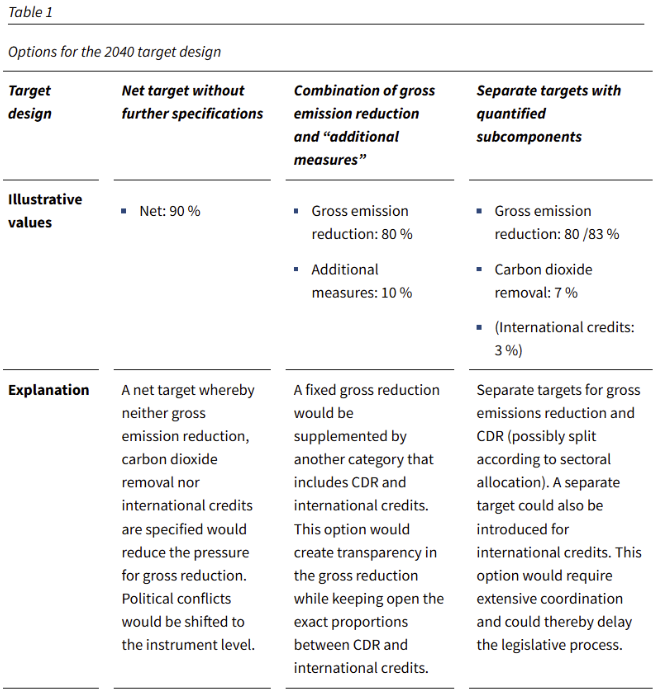
The establishment of different targets at the EU level for international credits and carbon removals would convey strong political willingness and guarantee the flow of investment in favor of both of the tools.
-
That said, in view of the approaching deadline for setting the 2040 mitigation target and ongoing political conflicts, other alternatives should also be considered.
-
Under the Paris Agreement, unlike the Kyoto Protocol, all parties are required to submit their nationally determined contributions. Therefore, countries selling mitigation outcomes may decrease their climate ambitions by increasingly relying on the Paris Agreement credits.
-
Notwithstanding the presence of such limitations, the use of Paris Agreement credits should be discussed now since the implementation of EU reforms is time consuming, the involvement of the EU in this mechanism would reinforce the UNFCCC negotiations and Paris Agreement credits can be used to tackle residual emissions through carbon removal.
Read the full comment here: International Credits in EU Climate Policy: Old Conflicts, New Challenges - Stiftung Wissenschaft und Politik