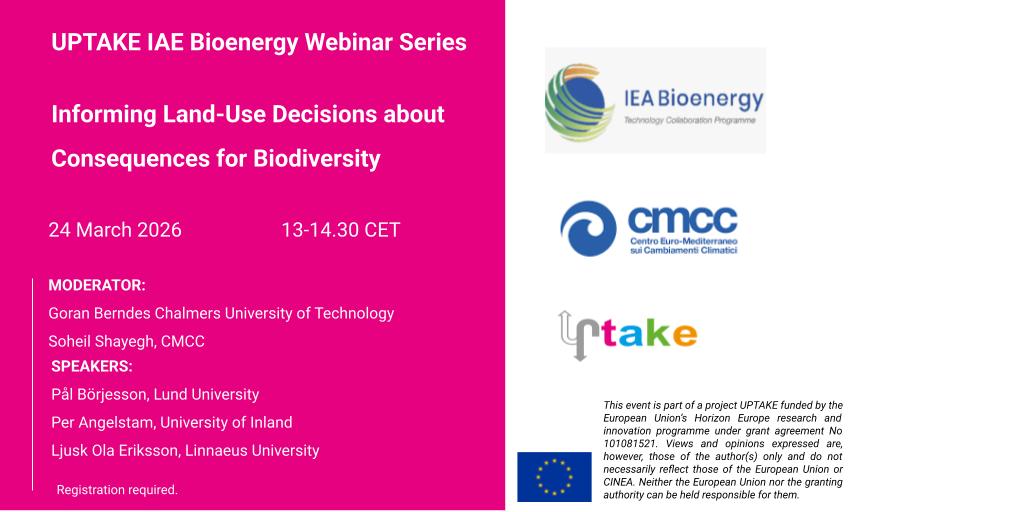
The webinar ‘Informing land-use decisions about consequences for biodiversity’ will be organized by IEA Bioenergy in collaboration with UPTAKE.
 24 March 2026 1:00 pm - 2:30 pm
Register here.
 Moderators:
Göran Berndes, Chalmers University of Technology
Centro Euro-Mediterraneo sui Cambiamenti Climatici, Soheil Shayegh
Speakers:
Pål Börjesson, Lund University
Per Angelstam, University of Inland
Ljusk Ola Eriksson, Linnaeus University
Growing awareness of the biodiversity crisis has prompted businesses and decision-makers to address biodiversity loss and promote the sustainable use of natural resources. To accomplish this, governance systems are necessary to help accelerate the incorporation of biodiversity considerations into decision-making processes.
This webinar will present two approaches to informing land-use decisions about their consequences for biodiversity.
The first part of the webinar will focus on how biodiversity impacts of biomass production can be quantified using life-cycle assessment (LCA).
A case study will be presented alongside an overview of the results and insights from a workshop at the Royal Swedish Academy of Agriculture and Forestry, and an IEA Bioenergy project that leverages the capacity of the project Pathways towards an efficient alignment of the financial system with the needs of biodiversity (BIOPATH). The report provides an overview of current progress in assessing biodiversity impacts and using assessment outcomes to inform decisions affecting land-use and land-use change, with a focus on bioenergy systems. It examines research relevant to enhancing and adapting LCA to incorporate biodiversity impact assessments and enable analyses of biodiversity – climate trade-offs. The report also discusses requirements regarding quantitative biodiversity data.
The second part includes two presentations drawing on initiatives that support biodiversity considerations in forest management and planning.
The first presentation provides an overview of a Nature Value Map, which describes Swedish forest landscapes according to their level of naturalness — that is, the probability of forests having high natural value. The map was created using open-access spatial data, such as remote sensing and LiDAR, as well as open-source software tools and machine learning. Independent spatial stand- and plot-level validation data confirmed the accuracy of the predictions representing different levels of forest naturalness.
The second presentation summarizes results from model-based analyses of how wood supply and forest industry output, as well as forest carbon, could change when forest management decisions are informed by a ranking of landscapes according to their relative likelihood of hosting high conservation value forests.
Each part ends with a moderated session in which participants are invited to share their experiences and reflections on the state of biodiversity impact assessments that support governance and operational decision-making for sustainable forest landscapes.
View the full program here.