In an article published at European Journal of Risk Regulation, ‘Governance of Carbon Dioxide Removal: Practitioners’ Perspectives on Fairness and Equity’, a group of authors led by Felix Dorpmund interviewed senior CDR stakeholders that develop technology, buy credits and fund CDR activities. In doing so, in order to fill a gap in the literature that has emerged due to the lack of studies examining the approaches of such actors operating as part of private entities, the authors examined their viewpoints regarding the elements of fair and equitable CDR systems. They concluded that the views of interviewed individuals converge in relation to the necessity for building robust regulatory frameworks, climate effectiveness, distribution of harms and benefits and involvement of oil and gas companies in CDR. Moreover, they revealed that the participants hold divergent views with respect to the prioritization of rapid commercialization of CDR over creating inclusive CDR schemes capable of generating co-benefits. Lastly, they stressed that mitigation deterrence was not raised as a concern by any of the participants. Against this background, this article offers some lessons regarding how private entities impact the regulation of CDR and stresses how the features of the CDR market and ethical priorities both shape the approaches of private entities.
Key takeaways:
- Frequently considered by the IPCC to be an essential tool for achieving net zero and offsetting emissions emanating from hard-to-abate sectors, CDR activities are at an initial stage as most efforts are geared towards research and development and for-profit deployment has recently begun.
- The overwhelming majority of CDR activities have been carried out by a small group of leading companies such as Microsoft. That said, the existing CDR regulations do not provide such companies with suitable conditions for creating a sector that can overcome technical barriers while achieving social and environmental goals.
- The authors carried out 79 interviews with stakeholders of the nascent CDR industry. Most of the participants to the interviews are located in the Global North and almost half of them engage in technology development. Notably, given that such participants operate in the CDR market to obtain profits, their views should not be regarded as impartial, particularly with respect to justice and equity. Instead, the participants should be viewed as individuals that can express favorable opinions in relation to actions that strengthen their positions. The past operations of the participants in the oil and gas industry were not considered prior to their recruitment.
- In reviewing the replies of the interviewees, the authors first classified the main elements of their approaches. Then, they grouped such elements using the framework established by Holland and Baatz in their article entitled ‘How to Govern Carbon Dioxide Removal: As Assessment Framework for Policy Instruments’.
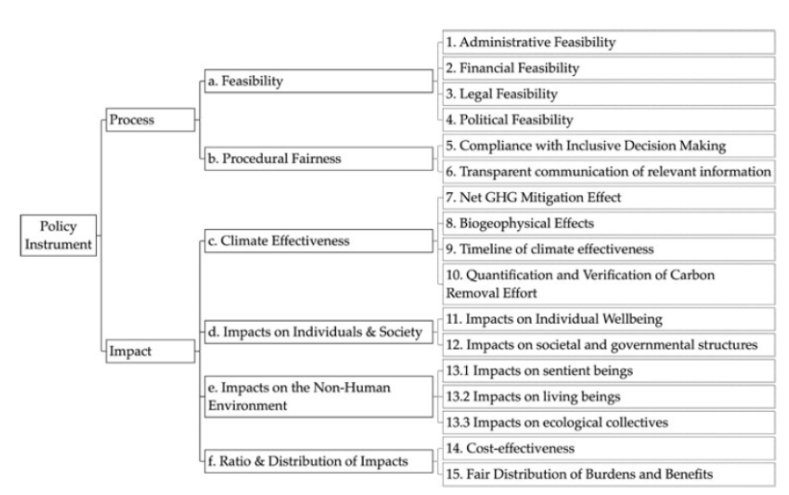
- While all interviewed actors expressed concern with respect to some issues, other areas did not receive equal attention from all of them.
- In this respect, all participants underline the significance of and necessity for regulation and governance by external actors such as mandatory incentives to enable private entities to engage in CDR. The reason why this subject matter is significant for all participants stems from the fact that adequate monitoring, reporting and verification (MRV) systems contribute to climate effectiveness, the most frequently mentioned issue. Climate effectiveness can be associated with fairness and equity in two ways. First, climate effectiveness not only factors in the amount of CO2 that is removed but also the pace at which CDR activities grow. An overly accelerated uptake of CDR activities may, in turn, go against equity considerations. Second, in mentioning climate effectiveness, participants also referred to procedural fairness. Accordingly, a CDR governance scheme can only be considered to possess climate effectiveness if the entirety of CDR activities are monitored and verified by all publicly available information. Similarly, according to all actors, ensuring an adequate distribution of harms and benefits resulting from CDR is an area requiring urgent action. Lastly, all actors are of the view that oil and gas companies should not be allowed to impact CDR governance.
- Some of the actors purchasing CDR credits and investing in CDR activities support the treatment of CDR as a commodity through the utilization of present channels to achieve commercial growth. Other participants belonging to the same group, on the other hand, emphasize the generation of co-benefits like soil improvement and enhancement of the well-being of marginalized communities, with some of such participants referring to them as a priority area. Notably, the emergence of commercial scale CDR activities might not create opportunities for upholding climate justice. Even though reconciling these tensions is a challenging task, the success of the CDR sector depends on the extent to which a fair balance can be achieved between them.
- Notably, even though the assessment framework used by the authors can detect statements raising concerns about mitigation deterrence, none of the participants mentioned this issue.
Read the full paper here: Governance of Carbon Dioxide Removal: Practitioners’ Perspectives on Fairness and Equity | European Journal of Risk Regulation | Cambridge Core