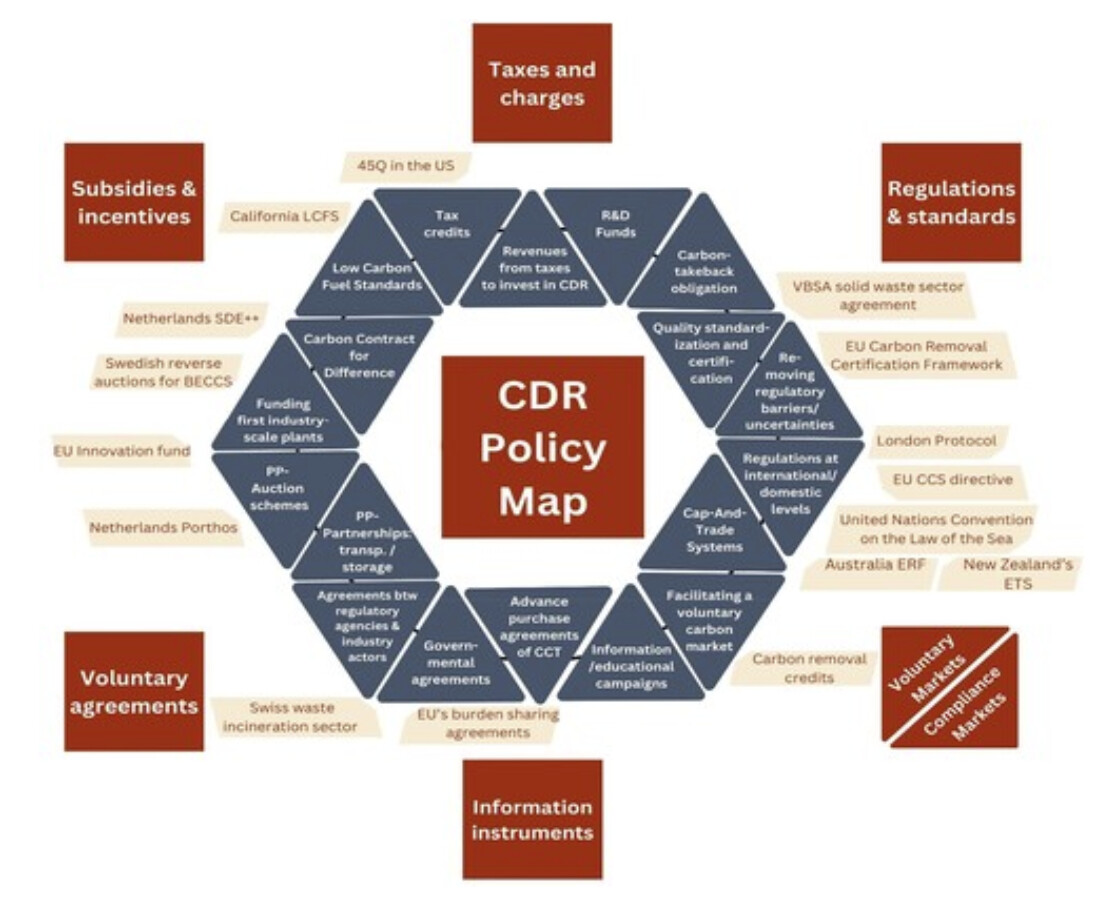
In a recently published article, ‘Exploring Key Dimensions of Policy Instruments for Carbon Dioxide Removal’, Malte Winkler, Soyoung Oh, Antonia Holland-Cunz, Matthias Honegger, Matthias Poralla, Alicia Vollmer and Axel Michaelowa have examined four CDR policy tools that can be implemented without the use of markets, ‘a technology-specific Carbon Contract for Difference in the EU, an internationally funded capacity-building campaign for Brazilian farmers to utilize voluntary carbon markets, a global carbon takeback obligation for fossil fuel producers, and national corporate exemption for Direct Air Capture plant setup and operation.’ In doing so, they have focused on their ‘feasibility, climate effectiveness, impacts on individuals and society and the ratio and distribution of impacts.’
Key takeaways:
-
In studying various policy tools, the authors have factored in different geographical and duration-related aspects in order to consider a divergent set of conditions.
-
The Carbon Contracts for Difference (‘CCfD’) is a subsidy to be implemented in the EU during a certain time frame prior to the incorporation of CDR into the Emission Trading Scheme (‘ETS’). Under this framework, a government pays a ‘strike price’ to a CDR company engaging in Direct Air Carbon Capture and Storage (‘DACCS’) or Bioenergy with Carbon Capture and Storage (‘BECCS’) for each tonne of CO2 that is captured. Depending on the changes with the market price of carbon that may lead the strike price to exceed the market price or vice versa, one party provides financial compensation to another party.
-
The second policy tool involves the transfer of funds from a group of high-income states to a national program in Brazil that seeks to spread awareness regarding the manner in which agroforestry activities can be incorporated to international carbon markets with a particular focus on farmers that have small-sized enterprises.
-
The third instrument that has worldwide applicability imposes the obligation to remove and durably store CO2 to corporations that produce and sell fossil fuels.
-
The last mechanism has been designed for the provision of national tax breaks to CDR corporations establishing and operating DAC facilities.
- Each option has different benefits and pitfalls.
- Robust regulatory frameworks such as a carbon takeback obligation are highly effective in terms of generating climate benefits but may face backlash from strong corporate lobbies.
- While subsidies may drive the creation of new technologies in the short term, corporations that benefit from them may later depend on them in an excessive manner without creating commercial plans to cut costs, jeopardizing the effective use of governmental resources. As a result, an unambiguous exit plan should be put in place that can result in the utilization of a carbon market once the government ceases to provide subsidies. Importantly, the consideration of the issuance of CDR credits as progress made towards achieving net-zero can strengthen the long-term sustainability of the operations of CDR corporations.
- While information campaigns can be beneficial in countries where the agroforestry sector plays an important role in driving the issuance of CDR credits, the effectiveness of such tools in countering climate change are challenging to evaluate as mere access to information may not automatically result in the obtainment of funding.
- Despite minimizing costs, a DAC tax break can be burdensome for the public budget and generate concerns related to distributional equity.
- Given the different benefits and weaknesses of each option, the creation of a policy portfolio enabling their simultaneous implementation will be of crucial importance.
Read the full paper here: https://www.tandfonline.com/doi/full/10.1080/14693062.2025.2521118?src=exp-la#d1e343