In an article published at the Perspectives of Earth and Space Scientists, ‘Early Career Recommendations for the Equitable Growth of a Marine Carbon Dioxide Removal Sector’, a group of authors led by G. D. Kitch who are early career ocean professionals (‘ECOPs’) have set out the extent to which marine carbon dioxide removal sector (‘mCDR’) has grown. In addition, they have studied the efforts underway for the further expansion of the mCDR sector as well as the realization of mCDR activities that can achieve equitable and just outcomes and lead to the issuance of credits that possess durability and integrity. Lastly, they have laid down suggestions for the reinforcement of the position of ECOPs working in the mCDR sector.
Key takeaways:
-
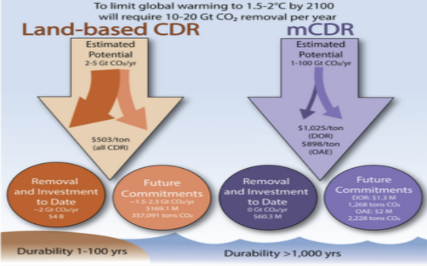
The number of research and development activities as well as requests for deployment in relation to mCDR is increasing. This situation stems from the fact that the capacity of the ocean to sequester carbon is 50 times higher than the pre-industrial atmosphere and the ocean has an enormous section used for achieving equilibrium between air and sea CO2. In fact, up until now, the ocean sink has hosted around 2Weekl5 % of all human-induced CO2 emissions. Moreover, despite being more costly, mCDR is more durable compared to land-based CDR.
-
The further growth of the mCDR sector will be shaped by the amount of investment flows that can decrease costs. Apart from technical costs, monitoring, reporting and verification (MRV) of mCDR is also costly due to the challenges inherent in observing the ocean that is dynamic.
-
The unequal allocation of expertise and positive impacts related to mCDR activities adversely affects global justice. In particular, in non-developed countries that host the greatest share of the world’s youth population and lack resources (i.e. countries located in Africa, Latin America and some parts of Asia), actions taken for combatting climate change conflict with other developmental issues requiring urgent actions. These countries do not host scientific mCDR studies that receive adequate funds due to resource constraints, resulting in unrobust calculations quantifying the amount of carbon captured by the ocean to the detriment of local communication. High-income and developed countries, however, can generate twice the amount of knowledge regarding the consequences of climate change compared to non-developed countries with low income.
-
However, the scientific activities carried out by foreign entities in non-developed countries can have repercussions on marginalized communities such as indigenous people given that such activities may not account for the various consequences that may be suffered by marginalized communities. As a result, such communities may face heightened risk of climate change and suffer from the effects of uneven power distribution and political conflicts in cases where foreign entities carry out research in their territories. Therefore, marine CDR activities in non-developed contexts should take into account local exigencies and make use of local knowledge while strengthening local ownership to foster social exchanges.
-
Interdisciplinary training programs that focus on marine science alongside policy, inclusive decision making and business can enable participants to tackle mCDR challenges in a comprehensive manner. Ensuring alignment between these programs and the industry exigencies of mCDR can pave the way for the issuance of credits that are durable and possess integrity.
-
Ensuring that experienced researchers and ECOPs do not leave academia and government jobs is significant for making scientific progress in mCDR. To offer such professional competitive remuneration, academic institutes and private entities can establish partnerships.
-
Organizations undertaking mCDR research should offer young ECOP professional growth opportunities suitable for different leadership demeanours to tackle the prejudiced attitudes against them.
Read the full paper here: https://agupubs.onlinelibrary.wiley.com/doi/full/10.1029/2024CN000246