In a working paper published by the World Resources Institute, ‘Direct Air Capture: Assessing Impacts to Enable Responsible Scaling’, the anticipated environment effects of constructing and running Direct Air Capture (‘DAC’) facilities in the United States have been set out and recommendations have been provided in relation to decision-making processes surrounding DAC.
Key takeaways:
- DAC is one of the CDR methods that has attracted increasing attention and financial flows. Comprehending its environmental and social effects is of crucial importance for its responsible uptake.
- DAC facilities are anticipated to have resource utilization effects that are similar to other kinds of industries. However, compared to the latter industries, DAC facilities emit considerably less, especially if they use renewable energy resources. Responsible project creation and governance under US environmental laws can diminish detrimental environmental impacts.
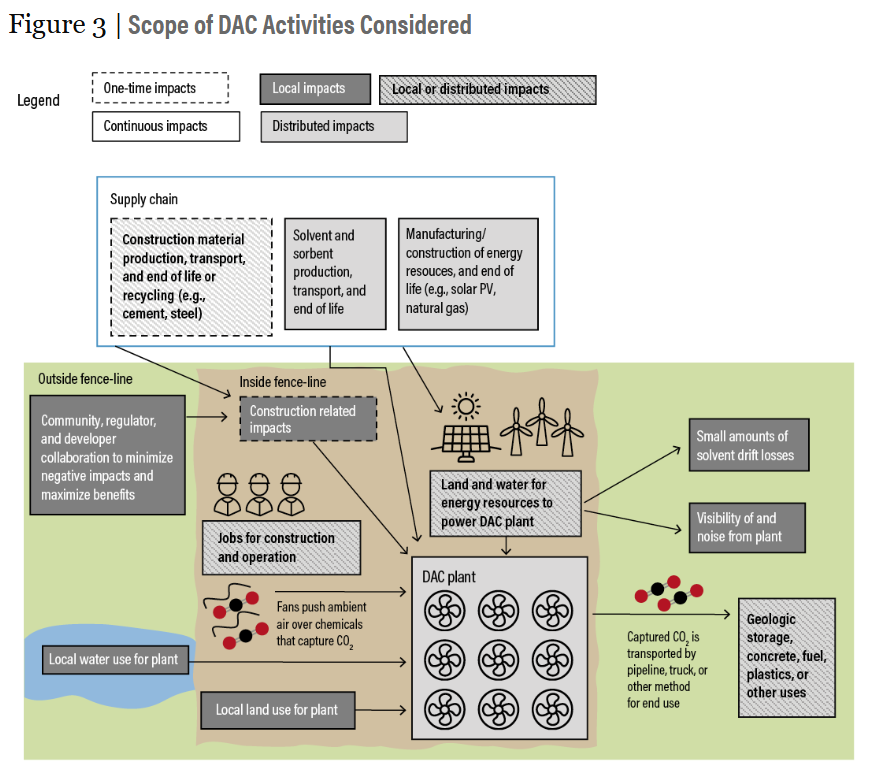
- The utilization of renewable energy sources would prevent the release of emissions but can necessitate the use of large land areas. The use of natural gas with carbon capture would necessitate the use of much less land but may release low degrees of emissions and may face backlash from certain groups.
- Establishing solvent facilities in rain-prone areas can diminish water use and technological developments can enable facilities to emerge as net water producers.
- That said, given that DAC is a novel technology and its effects vary depending on the implementation strategy, evaluations should be made for every activity separately to comprehend anticipated environmental and social repercussions compared to other industrial projects or a scenario where no DAC activity takes place.
- Social effects are contingent upon the extent to which groups that may be affected by DAC activities have access to data about them and can influence decision-making processes. Issuance of policies that necessitate consideration of equity in DAC activities will be useful for making sure that past mistakes that led to unjust project planning are not repeated.
- An important social impact of DAC is anticipated to be employment, both in-situ for the management of DAC facilities and externally for the production of components and infrastructure. Other benefits include monetary incentives through the payment of royalties or earnings obtained through community benefit agreements. More research is needed to ascertain potential benefits and tackle with the exigencies of groups based on the various features of different projects. Potential social effects are intertwined with environmental repercussions and include impacts related to construction, more intense traffic and land use modifications whose degree of severity may be diverse depending on the features of the project.
- As DAC is a novel method necessitating the utilization of novel infrastructure and the great majority of the public lacks awareness about it, taking steps geared towards ensuring inclusive participation to decision making will be of crucial importance for ensuring responsible uptake. Consultations with local communities should shed light upon fair decision-making in relation to location choices and activity design and can raise awareness regarding DAC. It can also augment the impacts of benefits and diminish harms. Even though these measures would put pressure on limited resources, they would be useful for establishing the foundation for a more just and successful long-term uptake.
- Federal governments and states can facilitate the equitable uptake of DAC through enacting policies and the private sector actors can set up demand-related social and environmental safeguards. In this regard, the federal governments can channel financial resources for research, project development and testing, guarantee that adequate DAC regulations are passed under existing federal governance mechanisms, impose the requirement of carrying out social and environmental impact assessments and adequately involve local groups in decision-making processes as a prerequisite for using federal funds. State and local governments can design policies that provide land classification, planning and permitting competences to support the fair realization of DAC activities. Moreover, carbon credit-certification programs can include criteria in relation to social and environmental effects that should be satisfied before carbon credits associated with DAC activities can be sold in voluntary markets.
Read the working paper here: Direct Air Capture: Assessing Impacts to Enable Responsible Scaling | World Resources Institute